Investing can feel like learning a completely new language. You hear words like “stocks,” “bonds,” “portfolio,” and “compound interest,” and it is easy to feel overwhelmed. But here is the truth: investing is not just for Wall Street experts or rich people. It is a tool that anyone can use to build a better financial future.
If you leave your money sitting under your mattress or in a basic bank account, it actually loses value over time. This comprehensive, step-by-step guide will teach you exactly how the financial world works, how to choose the right investments, and how to start growing your wealth safely in the United States.
Key Takeaways
- Investing builds wealth: It is the most reliable way to beat inflation and grow your savings over time.
- Start as early as possible: Because of compound interest, time is your greatest asset. Starting small today is better than waiting years to start big.
- Diversify to stay safe: Spreading your money across different investments reduces your risk of losing money.
- Keep it simple: Beginners do not need to trade hot stocks daily. Buying low-cost index funds or ETFs and holding them for the long term is a proven strategy.
Part 1: Investing Basics

What is Investing?
At its core, investing means putting your money to work so that it earns more money over time. When you invest, you use your cash to buy an asset. This asset could be a tiny piece of a company, a piece of real estate, or a loan to a government.
The goal is simple: you want the asset to grow in value, or you want it to pay you regular income (or both). Unlike working a job where you trade your hours for dollars, investing allows your money to earn income for you while you sleep.
READ MORE
- Real Ways Students Use AI in Their Life to Earn Money (2026)
- Hidden Ways Freelancers Use AI to Double Income in 2026
Why Investing is Important in the USA
In the United States, investing is not a luxury—it is a necessity for financial survival. There are two main reasons why everyone living and working in the US needs to invest:
- The Inflation Problem: Every year, the cost of groceries, housing, gas, and healthcare goes up. This is called inflation. If inflation is 3% a year, a $100 bill today will only have the purchasing power of $97 next year. Bank savings accounts usually pay very low interest rates that cannot keep up with inflation. If you only save cash, you are slowly losing wealth. Investing allows your money to grow faster than the cost of living.
- The Retirement Reality: In the US, traditional company pensions are mostly gone. You cannot rely solely on Government Social Security to live comfortably when you are old. You are responsible for funding your own retirement. Investing through US retirement accounts is the primary way everyday people build enough wealth to stop working later in life.

Difference Between Saving and Investing
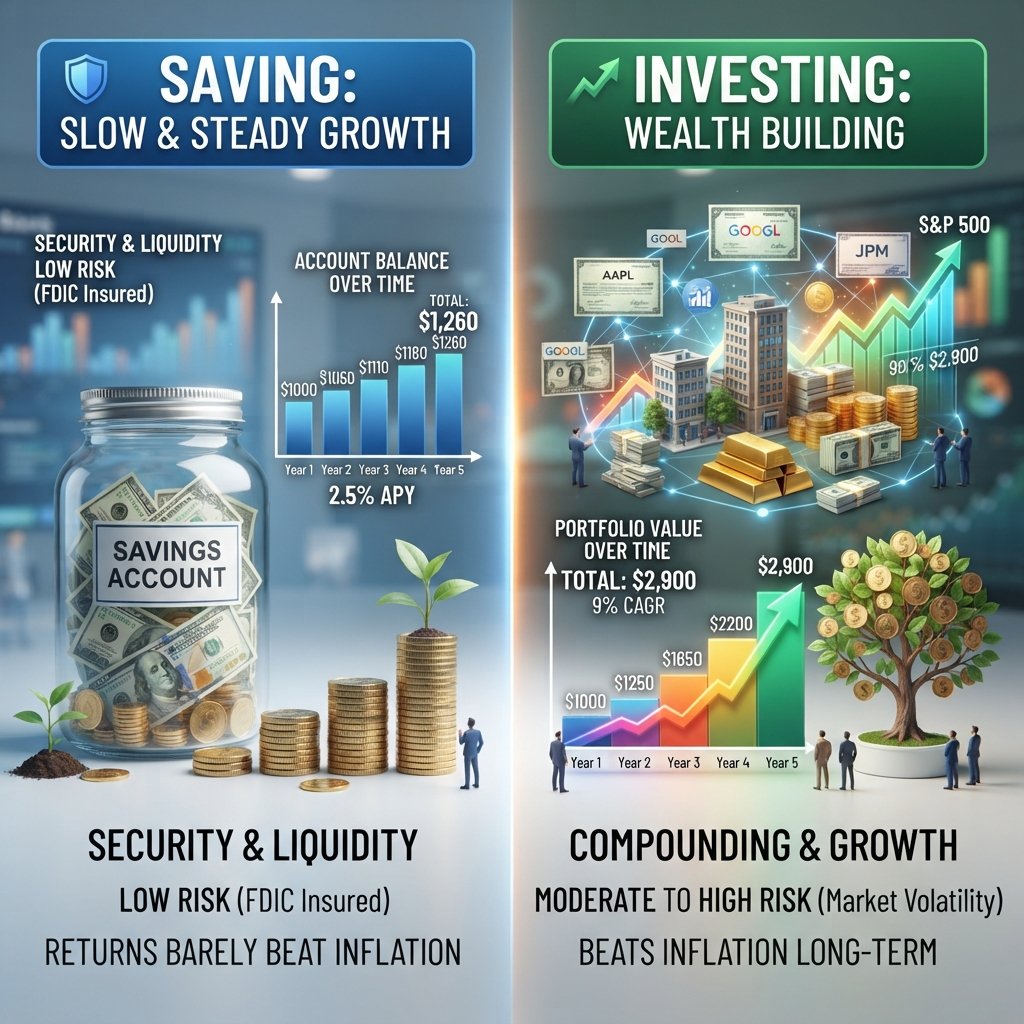
While saving and investing both involve setting money aside for the future, they serve completely different purposes.
| Feature | Saving | Investing |
| Where it goes | High-Yield Savings Accounts (HYSA), CDs, checking accounts | Stocks, ETFs, Mutual Funds, Bonds |
| Risk Level | Extremely low (FDIC insured up to $250,000) | Moderate to high (Values can go up and down) |
| Growth Potential | Low, fixed interest rates | High, long-term growth |
| Best Used For | Emergency funds, goals under 3 years | Retirement, long-term wealth (5+ years) |
| Access to Money | Easy and instant access | Best left untouched for years |
Part 2: Stock Market Foundation
What is the Stock Market?
Think of the stock market as a massive, digital marketplace. Instead of buying clothes or groceries, people buy and sell tiny pieces of public companies.
In the United States, the main marketplaces are the New York Stock Exchange (NYSE) and the Nasdaq. Decades ago, traders stood on a physical floor yelling out prices. Today, the stock market lives on secure computer networks, allowing you to buy shares instantly using an app on your smartphone.
How the Stock Market Works
When a company wants to expand, build new products, or hire more workers, it needs a lot of money. One way to get this money is to sell pieces of ownership to the public. This process is called going public.
- Shares: The ownership of the company is split into millions of tiny pieces called shares or stocks.
- Shareholders: When you buy a share, you become a shareholder. You own a tiny slice of that business.
- Public Trading: Once these shares are out in the world, investors trade them back and forth. If the company performs well and earns a profit, its shares become more valuable. If you own those shares, your investment grows in value.
Why Stocks Go Up and Down
The price of a single stock changes every second the market is open. This movement is driven by a simple economic rule: supply and demand. If more people want to buy a stock than sell it, the price goes up. If more people want to sell a stock than buy it, the price goes down.
But what causes people to buy or sell? Here are the primary drivers:
- Company Earnings: Every three months, public companies report how much money they made. If a company makes more profit than expected, people want to buy the stock, and the price rises.
- Economic News: When interest rates change, unemployment rates shift, or inflation numbers come out, it affects how the whole market moves.
- Industry Trends: If a new technology becomes popular, companies in that sector often see their stock prices rise because investors expect big future growth.
- Public Emotion: Fear and greed play a massive role. Bad news can cause panic selling, while good news can cause a buying frenzy.
Part 3: Investment Options Explained
When you start investing, you do not have to buy individual stocks. There are several different vehicles you can use to hold your money. Let’s break down the main options in plain language.

                  [Your Investment Capital]
                             │
       ┌─────────────────────┼─────────────────────┐
       ▼                     ▼                     ▼
[Individual Stocks]   [Pooled Funds]            [Bonds]
(High Risk/Reward)    (Diversified)       (Lower Risk/Income)
                             │
               ┌─────────────┴─────────────┐
               ▼                           ▼
         [Index Funds & ETFs]       [Mutual Funds]
         (Passive, Low Cost)     (Active, Higher Cost)
Stocks Explained
Buying a stock means purchasing direct ownership in one specific company (like Apple, Microsoft, or Walmart).
- The Good: If the company discovers a revolutionary technology or doubles its sales, your money can grow incredibly fast.
- The Bad: If the company goes bankrupt or manages its business poorly, you can lose your entire investment. Individual stocks carry higher risk because all your eggs are in one basket.
ETFs (Exchange-Traded Funds) Explained
An ETF is like a basket of goods. Instead of buying one apple, one orange, and one banana separately, you buy a pre-packaged fruit basket.
An ETF bundles hundreds of different stocks into a single investment that you can buy with one click. ETFs trade on the stock market just like regular stocks, meaning their prices change throughout the day, and you can buy or sell them whenever the market is open. They offer instant variety, which lowers your overall risk.

Mutual Funds Explained
Mutual funds are very similar to ETFs because they also pool money from thousands of investors to buy a massive collection of stocks or bonds.
However, standard mutual funds are often run by professional money managers who actively pick which companies to buy and sell. Because humans are managing the fund, mutual funds usually charge higher fees than ETFs. They also only trade once a day after the stock market closes.
Index Funds Explained
An index fund is a special type of mutual fund or ETF. Instead of hiring an expensive manager to guess which stocks will win, an index fund uses a computer program to automatically buy a complete list of companies.
The most famous list is the S&P 500. This index tracks the 500 largest public companies in the United States. When you buy an S&P 500 index fund, you instantly own a tiny piece of America’s 500 strongest businesses. Because there is no human manager to pay, index funds have incredibly low fees and consistently outperform most actively managed funds over long periods.
Bonds Basics
A bond is essentially a loan you give to a corporation or a government entity (like the US federal government).
When you buy a bond, you are lending them your money for a set period of time. In return, they promise to pay you back your original money on a specific date, plus regular interest payments along the way. Bonds are much safer than stocks, but they offer lower growth potential. They are excellent for protecting your money and earning steady, predictable income.

Part 4: How to Start Investing
Starting your journey in the US is simpler than ever before. You do not need thousands of dollars; you can start with as little as $5. Here is the exact checklist to get started.
How to Open a Brokerage Account
To buy stocks or funds, you need a special account called a brokerage account. Think of it as a portal that connects your regular bank account to the financial markets.
Opening an account is done entirely online or through an app. To open an account in the USA, you will generally need to provide:
- Your Social Security Number (SSN) or Individual Taxpayer Identification Number (ITIN).
- A valid US residential address.
- A US driver’s license or state ID.
- Your bank account details to link for funding.
Best Investment Apps Overview
Choosing a platform depends on what you want. Here is a quick look at the top choices for beginners:
- Robinhood: Perfect for complete beginners who want a clean, simple mobile app with zero trading fees and fractional shares (buying a slice of a stock for $1).
- Fidelity: A top-tier, trusted institution. Excellent for beginners and advanced investors alike, offering great customer service, zero-fee index funds, and robust retirement accounts.
- Charles Schwab: Another massive, reliable broker with excellent research tools, an easy-to-use platform, and zero commission fees on stocks and ETFs.
- Vanguard: The pioneer of low-cost index fund investing. Ideal for long-term investors who want to set up an automatic investment plan and leave it alone.

How to Deposit Money
Once your account is approved, you need to connect your traditional checking or savings account. You do this by typing in your bank’s routing and account numbers (ACH transfer).
Most modern platforms allow you to set up automatic deposits. This means you can instruct the app to safely transfer $25, $50, or $100 from your paycheck into your investment account every week or month automatically.
First Investment Steps
Once your cash arrives in your brokerage account, it sits there as uninvested cash. You are not invested yet. You must take action to buy your first asset:
- Log into your app.
- Use the search bar to type in the name or the “ticker symbol” (a short 3 or 4 letter code) of the fund or stock you want to buy. For example, the Vanguard S&P 500 ETF is VOO.
- Click “Buy.”
- Choose whether you want to buy by dollar amount (e.g., buy $20 worth) or by share amount (e.g., buy 1 full share).
- Review your order and click submit. Congratulations, you are now an investor!
Part 5: Beginner Strategies
You do not need a complicated strategy to build serious wealth. In fact, the simplest strategies almost always work best for everyday people.
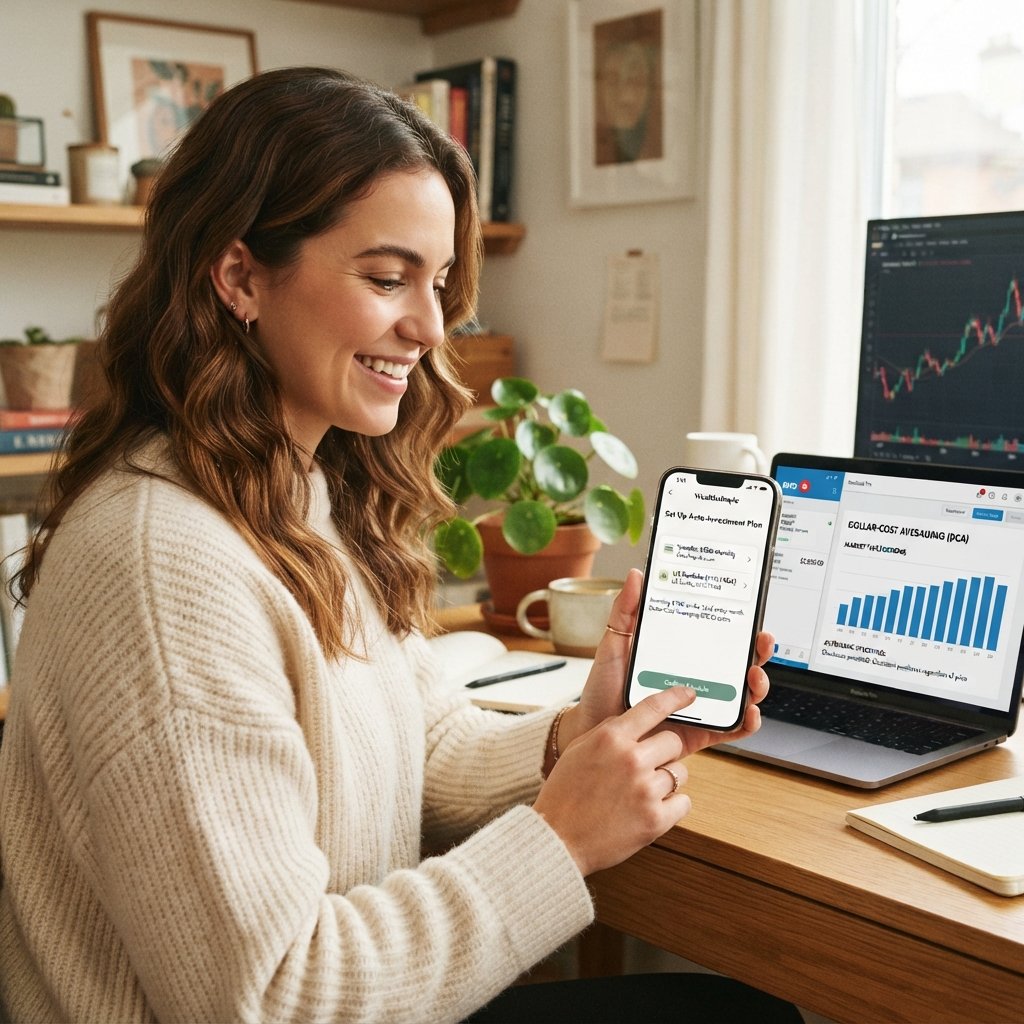
Dollar-Cost Averaging (DCA) Explained
Many beginners worry about timing the market. They ask, “Is today a good day to buy, or will the market drop tomorrow?”
Dollar-Cost Averaging (DCA) eliminates this stress entirely. With this strategy, you invest a fixed amount of money on a regular schedule, no matter what the market is doing.
[ Your Paycheck ] ───► Fixed Amount ($100) ───► Invest Every Month
                                                       │
                     ┌─────────────────────────────────┴─────────────────────────────────┐
                     ▼                                                                   ▼
         When Prices Are High:                                               When Prices Are Low:
      Your $100 buys FEWER shares.                                        Your $100 buys MORE shares.
                     │                                                                   │
                     └─────────────────────────────────┬─────────────────────────────────┘
                                                       ▼
                                   [ Result: Lower Average Cost Per Share ]
For example, you invest $100 every single month. When the market is up, your $100 buys fewer shares. When the market crashes, your $100 automatically buys more shares on sale. Over time, this smooths out your purchase price, ensuring you never invest all your money at the absolute worst time.

Long-Term Investing vs. Short-Term Investing
- Short-Term Investing (Trading): This involves buying stocks and trying to sell them a few days or weeks later for a quick profit. This is highly risky, behaves like gambling, and most people lose money doing it because short-term price movements are unpredictable.
- Long-Term Investing (Investing): This involves buying quality assets (like index funds) and holding onto them for 5, 10, or 20+ years. Historically, the US stock market goes up over long periods. Long-term investors ignore daily market drops because they know the market has historically recovered and climbed higher every single time.
Passive Investing Strategy
Passive investing means you do not spend your weekends analyzing balance sheets or corporate news. Instead, you buy broad-market index funds or ETFs that track the entire stock market and let the natural growth of the economy do the heavy lifting for you. It requires almost zero effort, costs very little in fees, and keeps your emotional stress to an absolute minimum.
Part 6: Risk & Safety
Risk vs. Reward in Investing
There is an golden rule in the financial world: Risk and reward always go hand in hand.
If an investment promises massive returns very quickly, it comes with a massive risk that you could lose everything. Cash in a bank account has almost zero risk, but it offers almost zero reward. Stocks have higher risk in the short term, but they offer the highest historical rewards over the long term. Your goal is not to avoid risk completely, but to manage it intelligently based on your goals.
Common Investing Mistakes
- Checking Your Account Daily: The stock market bounces around constantly. Checking your app every hour causes anxiety, which leads to emotional decisions like selling your investments during a normal temporary dip.
- Investing Money You Need Soon: Never invest cash that you will need for rent, bills, or an emergency within the next three to five years. If the market drops right when you need the cash, you will be forced to sell at a loss.
- FOMO (Fear of Missing Out): Buying an asset just because it went up quickly and everyone on social media is talking about it is a recipe for disaster. Usually, by the time everyone is hyping a trend, it is about to drop.

How to Avoid Scams
The internet is full of fraudulent schemes looking to steal your hard-earned money. Protect yourself with these rules:
- Only use regulated brokers: Only open accounts with well-known, institutional US companies (like Fidelity, Schwab, Vanguard, Robinhood) that are protected by the SIPC (Securities Investor Protection Corporation).
- Beware of “Guaranteed” Returns: No legitimate investment provider can guarantee you a specific high return. If someone promises you a guaranteed 10% profit a month, it is an illegal Ponzi scheme or scam.
- Avoid social media “gurus”: Legitimate financial institutions do not DM you on WhatsApp, Telegram, or Instagram offering to trade crypto or stocks for you.
Part 7: Portfolio Building
What is Diversification?
Diversification is the ultimate safety net for investors. It simply means spreading your money across many different investments so that a single failure cannot ruin you.
If you put all your money into one tech company and that company goes bankrupt, you lose everything. But if you put your money into an index fund that holds 500 different companies, and one company goes bankrupt, your overall portfolio barely notices. You have protected your wealth through diversification.
How to Build a Simple Portfolio
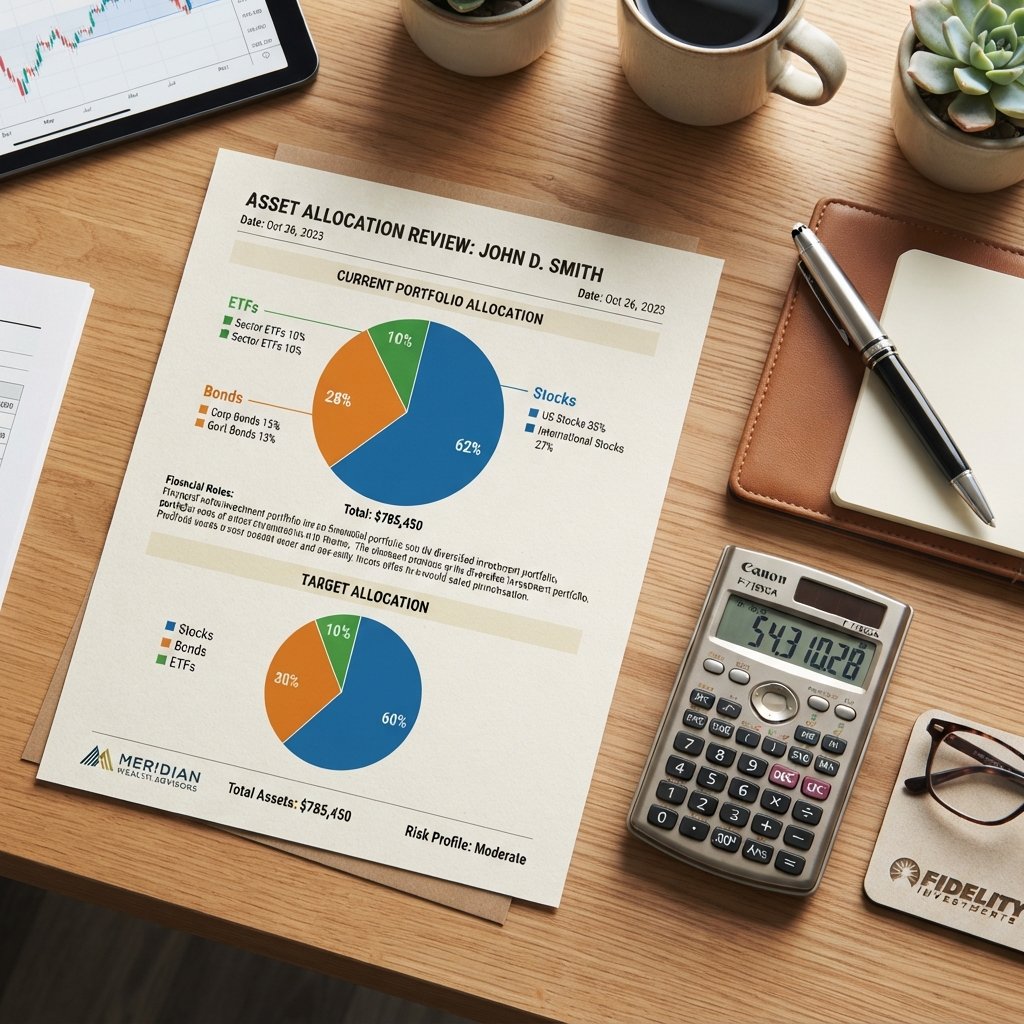
Building a portfolio does not have to be complicated. For a beginner, a great starting framework is a simple asset allocation based on your age and risk comfort.
- Younger Investors (Ages 20-40): Since you have decades before you need to retire, your portfolio should focus heavily on growth. That means holding mostly stocks and stock-focused ETFs.
- Older Investors (Ages 50+): As you get closer to needing your money, you want to protect what you have built. Your portfolio should slowly shift to include more bonds and cash investments to prevent sudden drops.

Example Beginner Portfolio (USA)
A classic, highly effective beginner portfolio can be built using just two or three low-cost ETFs. Here is a simple example for a long-term beginner:
- 80% Total US Stock Market ETF (Example Ticker: VTI): This single fund buys you a tiny piece of nearly every public company in the United States, giving you ultimate exposure to US economic growth.
- 20% Total Bond Market ETF (Example Ticker: BND): This fund provides stability, lowers your portfolio’s daily volatility, and pays out steady monthly interest income.
Part 8: Money & Growth Concepts
How Compound Interest Works
Albert Einstein reportedly called compound interest the “eighth wonder of the world.” It is the engine that drives true wealth creation.
When you invest, your money earns a return. Compound interest happens when the returns your money earned start earning returns of their own.
Imagine you invest $1,000, and it earns a 10% return in year one. You now have $1,100. In year two, you do not just earn 10% on your original $1,000—you earn 10% on your new balance of $1,100. That means you earn $110 in year two, bringing your total to $1,210.
Over a few years, this difference feels small. But over 20, 30, or 40 years, the growth curve bends sharply upward, turning small savings into massive fortunes.
Year 01: [ $1,000 ] ──► +10% ($100) ──► $1,100
Year 02: [ $1,100 ] ──► +10% ($110) ──► $1,210
Year 03: [ $1,210 ] ──► +10% ($121) ──► $1,331
...
Year 30: [ $17,449 ] ──► +10% ($1,745) ──► $19,194  <-- Growth accelerates rapidly over time
How Small Investments Grow Over Time

Many people don’t start investing because they assume $50 a month isn’t enough to matter. They are wrong. Let’s look at what happens if you invest just $100 a month into a diversified stock index fund assuming an average 9% annual return:
- In 10 Years: You will have saved $12,000 of your own money, but your portfolio will be worth around $19,000.
- In 20 Years: You will have saved $24,000 of your own money, but your portfolio will be worth around $66,000.
- In 30 Years: You will have saved $36,000 of your own money, but your portfolio will be worth around $184,000.
Your money did not just grow; it multiplied because of consistency and time.
Why Starting Early Matters
Because compounding requires time to work its magic, the day you start investing is more important than the amount of money you invest.
Consider two people:
- Investor A starts at age 20, invests $100 a month for 10 years, and then stops completely at age 30, leaving the money to sit and grow.
- Investor B waits until age 30 to start, and then invests $100 a month every single month for 35 years until retirement at age 65.
Even though Investor B put in way more of their own cash, Investor A will end up with more money at retirement. The extra ten years of early compounding did more heavy lifting than decades of manual deposits later in life. Start today, even if the amount is small.
Part 9: Tools & Platforms
Best Investment Apps for Beginners
Let’s look closer at the specific features of popular platforms so you can select the one that fits your personal workflow.
- Fidelity Investments: Known for its “Fractional Shares” feature, allowing you to buy pieces of expensive stocks for pennies. They charge zero account fees and offer incredible online learning tools for beginners.
- Robinhood: Best for individuals who prefer an incredibly clean mobile experience. It has a very low learning curve and offers automated recurring investments, making it simple to build a monthly routine.
- Vanguard: Best for hands-off investors who want to buy high-quality, ultra-low-fee index funds and hold them for decades without checking their phones constantly.
Robo-Advisors Explained
If you don’t want to choose your own ETFs, you can use a service called a Robo-Advisor (platforms like Betterment or Wealthfront).
When you sign up, the platform asks you a few simple questions: How old are you? What is your goal? How much risk do you like?
An automated computer program then builds a diversified portfolio of low-cost ETFs for you and manages it completely automatically. They handle the buying, selling, and balancing for a very small annual fee, making it a completely hands-off way to invest safely.
Brokerage Accounts Comparison Overview
| Broker Platform | Minimum to Start | Fees on Stocks/ETFs | Best For | Fractional Shares |
| Fidelity | $0 | $0 | Overall Beginners & Pros | Yes |
| Robinhood | $0 | $0 | Mobile-first & Automated DCA | Yes |
| Vanguard | $0 | $0 | Long-Term Index Investors | Yes (Vanguard ETFs only) |
| Betterment (Robo) | $0 | 0.25% annual management fee | Complete Hands-Off Management | Yes |
Part 10: Advanced but Simple Ideas
As you get comfortable with the basics, understanding a few slightly advanced concepts will help you optimize your wealth building and navigate taxes smoothly.
Dividend Investing Basics

When public companies make a profit, they have two choices: they can reinvest that money into the business, or they can share the cash directly with their investors.
Payments made directly to shareholders are called dividends. Many established, stable companies (like Coca-Cola or Target) pay out dividends every three months.
As a beginner, you can turn on a setting in your brokerage account called DRIP (Dividend Reinvestment Plan). This feature automatically takes any cash dividend you receive and instantly uses it to buy more fractions of that same stock, supercharging your compound interest engine without any manual effort.
Inflation and Investing
We touched on this earlier, but it’s important to understand the deep relationship between inflation and your assets.
- Cash is destroyed by inflation because its value is fixed while prices rise.
- Stocks and Quality Real Estate act as a natural shield against inflation. Why? Because when inflation rises, companies charge more for their goods and services. As their prices increase, their revenues increase, which eventually pushes their stock prices up along with inflation.
Investing is the single best way to ensure your wealth preserves its true buying power over your lifetime.
Retirement Investing Basics (401k & IRA Intro)
In the US, the government wants you to save for retirement, so they created special tax-advantaged investment accounts. If you invest through these accounts instead of a standard brokerage account, you can save thousands of dollars in taxes.
                               ┌─────────────────────────┐
                               │   Retirement Accounts   │
                               └────────────┬────────────┘
                                            │
                     ┌──────────────────────┴──────────────────────┐
                     ▼                                             ▼
         [ 401(k) / 403(b) ]                                [ IRA / Roth IRA ]
     Provided by your employer.                        Opened by yourself at a broker.
                     │                                             │
   💡 Key Perk: Free Employer Match              💡 Key Perk: Freedom to choose any fund
- 401(k): This is a retirement account offered through your employer. The money is taken directly out of your paycheck before taxes are calculated, reducing your tax bill today. Many companies offer a 401(k) match—meaning if you contribute 3% of your salary, they will match it and put an extra 3% into your account for free. Always invest enough to get your full employer match; it is free money.
- IRA (Individual Retirement Account): This is a personal retirement account that you open yourself at a broker like Fidelity or Vanguard.
- Traditional IRA: You get a tax break today when you deposit money, but you pay taxes when you withdraw the money in retirement.
- Roth IRA: You invest money that has already been taxed. The massive benefit? Your money grows completely tax-free, and when you withdraw it in retirement, you do not pay a single penny in taxes to the government.
Frequently Asked Questions (FAQ)
How much money do I need to start investing in the US?
You do not need a fortune. Many modern brokerage platforms like Robinhood or Fidelity have a $0 account minimum and offer fractional shares, meaning you can start investing with as little as $1 to $5.
Can I lose all my money in the stock market?
If you buy individual shares of one single company, yes, you can lose all your money if that company goes bankrupt. However, if you invest in diversified index funds or ETFs tracking large markets (like the S&P 500), it is nearly impossible to lose everything because all 500 of America’s largest businesses would have to go bankrupt simultaneously for your investment to drop to zero.
What is the best investment for a complete beginner?
For most beginners, a low-cost S&P 500 or Total Stock Market index fund (such as an ETF like VOO or VTI) is considered the best starting point. It gives you instant diversification across hundreds of successful companies at an extremely low cost.
What is a Roth IRA vs a traditional brokerage account?
A traditional brokerage account lets you invest unlimited money and withdraw it whenever you want, but you have to pay taxes on your investment gains every year. A Roth IRA is a designated retirement account where your money grows completely tax-free and can be withdrawn completely tax-free after age $59\frac{1}{2}$, but it has annual contribution limits set by the government.
Is it safe to link my bank account to investment apps?
Yes, as long as you are using well-known, heavily regulated US brokers (such as Fidelity, Charles Schwab, Vanguard, or Robinhood). These platforms use high-level bank-grade encryption and are monitored by US financial regulators to ensure your money and data stay safe.

Summary Next Steps to Start Today
- Build an emergency fund: Before investing, save 3 to 6 months of living expenses in a secure High-Yield Savings Account so you never have to touch your investments during tough times.
- Check your employer benefits: Ask your job if they offer a 401(k) program with a match feature. If they do, sign up immediately.
- Open a beginner account: Pick a broker that fits your style (like Fidelity or Robinhood) and spend ten minutes setting up your profile online.
- Automate a small deposit: Set your account to automatically transfer a manageable amount of cash (even just $20 a month) on your payday.
- Buy a diversified fund: Purchase your first share or partial share of a low-cost total market ETF and let your long-term wealth journey begin.