

Affiliate content writing is the process of creating useful online content that helps readers evaluate products or services while using affiliate links to generate commissions from qualifying purchases. Unlike a simple promotional article, a good affiliate guide is designed around the reader’s buying decision rather than the commission itself.
An affiliate guide might compare several products, explain important features, discuss advantages and limitations, and help readers understand which option may fit different needs or budgets. When a reader clicks an affiliate link and completes a qualifying purchase, the publisher may receive a commission at no additional cost to the reader.
The real value of affiliate content comes from helping people make better-informed decisions. Instead of simply saying that one product is “the best,” a useful guide explains why a product may be suitable for a particular type of buyer and what trade-offs the reader should consider.
Trust is especially important. Product claims should be supported by reliable information, important specifications should be checked, and the article should clearly distinguish verified facts from opinions or recommendations. If the publisher has an affiliate relationship, that relationship should also be disclosed clearly and conspicuously. The U.S. Federal Trade Commission (FTC) specifically advises affiliate marketers to disclose their relationship with retailers and recommends placing the disclosure close to the relevant recommendation or affiliate link.
AI can make this process faster by helping with research organization, outlines, comparison structures, drafts, FAQs, and editing. However, AI should not automatically be treated as a source of truth. It may provide outdated or incorrect product information, so human judgment is still needed to verify important claims, evaluate evidence, identify meaningful differences between products, and add original insights.

2. How AI Can Help You Create Affiliate Guides
AI can make affiliate content creation much faster, but its biggest value is not simply generating paragraphs. It can help you organize research, identify useful content angles, structure comparisons, and turn verified information into a clearer guide.
Topic and Product Research
AI can help you brainstorm potential topics, identify common buyer questions, and create a research plan. Modern AI research tools can also work with web sources; for example, Gemini’s Deep Research can conduct real-time research and use Google Search as a source. Gemini Deep Research
However, AI-generated suggestions should be treated as a starting point. Important product information still needs to be checked against reliable sources.
Content Planning
Once you know the topic and audience, AI can create an initial outline covering the sections readers may need before making a purchase. It can also help identify gaps in your planned content, such as missing buying criteria, FAQs, or important product limitations.
Organizing Product Information
Affiliate research can quickly become messy when you are comparing multiple products. AI can organize verified information into structured notes, review frameworks, tables, and categories, making it easier to see differences between products.
Product Comparisons
AI can help turn your verified product data into consistent comparisons. For example, you can provide specifications for five products and ask AI to organize them according to the same criteria. The important part is that you provide or verify the underlying information.
Review Structure and Supporting Content
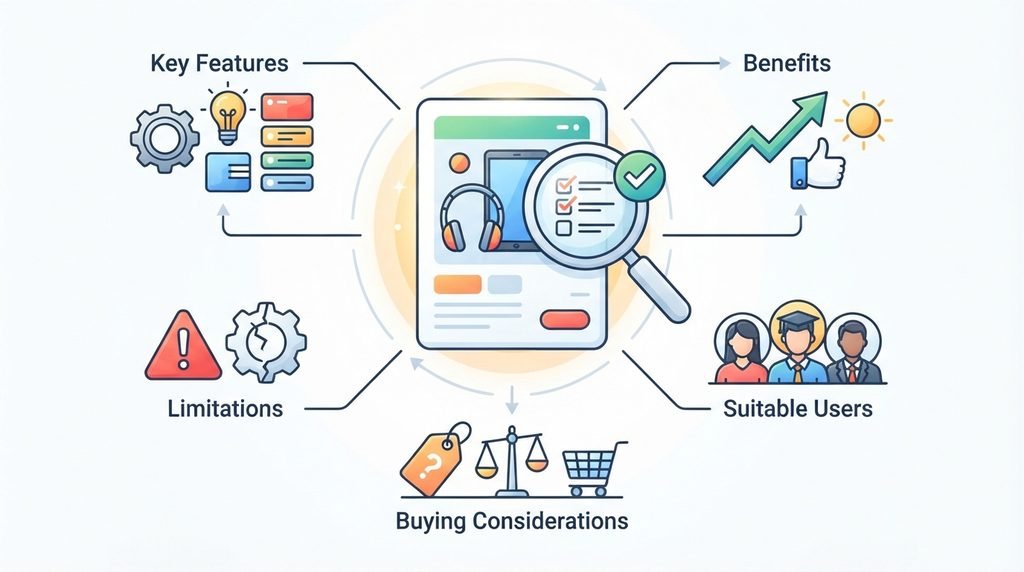
AI can also create a consistent structure for product reviews, including features, benefits, limitations, suitable users, buying considerations, and FAQs. Google itself documents AI-assisted workflows for creating drafts and refining written content. Google Docs with Gemini
What AI Should Not Do on Its Own
AI should not invent product specifications, prices, testing experiences, ratings, quotes, availability, or performance claims. AI systems can produce inaccurate information and present it as factual, so important claims should always be checked before publication.
Think of AI as a research and writing assistant—not the final source of truth. Your job is to verify the evidence, make the comparisons meaningful, add original insights, and decide what is genuinely useful for the reader.
The goal is not to let AI write everything. The goal is to use AI to make the affiliate content creation process faster, more organized, and more useful for the reader.

3. Affiliate Disclosure and Editorial Transparency
Affiliate disclosure is a simple statement that tells readers when a website may earn a commission if they purchase a product through one of its affiliate links. The purpose is transparency: readers should understand the financial relationship behind a recommendation before deciding how much weight to give it.
For example, a website might state:
“We may earn a commission from purchases made through links in this article.”
The exact wording can vary, but the important point is that the relationship should be clear and easy to understand. The FTC’s current guidance specifically addresses affiliate marketers and says the relationship with a retailer should be disclosed clearly and conspicuously. It also recommends placing the disclosure close to the relevant recommendation or affiliate link.
An affiliate link is different from an ordinary external link. An ordinary external link may simply send readers to another website as a useful source or reference. An affiliate link, however, may generate a commission when a qualifying purchase occurs.
A disclosure should not be hidden only on an About page, terms page, or somewhere readers are unlikely to notice. The FTC notes that simply writing “affiliate link” may also be unclear because some readers may not understand that it means the publisher receives compensation.
Most importantly, disclosure does not replace honest editorial judgment. A website should not recommend a product simply because it pays a higher commission. Recommendations should be based on relevant criteria such as features, price, suitability, limitations, quality, and the needs of the intended reader.
This approach creates a clearer relationship between monetization, transparency, and useful content—which is especially important when AI is being used to help produce affiliate guides.
4. The AI Workflow for Creating an Affiliate Guide
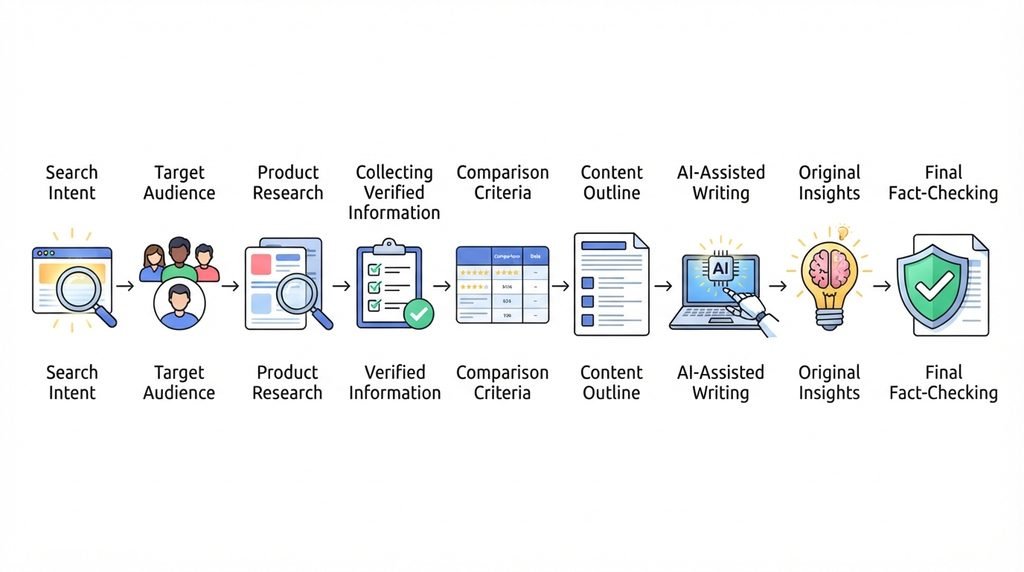
Creating an affiliate guide with AI works best as a step-by-step workflow, rather than asking an AI tool to generate an entire article from a single prompt. The goal is to combine AI’s speed with human research, judgment, and verification.
Step 1: Choose the Search Intent
Start by identifying what the reader actually wants. Someone searching for “best web hosting for beginners” has a different intent from someone searching for “how does web hosting work?” An affiliate guide should match a commercial investigation or buying-related intent and answer the questions that matter before a purchase.
Step 2: Define the Target Reader
Decide who the guide is for. Consider their experience level, budget, goals, and likely concerns. A beginner may care about simplicity and customer support, while an experienced buyer may prioritize advanced features or performance.
Step 3: Research the Products
Create a shortlist of relevant products and research them using reliable sources. AI can help organize the research, but don’t treat its initial product suggestions as automatically accurate.
Step 4: Collect Important Product Information
Gather the information readers need to compare options, such as price, features, specifications, compatibility, limitations, warranty, support, and availability. For time-sensitive details, record when the information was checked.
Step 5: Define Your Comparison Criteria
Before asking AI to compare products, decide what actually matters. Using consistent criteria makes comparisons more useful and reduces the chance of making arbitrary recommendations.
Step 6: Build the Content Structure
Create an outline based on the reader’s decision-making process. This might include an introduction, comparison table, individual reviews, buying guide, use-case recommendations, FAQs, and a final checklist.
Step 7: Generate and Refine the Draft
Now use AI to turn your research and structure into a readable first draft. Treat the output as a working draft, not a finished article. Improve unclear explanations, remove repetition, and make sure every section serves a purpose.
Step 8: Add Original Insights and Decision-Making Criteria
This is where the article becomes more than generic AI content. Explain meaningful trade-offs, highlight differences between products, and tell readers why certain features matter. Google specifically emphasizes creating useful, original content that adds value beyond information that AI can easily reproduce.
Step 9: Fact-Check the Final Content
Finally, verify important claims against current and reliable sources. Check specifications, prices, features, availability, and other time-sensitive information before publishing.
The basic workflow is simple: research → organize → write → improve → verify. AI can accelerate almost every stage, but the final responsibility for accuracy and usefulness remains with the publisher.
5. The Master AI Prompt for Affiliate Guides
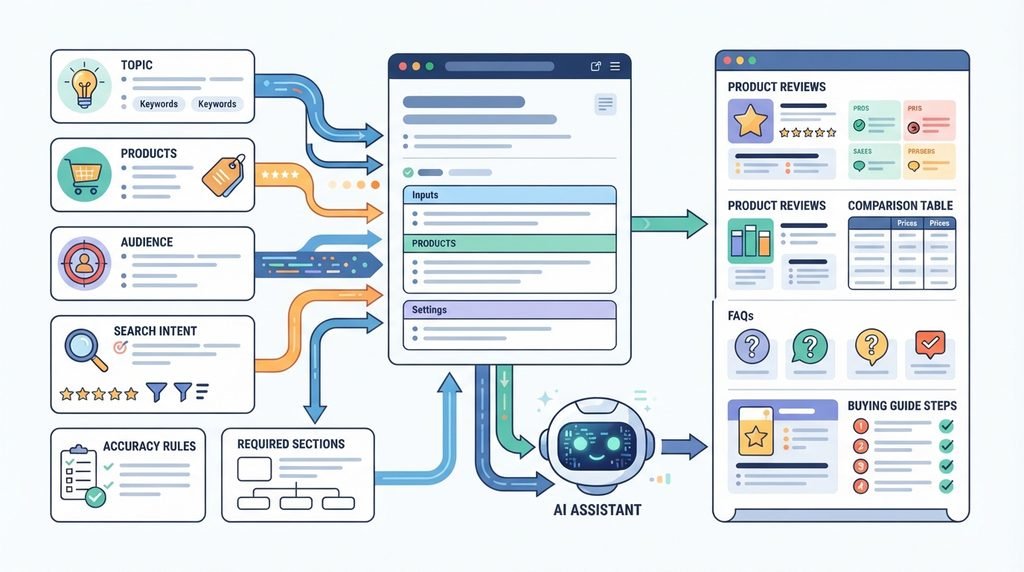
A strong affiliate article starts with a strong prompt. Instead of asking AI to “write an affiliate article,” give it enough context to understand the topic, audience, products, search intent, comparison criteria, and standards the content must follow.
The more useful information you provide, the less likely you are to receive a generic article that treats every product the same.
Your master prompt should include these elements:
- Topic: What the affiliate guide is about
- Products: Which products or services should be covered
- Target audience: Who the guide is written for
- Search intent: What the reader wants to accomplish
- Writing style: Clear, natural, practical, and easy to understand
- Review criteria: Which features or factors should be evaluated
- Required sections: Comparison, individual reviews, buying guide, FAQs, and other useful sections
- Comparison requirements: Which criteria should be applied consistently
- Buying considerations: What readers should think about before purchasing
- Accuracy requirements: Which information must be verified
- Fact-checking instructions: How AI should identify information that requires additional research
Master Prompt
Act as an experienced affiliate content writer and research assistant.
Create a detailed affiliate guide about [TOPIC] for [TARGET AUDIENCE].
The reader’s search intent is [SEARCH INTENT]. The main goal is to help the reader understand the available options and make an informed decision.
Products to cover:
[PRODUCT 1]
[PRODUCT 2]
[PRODUCT 3]Evaluate each product using these criteria: [CRITERIA].
Include:
- A useful introduction
- A product comparison
- Individual product reviews
- Key features and benefits
- Limitations and trade-offs
- Who each product is suitable for
- Buying considerations
- Relevant FAQs
Use clear, natural language and avoid repetitive or generic statements.
Accuracy rules: Do not invent product information, specifications, prices, availability, ratings, quotes, testing results, customer experiences, or performance claims. Do not claim that a product was personally tested unless genuine testing information has been provided. Clearly distinguish verified facts from recommendations or interpretations. If information cannot be confirmed, flag it for verification instead of guessing.
Do not make every product sound equally good. Explain meaningful differences, advantages, limitations, and trade-offs based on the available evidence.
Before finalizing the article, create a list of claims that should be fact-checked against current and reliable sources.
This last instruction is particularly important for affiliate content. A polished AI-generated paragraph can still contain an incorrect claim, so the final article should be reviewed by a human before publication. Honest, non-misleading recommendations are also an important principle in the FTC’s guidance on endorsements.
6. How to Write a Strong Affiliate Guide Introduction With AI
The introduction of an affiliate guide should quickly answer one question:
“Why should I keep reading this guide?”
Instead of starting with a generic statement such as “Choosing the right product can be difficult,” begin with the buyer’s actual problem. Tell readers what they are trying to decide and what your guide will help them understand.
A strong introduction should:
- Identify the buyer’s problem
- Explain what the guide covers
- Set realistic expectations
- Briefly explain how the products will be compared
- Highlight what makes the guide useful
- Get to the main topic quickly
For example, if the article is about web hosting, the introduction could explain that beginners often have difficulty comparing storage, performance, support, pricing, and renewal costs. The guide can then tell readers that these factors will be compared to help them identify the option that fits their needs.
AI Prompt for the Introduction
Write a concise introduction for an affiliate guide about [TOPIC].
The target reader is [AUDIENCE], and their main problem is [BUYER PROBLEM].
Explain what this guide will help them understand and briefly mention the criteria used to compare the products.
Start with the reader’s problem rather than a generic statement. Do not use exaggerated claims, filler, clichés, or phrases such as “in today’s fast-paced world.”
Keep the introduction practical, natural, and focused on the reader’s buying decision.
The objective is not to make the introduction sound artificially “human.” It is to make it specific, useful, and relevant from the first few sentences.
7. How to Build Product Recommendations With AI
Product recommendations are one of the most important parts of an affiliate guide because readers usually want more than a list of products. They want to understand which option fits their specific needs and why.
AI can help organize research and turn product information into clear recommendations, but it should not independently decide which product is “the best.” Start by creating a product shortlist based on relevance to the topic, audience, and search intent.
Before selecting products, define your selection criteria. Depending on the category, this could include price, features, performance, ease of use, compatibility, durability, customer support, or other factors that actually matter to buyers.
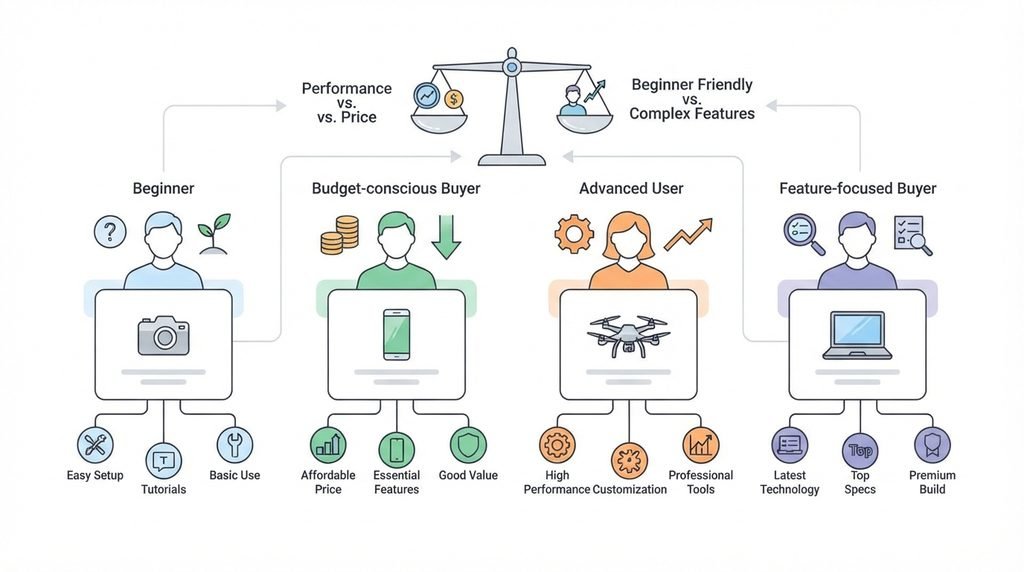
Next, organize products by use case rather than treating every reader the same. For example, one product might be suitable for beginners, another for buyers with a limited budget, and another for users who need advanced features.
For every recommendation, explain why the product was included. A useful recommendation should connect the product’s characteristics with a specific reader need. At the same time, mention important strengths and limitations so readers can understand the trade-offs.
Avoid unsupported statements such as “This is the best product on the market” unless you have clear evidence and a defined basis for making that comparison. AI may confidently produce recommendations that sound convincing without having enough evidence behind them.
You should also avoid allowing commission rates to determine your recommendations. The products included in the guide should be relevant to the reader first.
AI is most useful here as an organization and analysis assistant. Give it verified product information and your selection criteria, then ask it to structure the reasoning. You can use resources such as Google’s product structured data documentation when planning how product information is presented online.
AI Prompt for Product Recommendations
Analyze the following products for an affiliate guide: [PRODUCTS].
Target audience: [AUDIENCE]
Main use cases: [USE CASES]
Selection criteria: [CRITERIA]Based only on the information provided, organize the products according to the readers they may suit best.
For each recommendation:
- Explain why it may be suitable
- Identify its strongest features
- Mention important limitations
- Explain relevant trade-offs
- Avoid unsupported superlatives such as “best” or “number one”
Do not invent specifications, prices, testing results, ratings, reviews, or performance claims. If information is missing or uncertain, clearly flag it for verification.
Do not choose a product based on affiliate commission potential. Focus on relevance to the reader and the stated selection criteria.
8. How to Write Detailed Product Reviews With AI
A detailed product review should do more than repeat the manufacturer’s product description. Its purpose is to help readers understand what the product offers, who it is suitable for, what its limitations are, and what they should consider before buying it.
A consistent review structure also makes an affiliate guide easier to compare. For each product, start by explaining what it is and what problem it is designed to solve. Then cover its most relevant features rather than listing every specification available.
Next, explain the main benefits in practical terms. Instead of simply saying that a product has a certain feature, explain why that feature may matter to the target reader. At the same time, include meaningful limitations and trade-offs. A review that only lists positive points can make the content feel promotional rather than genuinely useful.
The review should also explain who the product is suitable for. A product can be excellent for one type of buyer while being unnecessary or unsuitable for another. Consider factors such as experience level, budget, intended use, compatibility, and required features.
Important claims should have evidence behind them. Product specifications can often be checked against the manufacturer’s official information, while independent performance claims may require additional reliable sources. Keep these sources clearly distinguished in your research notes.
If you personally tested a product, you can include your genuine observations. However, never write as though you tested something when you did not. The FTC states that endorsements should reflect the endorser’s honest experience and specifically warns against discussing personal experience with a product that has not actually been tried.
AI can help transform your verified research into a consistent review, but it should not create the evidence itself. Give the AI your product information, sources, observations, and review criteria, then ask it to organize and explain them clearly.
AI Prompt for Product Reviews
Write a detailed product review for [PRODUCT NAME] using only the information provided below.
Target audience: [AUDIENCE]
Main use case: [USE CASE]
Review criteria: [CRITERIA]Structure the review with:
- What the product is
- Key relevant features
- Main benefits
- Limitations and trade-offs
- Who it is suitable for
- Who may want to consider another option
- Important buying considerations
For every important claim, distinguish between:
1. Manufacturer-provided information
2. Information from reliable independent sources
3. My actual observations or testing, only where genuine testing information is provided.Do not invent specifications, prices, performance results, ratings, quotes, testing experiences, customer opinions, or product capabilities.
Do not describe the product as “the best” unless a specific comparison criterion and supporting evidence have been provided.
If information is missing or cannot be verified, clearly mark it as “Needs verification” instead of guessing.
Write naturally and explain why important features matter to the target reader. Include both strengths and meaningful limitations so the review remains balanced and useful.
9. How to Create an Affiliate Comparison Table
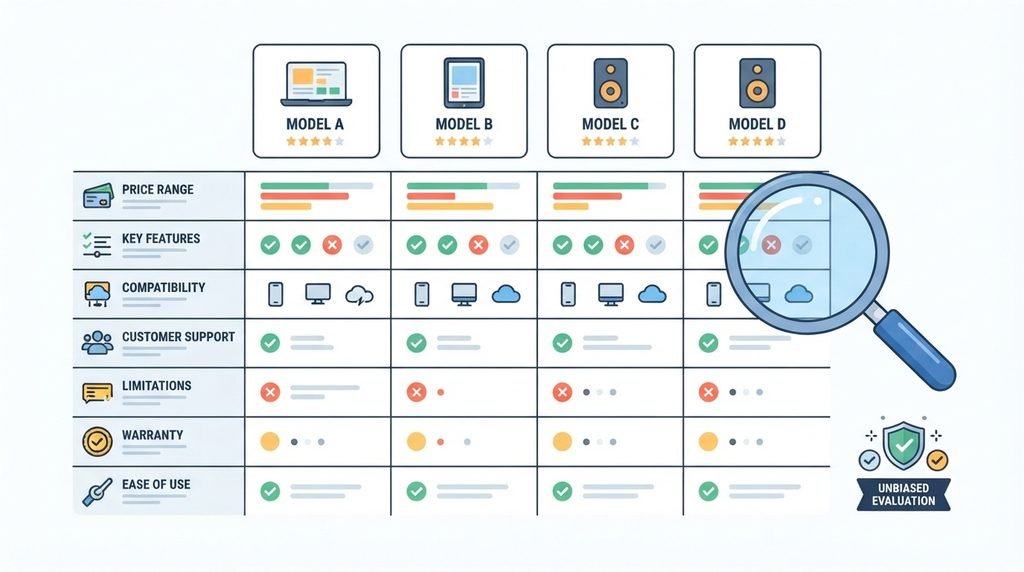
A comparison table gives readers a quick way to understand the differences between several products before reading the detailed reviews. However, a useful table should contain decision-making information, not every specification you can find.
The information you include depends on the product category. For example, a web-hosting comparison might include pricing, storage, websites supported, customer support, and important limitations. A laptop comparison could focus on processor, memory, storage, display, battery, weight, and price.
The key is to identify the specifications that actually matter to the target reader. Don’t add a column simply because the information is available. Every row should help answer an important buying question.
For a fair comparison, use the same criteria for every product. If one product is evaluated on five important features, the others should be evaluated using the same framework. Also, make sure you’re comparing equivalent information. Mixing unrelated features can make a table look detailed while providing little practical value.
AI can make this process much easier. You can provide verified product information and ask AI to organize it into a consistent table. However, AI should not be allowed to fill missing information by guessing.
Before publishing, verify important specifications against current sources, particularly when prices, features, compatibility, or availability can change.
AI Prompt for Comparison Tables
Create a clear comparison table for [PRODUCT CATEGORY] using only the verified information provided below.
Products:
[PRODUCT 1]
[PRODUCT 2]
[PRODUCT 3]Comparison criteria:
[CRITERIA]Use the same criteria for every product. Include only information that helps the target reader make a buying decision.
Do not invent or estimate missing specifications, prices, ratings, performance results, or features. If information is unavailable, write “Not verified” rather than guessing.
After creating the table, identify any product information that should be fact-checked before publication.
10. How to Explain Your Research, Review, or Testing Method
A transparent methodology helps readers understand how you reached your recommendations. It also prevents a common affiliate-content problem: making an article sound as though products were personally tested when they were actually researched from online sources.
Start by explaining what you compared and why those criteria were selected. For example, if you’re comparing web-hosting services, you might evaluate pricing, storage, support, performance-related features, renewal costs, and limitations because these factors can directly affect a beginner’s decision.
Next, explain how the information was collected. You might use official manufacturer or provider pages for specifications, documentation for technical details, and reliable independent sources for additional evidence.
Be precise about personal testing. If you actually tested a product, you can describe your genuine observations and explain what you tested. If you did not test it, say that the review is based on research and verified information instead.
This distinction matters. The FTC says endorsers should not discuss their experience with a product if they have not actually tried it, and product claims should have appropriate support.
Finally, explain any limitations in your methodology. Some information may change over time, some products may not have been personally tested, and certain performance claims may require independent testing.
AI Prompt for Review Methodology
Create a transparent methodology section for an affiliate guide about [TOPIC].
Explain:
- What products were compared
- Why these products were selected
- Which criteria were used
- How the information was collected
- Which information came from official sources
- Which information came from reliable third-party sources
- Which products were personally tested, if applicable
- What was actually observed during testing
- What limitations readers should understand
Do not claim that products were tested unless genuine testing information is provided.
Clearly distinguish between researched information, manufacturer claims, independent evidence, and personal observations.
Do not invent testing results, benchmarks, personal experiences, customer feedback, or conclusions. If an important part of the methodology cannot be verified, identify it as a limitation rather than filling the gap with assumptions.
Keep the methodology factual, transparent, and easy for readers to understand.
11. How to Choose the Right Product for Different Readers
There is rarely one product that is the right choice for every reader. Different buyers have different budgets, experience levels, priorities, and use cases. Instead of forcing every reader toward the same product, a strong affiliate guide can organize recommendations around specific needs.
For example, a product might be particularly suitable for beginners because it is easier to set up and use. Another may make more sense for buyers with a limited budget, while a different option may be more appropriate for advanced users who need additional features.
You can also create recommendations around specific use cases. A product designed for portability may suit frequent travelers, while another with more advanced capabilities may be better for users who need professional-level functionality.
The important part is to explain why each recommendation fits the particular reader. Don’t simply attach a label such as “best for beginners.” Explain which features make it suitable and what the reader gives up by choosing it.
Every recommendation should also include its limitations and trade-offs. A lower-priced product may have fewer features. A premium product may offer better capabilities but cost more. A feature-rich option may also be more complicated for beginners.
This approach gives readers useful context instead of pretending that one product is universally superior. It also creates more meaningful affiliate content because the recommendation is connected to a specific decision-making situation.
AI Prompt for Use-Case-Based Recommendations
Analyze the following products for different types of buyers:
Products: [PRODUCTS]
Target audience: [AUDIENCE]
Selection criteria: [CRITERIA]Organize recommendations around relevant use cases such as:
- Beginners
- Budget-conscious buyers
- Advanced users
- Specific professional or personal use cases
- Buyers who prioritize particular features
For each recommendation:
- Explain why the product fits that reader
- Identify the relevant features
- Explain its limitations
- Explain important trade-offs
- Avoid unsupported claims and universal “best” statements
Base the recommendations only on the verified information provided. Do not invent product capabilities, prices, testing results, ratings, or performance claims. If the available information is insufficient to support a recommendation, clearly identify what needs to be verified.
12. How to Add Useful Supporting Information
A strong affiliate guide should not stop after listing products. Readers often need additional information to understand how to choose between those products.
Start with a practical buying guide that explains the features and factors readers should consider before making a purchase. Focus on criteria that actually affect the decision rather than filling the section with technical specifications that have little relevance to the target audience.
You can also explain common mistakes buyers make. For example, someone might focus only on the initial price without checking ongoing costs, compatibility, limitations, or important features.
Adding alternatives can also make the guide more useful. Some readers may discover that none of the main recommendations perfectly matches their needs, so explaining when another type of product might be worth considering can provide additional value.
Pros and cons are useful when they are specific. Instead of writing generic statements such as “great performance” or “easy to use,” explain exactly what the advantage or limitation means for the buyer.
You can also include practical tips and questions buyers should ask before purchasing. This turns the article from a product list into a decision-making resource.
Finally, explain situations where a recommended product may not be suitable. Being willing to tell readers when they should consider another option can make the content more balanced and trustworthy.
This additional information is particularly valuable for affiliate websites because Google identifies meaningful comparisons, original reviews, testing, and additional product information as examples of ways affiliate pages can provide value beyond copied merchant descriptions.
AI Prompt for Supporting Sections
Create useful supporting sections for an affiliate guide about [TOPIC].
Target audience: [AUDIENCE]
Based only on the verified information provided, create:
- A practical buying guide
- Important features to consider
- Common mistakes buyers should avoid
- Relevant alternatives
- Specific pros and cons
- Helpful purchasing tips
- Questions buyers should ask before purchasing
- Situations where the recommended products may not be suitable
Do not repeat information already covered in the product reviews. Each section should provide new value or help the reader make a better decision.
Do not invent product claims, prices, specifications, testing experiences, or customer opinions. If important information is missing, identify it for verification instead of guessing.
Keep the content practical, specific, and focused on the reader’s actual buying decision.
13. How to Make AI-Assisted Affiliate Content More Useful and Original
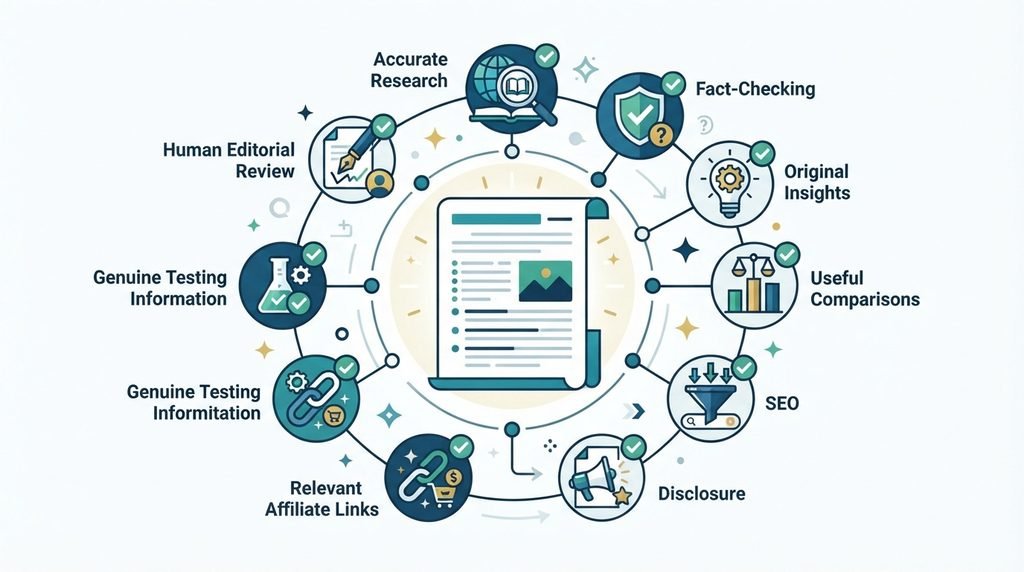
Using AI to create an affiliate guide does not mean simply generating a long article and publishing it. The real value comes from what you add to the AI-assisted draft.
Google’s current Search guidance specifically warns against scaled AI-generated content that provides little or no additional value. It also distinguishes useful affiliate pages from “thin affiliation,” where merchant descriptions are copied without meaningful original content. Google gives examples of added value such as original reviews, rigorous testing, useful product comparisons, and additional product information.
Add Real Observations
If you have personally used or tested a product, include genuine observations that a generic product description would not provide. Explain what you noticed, how you used it, and whether the experience matched your expectations.
Never invent personal experience simply to make AI content appear more authentic.
Use Specific Examples
Replace vague statements with practical examples. Instead of saying that a feature is “useful,” explain when, why, and for whom it is useful.
Specific examples help readers understand how a product may fit into a real situation.
Add Original Comparisons
Don’t simply repeat specifications that readers can find on every other affiliate website. Compare products using criteria that actually matter to your target audience.
For example, instead of only comparing storage and price, explain which option may make more sense for a beginner, a budget-conscious buyer, or an advanced user.
Explain Trade-Offs
Useful recommendations aren’t only about advantages. Explain what a buyer gains and what they give up. A cheaper product may have fewer features, while a premium option may provide more capabilities at a higher cost.
Remove Repetition and Empty Claims
AI often repeats the same ideas using slightly different wording. Remove unnecessary repetition and vague phrases such as “excellent choice,” “cutting-edge,” or “high-quality product” when they aren’t supported by evidence.
Add Information AI Cannot Know Without Research
Give AI verified product specifications, genuine observations, current pricing information, testing results, and reliable source material. AI can organize this information, but it should not invent missing evidence.
Edit the AI Output Manually
Read the complete draft as an editor, not just as a publisher. Check whether the recommendations make sense, whether claims are supported, whether sections repeat each other, and whether the article actually helps someone make a decision.
Add Your Own Editorial Perspective
Finally, explain how you reached your conclusions. Your selection criteria, comparisons, observations, and explanation of trade-offs can turn an AI-assisted draft into genuinely useful editorial content.
The goal isn’t to hide the fact that AI was used. The goal is to ensure that AI assistance results in better content rather than more content.
14. How to Fact-Check AI-Generated Affiliate Content
AI can help you research and organize an affiliate guide, but it should never be treated as the final authority for current product information. Product details can change, and AI can sometimes produce information that sounds accurate without actually being verified.
Before publishing, check the most important details, including:
- Product specifications
- Current prices
- Features
- Availability
- Compatibility
- Claims and statistics
- Warranty information
- Product limitations
- Information that may have become outdated
A Simple Verification Process
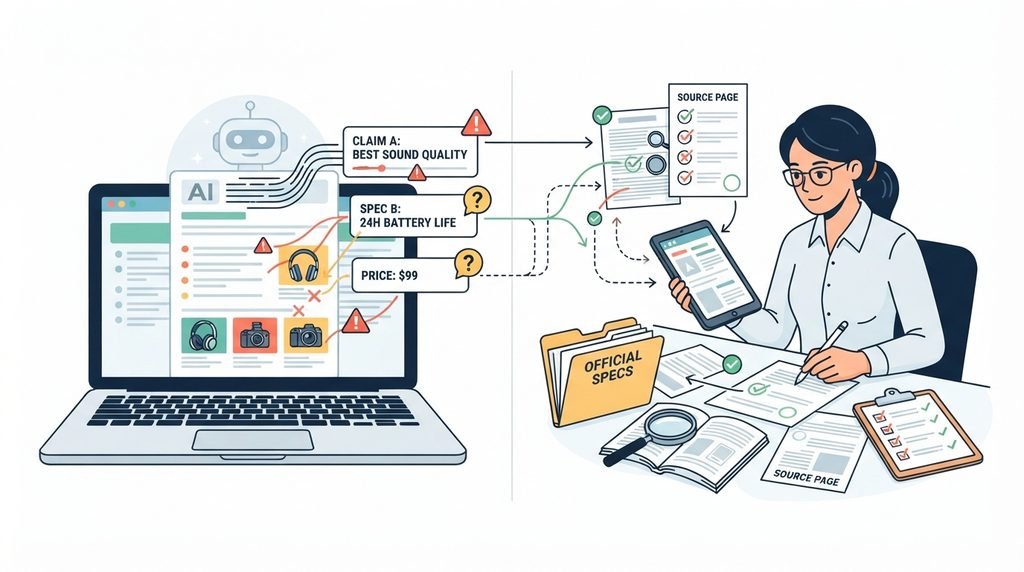
1. Check the official product or manufacturer source first.
Use the manufacturer’s website, official documentation, or official retailer information to verify specifications, features, compatibility, and other product details.
2. Compare important claims with reliable sources.
For claims that go beyond basic specifications, look for trustworthy independent sources or primary evidence.
3. Check time-sensitive information.
Prices, plans, availability, features, and product policies can change. Don’t assume information found during earlier research is still current.
4. Record when important information was verified.
For frequently changing information, keeping a simple research date can make future updates much easier.
5. Remove anything that cannot be confirmed.
If an important claim cannot be verified, don’t fill the gap with an AI-generated assumption. Either find better evidence or remove the claim.
This process is especially important for affiliate content because a polished article can still contain inaccurate product information. Google also emphasizes that affiliate pages should provide meaningful value rather than simply reproducing merchant information. Its current Search guidance specifically identifies useful comparisons, original reviews, testing, and additional product information as examples of added value.
The rule is simple: use AI to accelerate the work, but verify the facts yourself.
15. How to Optimize Affiliate Guides for SEO
Affiliate SEO should not be about adding as many keywords as possible. The goal is to create a page that matches the reader’s search intent and provides enough useful information to help them make a decision.
Match Search Intent
Start with the reason someone is searching. If the query has commercial investigation intent, the page should help the reader compare options rather than provide a general definition of the topic.
Use the Primary Topic Naturally
Include the main topic where it makes sense, such as the title, introduction, relevant headings, and product sections. Avoid forcing the same phrase into every paragraph.
Cover Related Buyer Questions
Think beyond the main keyword. Include questions readers are likely to have before purchasing, such as pricing, compatibility, features, limitations, alternatives, and who the product is suitable for.
Create Useful H2 and H3 Headings
Use descriptive headings that make the article easy to scan. A reader should be able to understand the structure of the guide simply by looking at its headings.
Optimize Product Sections
Give each product enough useful information to support the buying decision. Avoid copying manufacturer descriptions. Add comparisons, context, limitations, and relevant explanations.
Add Relevant Internal Links
Link naturally to other useful pages on your website when they genuinely help the reader. For example, an article about affiliate content could link to your relevant guides about SEO, keyword research, or content creation.
Add Relevant FAQs
FAQs can answer remaining buyer questions and make the page more useful. However, don’t add questions simply to increase word count or because you expect FAQ rich results. Google removed its FAQ rich-result documentation in 2026, so the value of FAQs should primarily come from helping readers.
Write a Useful Title and Meta Description
Your title should accurately communicate what the page offers without exaggerated claims. A useful meta description can summarize the page and encourage the right searcher to click.
Use Descriptive Image Alt Text
Describe images accurately when alt text is appropriate. Don’t stuff keywords into image descriptions.
Avoid Keyword Stuffing
Repeating keywords unnaturally can make content difficult to read and does not turn a weak affiliate page into a useful one. Google’s current spam guidance focuses on whether content provides value rather than simply how much content or how many keywords it contains.
Optimize for the reader first. When the page genuinely answers the buyer’s questions and adds information beyond basic merchant descriptions, SEO becomes part of the publishing process rather than the entire purpose of the article.
16. Affiliate Guide AI Prompt Templates
Instead of using one enormous prompt for every task, you can use smaller prompts for different stages of the affiliate workflow. This makes it easier to control the output and verify each stage before moving to the next one.
Prompt 1 — Product Research
Research the information I need to compare [PRODUCT CATEGORY] for [TARGET AUDIENCE]. Create a research checklist covering specifications, features, pricing, compatibility, limitations, warranty, and other important buying factors. Do not invent missing information.
Prompt 2 — Content Outline
Create a detailed affiliate guide outline for [TOPIC] based on [SEARCH INTENT]. Include the sections a buyer would need before making a decision. Avoid repetitive sections and generic filler.
Prompt 3 — Introduction
Write a concise introduction for an affiliate guide about [TOPIC]. Start with the buyer’s problem, explain what the guide covers, and briefly explain how the products will be compared. Avoid generic AI-style openings.
Prompt 4 — Product Selection
Analyze these products using the following criteria: [CRITERIA]. Organize them according to relevant buyer use cases. Explain why each product may fit a particular reader and identify important limitations. Do not invent missing information.
Prompt 5 — Product Review
Write a structured review of [PRODUCT] using only the verified information provided. Cover its purpose, relevant features, benefits, limitations, suitable users, and buying considerations. Clearly identify information that requires verification.
Prompt 6 — Comparison Table
Create a comparison table for [PRODUCTS] using these criteria: [CRITERIA]. Use the same criteria for every product. Do not estimate or invent missing specifications. Mark unavailable information as “Not verified.”
Prompt 7 — Buying Guide
Create a practical buying guide for [PRODUCT CATEGORY]. Explain which features and factors matter most to [TARGET AUDIENCE], common mistakes to avoid, and questions buyers should consider before purchasing.
Prompt 8 — FAQs
Create [NUMBER] useful FAQs for an affiliate guide about [TOPIC]. Focus on genuine questions buyers may have before purchasing. Do not repeat information already clearly explained in the article.
Prompt 9 — Editing
Edit the following affiliate content for clarity, accuracy, repetition, and usefulness. Remove unsupported claims, exaggerated language, generic statements, and repeated information. Do not add facts that are not present in the verified research.
Prompt 10 — SEO Optimization
Review this affiliate guide for SEO and reader usefulness. Check search intent, title, headings, topic coverage, internal-link opportunities, keyword usage, product sections, FAQs, and meta description. Recommend improvements without keyword stuffing or changing factual information.
The key is to treat these prompts as workflow tools rather than automatic publishing commands. AI can help produce an outline, organize research, draft sections, and identify gaps, but the final article still needs human review and fact-checking.
That approach also aligns better with Google’s current Search guidance: the issue is not simply whether AI was used, but whether the resulting content provides genuine value rather than large amounts of unoriginal material created primarily to manipulate Search.
17. Complete Example: Creating an Affiliate Guide With AI
To see how the workflow works in practice, let’s use “Best Web Hosting for Beginners” as an illustrative example. The purpose of this example is to demonstrate the research and writing process, not to declare a universal winning hosting provider.
Step 1: Choose the Search Intent
First, identify what the searcher wants. Someone searching for “best web hosting for beginners” is generally looking to compare hosting options before choosing one.
The article should therefore focus on comparison, buying considerations, features, limitations, and suitability for different types of beginners rather than explaining only what web hosting means.
Step 2: Define the Audience
For this example, the target reader could be:
Beginners launching their first website who want simple, affordable hosting without unnecessary technical complexity.
Defining the audience helps determine which features deserve the most attention.
Step 3: Prepare the Research
Before asking AI to write anything, collect verified information about the hosting products being considered.
Important research areas may include:
- Hosting plans
- Current pricing
- Included features
- Storage
- Number of websites supported
- Customer support
- Renewal pricing
- Important restrictions
- Backup options
- Security features
- Resource limitations
Current information should be checked against official provider sources because prices, plans, features, and availability can change.
Step 4: Create the Outline
Once the research is ready, AI can turn the information into a logical structure.
For example:
- Introduction
- Quick comparison
- Individual hosting reviews
- Important hosting features
- Which type of beginner each option may suit
- Buying considerations
- FAQs
The AI is organizing the information; it is not deciding which facts are true.
Step 5: Generate the Introduction
Give AI the target audience, search intent, and verified research.
A useful prompt could be:
Write an introduction for beginners comparing web-hosting options. Explain the problem they face, what this guide compares, and which factors matter when choosing hosting. Avoid exaggerated claims and generic introductions.
The resulting draft can then be edited to make it more specific and useful.
Step 6: Build the Product Shortlist
Apply predetermined criteria to the researched hosting providers.
For example, you might consider:
- Beginner-friendliness
- Overall cost
- Important features
- Support
- Website limitations
- Renewal pricing
The shortlist should be based on relevance to the reader—not simply on which products offer the highest affiliate commission.
Step 7: Write Product Sections
Each hosting provider can follow the same structure:
What it offers → Key features → Main advantages → Limitations → Who it may suit → Important buying considerations
This makes the reviews easier to compare.
Step 8: Create the Comparison
AI can turn verified research into a simple table using the same criteria for every provider.
If pricing or another specification has not been verified, AI should mark it for verification rather than inventing a value.
Step 9: Add Buying Advice
The article should explain how different beginners might make different choices. Someone starting a simple personal website may have different requirements from someone planning a business website or an online store.
Step 10: Fact-Check and Edit
Finally, verify important claims against current sources, remove unsupported statements, check for repetition, and review the recommendations yourself.
If you didn’t personally test the hosting services, don’t write that you did. Describe the article as research-based rather than creating a fictional testing experience.
This final step is what turns an AI-assisted draft into a more responsible affiliate guide. Google specifically distinguishes useful affiliate pages from “thin affiliation,” where merchant descriptions are simply copied without meaningful original value.
18. Adapting the AI Workflow to Different Product Categories
The workflow doesn’t change dramatically when you move from one product category to another. What changes is the research criteria and buying questions.
For example, the same process used for web hosting can be applied to gaming keyboards.
Web Hosting
Important criteria might include:
- Price
- Storage
- Support
- Performance-related features
- Website limits
- Renewal pricing
- Security features
Gaming Keyboards
The criteria would be different:
- Switch type
- Keyboard layout
- Connectivity
- Build quality
- Software
- Gaming features
- Customization
- Compatibility
The workflow remains:
Search intent → Target audience → Product research → Selection criteria → Verified information → Outline → AI-assisted writing → Original analysis → Fact-checking
For example, if the target audience is competitive PC gamers, response time, switch characteristics, connectivity, and customization may matter more than factors that would be important to an office user.
The same principle applies to almost any category. A camera guide may focus on sensor size, autofocus, lens compatibility, and video capabilities. A laptop guide may focus on processor, RAM, battery life, display, portability, and upgradeability.
AI can help you organize all of these criteria, but the criteria must come from the product category and the reader’s needs.
That is what makes the workflow scalable: you are not creating a completely new content system for every affiliate topic. You are applying the same research-and-verification framework while changing the questions used to evaluate each category.
The result should be a guide that adds meaningful information rather than simply reproducing product descriptions from merchants.
19. Common Mistakes When Using AI for Affiliate Content
AI can make affiliate content much faster to create, but using it without proper review can reduce the quality of your guide. Here are some of the most common mistakes to avoid.
Publishing raw AI output: AI-generated text often needs editing. Review the wording, remove repetition, improve explanations, and add information that actually helps readers make a decision.
Making unsupported product claims: Never assume AI-generated claims are accurate. Specifications, performance statements, prices, features, and compatibility details should be verified before publication.
Using outdated information: Products, plans, prices, features, and availability can change. Check important details against current sources rather than relying on old AI knowledge.
Creating fake testing experiences: Do not allow AI to invent hands-on testing, customer experiences, ratings, or results. If you did not personally test a product, do not write as though you did.
Copying manufacturer descriptions: Rewriting a product page with slightly different wording does not create much additional value. Add comparisons, context, limitations, examples, and buying advice instead.
Repeating the same information: Avoid explaining identical features in the introduction, product review, comparison table, and conclusion unless each section adds a different purpose.
Making every product sound equally good: Readers need meaningful differences. Explain where each product performs well, where it has limitations, and what type of buyer it may suit.
Over-optimizing for keywords: Repeating phrases unnaturally can make an article harder to read. Use relevant terminology naturally while prioritizing clear, useful information.
Choosing products only because of commissions: Affiliate earnings should not determine your editorial judgment. Product recommendations should be based on relevance, evidence, features, limitations, and reader needs.
Finally, avoid generic reviews without useful differentiation. A strong affiliate guide should help readers understand not just what a product offers, but why those differences matter to them.
20. Final Affiliate Guide Checklist
Before publishing an AI-assisted affiliate guide, run through this checklist:
- Search intent clearly matches the article.
- The target reader is clearly defined.
- Products have been properly researched.
- Product selection criteria are explained.
- Important claims have been fact-checked.
- Prices, features, specifications, and availability are current.
- Product reviews provide useful information beyond basic descriptions.
- Comparisons use accurate and consistent criteria.
- Original insights, examples, or decision-making guidance have been added.
- AI-generated writing has been reviewed and edited.
- The article is optimized for search without keyword stuffing.
- FAQs answer relevant reader questions.
- Affiliate disclosure is clear and easy to find.
- Affiliate links are relevant to the recommendation being made.
- External sources are included where evidence or additional information is useful.
- No fabricated testing or personal experience is presented.
- No unsupported product claims remain.
A final human review is especially important. AI can help with research organization, writing, and editing, but the publisher remains responsible for the accuracy, usefulness, transparency, and originality of the finished affiliate guide.
OTHER ARTICLES
- How to Create Better Digital Product Guides Using AI Prompts
- What Is SEO? A Complete Beginner’s Guide
- What Is Digital Marketing? A Complete Beginner’s Guide 2026
- Write Ecommerce Product Descriptions with AI
- What Is GEO (Generative Engine Optimization)?
- How to Write Better YouTube Scripts and Articles With AI