
Writing product descriptions can become difficult when you have many products to sell. Writing one good description may be easy, but writing descriptions for 50, 100, or even hundreds of products can take a lot of time. You also need to make sure that every description is clear, useful, and different from the others.
A product description should do more than list features. For example, saying that a water bottle is made of stainless steel tells the customer what the product has, but it does not clearly explain why that feature matters to them. A good description connects product features with real customer needs.
Another common problem is generic writing. If every product description uses the same phrases, the products can start to look almost identical. This can make it harder for shoppers to understand what makes each product useful.
AI can make this process much faster. However, simply telling an AI tool to “write a product description” usually does not produce the best result. The quality of the product information and the instructions you give the AI have a big effect on the final description.
In this guide, you will learn how to prepare product information, use AI step by step, create better prompts, make AI writing sound more natural, check the content for mistakes, and optimize your product descriptions for SEO. You will also get copy-ready prompts that you can use for your own products.
What Is Ecommerce Product Description Writing?
An ecommerce product description is the written content that explains what a product is, what it offers, and why it may be useful to a customer. It usually appears on an online product page next to the product images, price, and other important details.
A good product description helps shoppers understand the product before they decide whether to buy it. It should answer basic questions such as: What is this product? What does it do? What is it made of? Who is it for? And how can it be used?
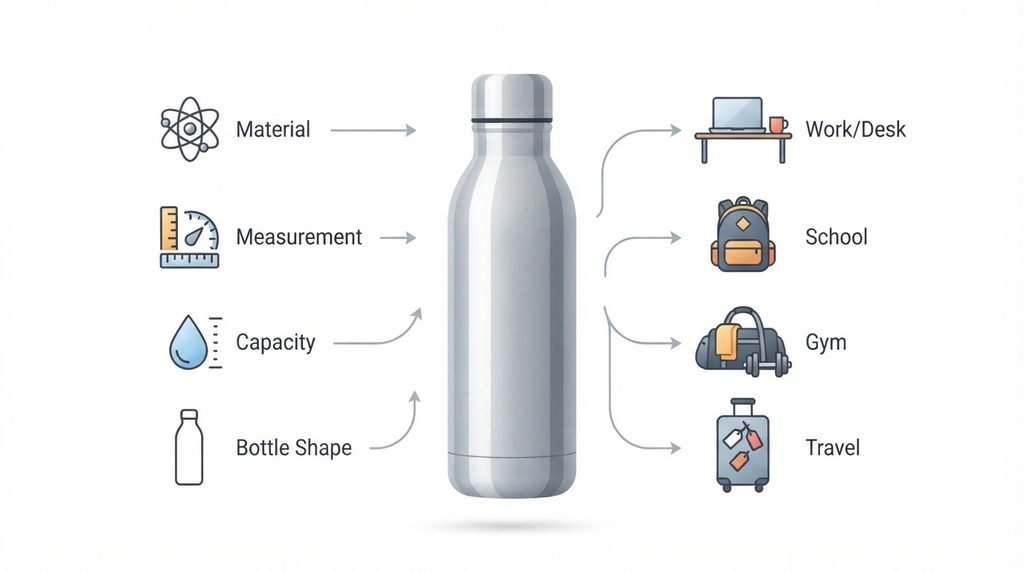
The goal is not just to list product information. A useful description connects the product’s features with the customer’s needs. For example, instead of only saying that a water bottle has a 750 ml capacity, the description can explain that this gives the user enough space for everyday use at work, school, or while traveling.
Product information can also be used by search engines to better understand product pages. Google provides specific guidance for using product information and structured data on ecommerce pages. Google Search Central: Product Structured Data
Product Description vs. Product Specifications
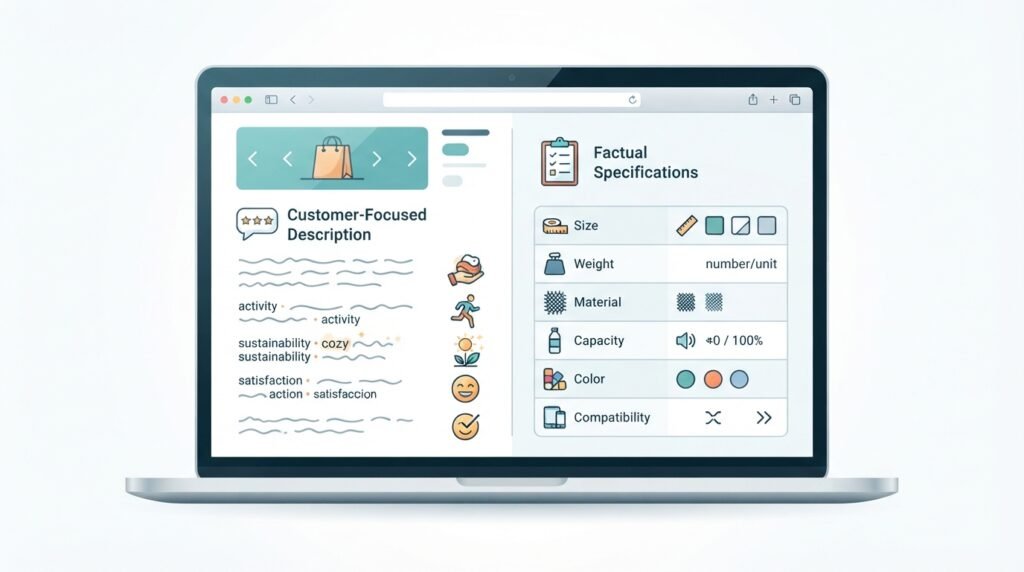
A product description explains the product in a more natural and customer-focused way. It can:
- Explain what the product is
- Highlight useful features
- Explain customer benefits
- Show how the product can be used
- Help shoppers understand if it is right for them
Product specifications are more factual and specific. They may include:
- Size
- Weight
- Material
- Dimensions
- Capacity
- Color
- Compatibility
- Package contents
Both are important, but they serve different purposes. The description helps the customer understand the product, while the specifications give them exact details they may need before buying.
Where Are Product Descriptions Used?
Product descriptions are commonly used on:
- Ecommerce websites
- Online marketplaces
- Product catalogs
- Product landing pages
- Individual product pages
Whether you are selling one product or managing a large online store, clear product descriptions make it easier for shoppers to understand what you are offering.
What Makes a Good Ecommerce Product Description?
A good ecommerce product description should be clear, useful, and easy to understand. It should give shoppers the information they need while also helping them understand why the product may be useful to them. The best descriptions are not just a list of product features. They connect those features to real customer needs.
A Clear, Specific Product Title
The product title should tell shoppers exactly what they are looking at. Include important details that help identify the product, such as the product type, material, size, model, or other important information.
For example, instead of writing:
“Amazing Premium Bottle”
a clearer title could be:
“750 ml Stainless Steel Water Bottle”
Avoid adding unnecessary adjectives just to make the title sound more exciting. You should also avoid repeating the same keyword many times. Shopify’s product description guidance recommends focusing on clear and useful product information rather than writing descriptions that simply try to sound impressive.
A Strong Opening
The first few lines should quickly explain what the product is and why it may be useful.
A strong opening can answer three simple questions:
- What is the product?
- Who is it for?
- What is it useful for?
This helps shoppers understand the product without reading a long paragraph first.
Features vs. Benefits
One of the most important parts of product writing is understanding the difference between a feature and a benefit.
A feature tells the customer what the product has.
A benefit explains why that feature may matter to the customer.
For example:
Feature: Stainless steel construction
Benefit: Provides a durable material for everyday use.
However, the benefit must be based on real product information. AI should not turn a simple feature into an unsupported claim such as “will last for many years” unless there is reliable information to support it.
Useful Product Specifications
Customers often need exact information before deciding whether a product is right for them. Depending on the product, useful specifications may include:
- Dimensions
- Weight
- Material
- Color
- Capacity
- Compatibility
- Package contents
Keep these details accurate and easy to scan. A customer looking for a specific size or compatible device should not have to search through a long paragraph to find the answer.
Customer and Use Case
A description becomes more useful when it explains who the product is for and how it can be used.
For example, a water bottle may be suitable for:
- Office workers
- Students
- Gym users
- Travelers
Instead of making broad claims, explain practical situations where the product can be useful. This helps shoppers decide whether it fits their needs.
Accuracy and Trust
Accuracy is one of the most important parts of product content. Never add information simply because it makes the product sound better.
Do not:
- Invent specifications
- Create fake guarantees
- Invent certifications
- Fabricate customer reviews
- Make unsupported comparisons
- Promise results that the product information does not support
If a detail is missing, it is better to leave it out or ask for the correct information. This is especially important when using AI because AI tools can sometimes produce information that was not included in the original product brief.
A strong product description should make the product easier to understand—not make the product sound better by using information that is not true.
How to Write Ecommerce Product Descriptions With AI
AI can make product writing much faster, but the result depends on the information and instructions you give it. If you only type, “Write a product description for this product,” the AI may create a description that sounds general or includes details that were never provided.
A better approach is to give the AI clear product information and use a step-by-step process.
The basic workflow looks like this:
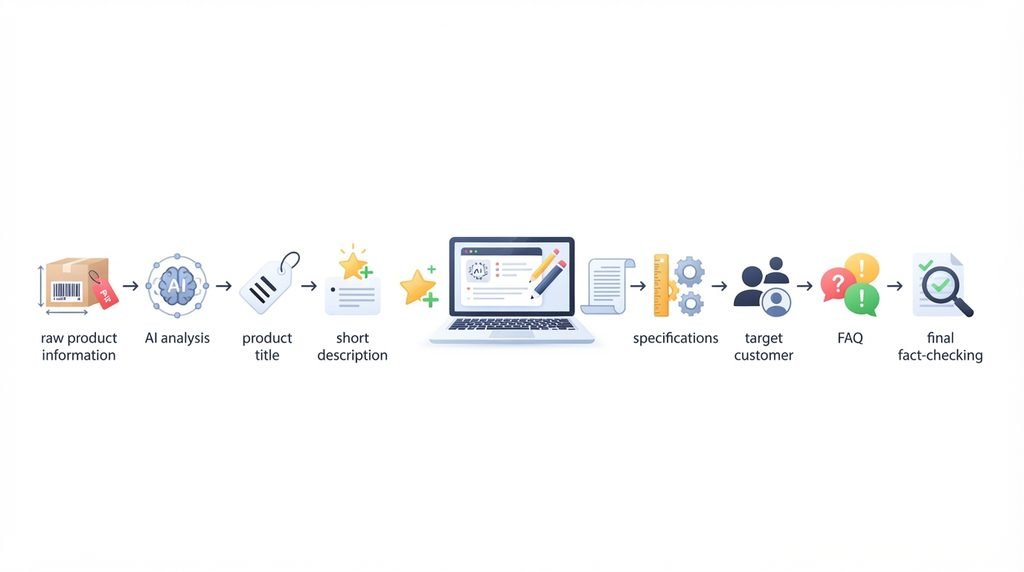
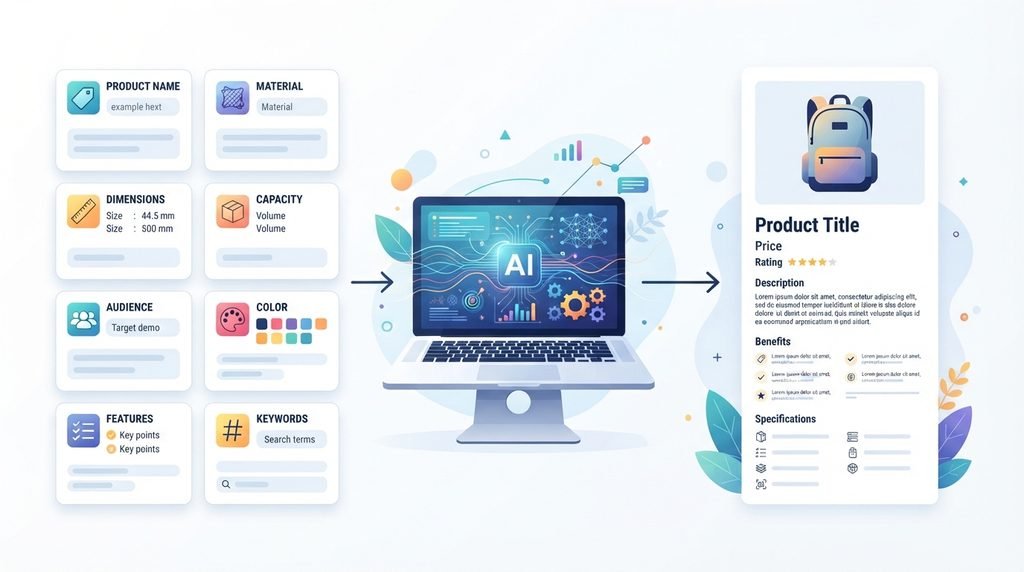
Product information → AI analysis → product title → short description → benefits → detailed description → specifications → target customer → optional pros and cons → FAQs → fact-check
You do not need to use every step for every product. For example, pros and cons may be useful for a buying guide but may not be needed on a simple product page.
Step 1: Give AI Complete Product Information
Before asking AI to write anything, give it as much useful product information as possible. The more accurate information you provide, the less the AI has to guess.
Your product brief can include:
- Product name
- Product category
- Main features
- Product specifications
- Material
- Dimensions
- Weight
- Colors or variants
- Included accessories
- Compatibility
- Price, when relevant
- Target customer
- Main use
- Brand voice
- Main SEO keyword
- Important restrictions or claims to avoid
For example, instead of giving AI only:
“Write a description for a stainless steel water bottle.”
give it a structured brief:
Product: Stainless Steel Water Bottle
Capacity: 750 ml
Material: Stainless steel
Color: Black
Audience: Students and office workers
Main use: Everyday drinking water
Keyword: 750 ml stainless steel water bottle
This gives the AI real information to work with.
Copy-Ready Prompt: Product Information Analysis
You are helping me prepare an ecommerce product description.

First, analyze the product information below.

PRODUCT INFORMATION:
[Paste all product information here]

Your tasks:

1. Organize the information clearly.
2. Separate confirmed facts from assumptions.
3. List the most useful product features.
4. Explain which features may be useful to the target customer.
5. Identify any important information that is missing.
6. Point out any information that is unclear or contradictory.
7. Do not invent specifications, features, benefits, certifications, guarantees, reviews, or other product details.

Do not write the final product description yet. First, give me the product information analysis.
This first step is important because it gives you a chance to catch missing information before AI starts writing the final copy.
Step 2: Create a Strong Product Title
The product title should make the product easy to identify. It should usually include the most important information a shopper needs.
For example:
Weak:
“Premium Amazing Water Bottle”
Better:
“750 ml Stainless Steel Water Bottle”
The second title tells the shopper what the product is and gives useful details immediately.
Keep the title clear instead of filling it with marketing words. You should also avoid repeating the same keyword again and again just to improve search visibility. Google recommends creating content for people rather than trying to manipulate search rankings through excessive keyword use. Google Search Central’s SEO guidance is a useful reference when reviewing your product-page content.
Copy-Ready Prompt: Ecommerce Product Title
Create 5 clear ecommerce product title options using only the product information I provide.

PRODUCT INFORMATION:
[Paste product information]

MAIN SEO KEYWORD:
[Insert keyword]

Rules:

- Make each title clear and specific.
- Include important product details when useful.
- Use the main keyword naturally.
- Do not keyword-stuff.
- Do not use unnecessary adjectives.
- Do not make unsupported claims.
- Do not add information that is not provided.
- Keep the titles easy for shoppers to understand.

After the titles, briefly explain which option is the clearest and why.
Step 3: Write the Short Product Description
A short description gives shoppers a quick understanding of the product.
It should normally communicate:
- What the product is
- Its main value
- How it can be used
- The most relevant customer benefit
Do not try to include every product detail in the opening. The goal is to give the shopper a useful summary before they decide whether to read more.
For example, a short description for a water bottle could explain that it is a 750 ml stainless steel bottle designed for everyday use at work, school, or while traveling—if those uses match the actual product information.
Copy-Ready Prompt: Short Product Description
Write a short ecommerce product description using only the information provided below.

PRODUCT INFORMATION:
[Paste product information]

TARGET CUSTOMER:
[Insert target customer]

MAIN KEYWORD:
[Insert keyword]

Requirements:

- Clearly explain what the product is.
- Mention its main value.
- Include the most useful customer benefit.
- Keep the writing simple and natural.
- Use the keyword naturally if it fits.
- Avoid exaggerated marketing language.
- Do not invent features, results, guarantees, or specifications.
- Do not repeat the same idea.
Step 4: Turn Product Features Into Customer Benefits
Features and benefits are related, but they are not the same.
A feature tells the customer what the product has.
A benefit explains why that feature may be useful.
For example:
Feature: Stainless steel body
Benefit: Provides a durable material for regular everyday use.
Another example:
Feature: 750 ml capacity
Benefit: Gives the user space for a useful amount of water during everyday activities.
The important rule is that the benefit must come from the actual product information. AI should not turn a simple feature into a promise that the product cannot support.
For example, if the product information only says that a bottle is stainless steel, AI should not automatically claim that it “will never break” or “will last for 10 years.”
Copy-Ready Prompt: Features Into Benefits
Turn the product features below into clear customer-focused benefits.

PRODUCT INFORMATION:
[Paste product information]

For each feature:

1. State the original feature.
2. Explain the practical benefit for the customer.
3. Keep the benefit directly connected to the supplied information.
4. Do not make unsupported claims.
5. Do not promise specific results unless they are provided.
6. Do not use exaggerated marketing language.

Format:

Feature:
Benefit:
Why it matters:
Step 5: Write the Detailed Product Description
Once the basic information is ready, AI can create the main product description.
A useful structure is:
- Opening value statement
- Main product features
- Customer benefits
- Practical use cases
- Important specifications
- Who the product is suitable for
The description should answer the questions a shopper is likely to have. It should also be easy to scan rather than being one large block of text.
Copy-Ready Prompt: Detailed Product Description
Write a detailed ecommerce product description using only the product information below.

PRODUCT INFORMATION:
[Paste product information]

TARGET CUSTOMER:
[Insert target customer]

MAIN USE:
[Insert main use]

BRAND VOICE:
[Friendly / Professional / Simple / Premium / Other]

SEO KEYWORD:
[Insert keyword]

Use this structure:

1. Short opening that explains what the product is and its main value.
2. Important product features.
3. Customer benefits based on those features.
4. Practical use cases.
5. Important product specifications.
6. Who the product is suitable for.

Writing rules:

- Use simple, natural English.
- Make the content easy to scan.
- Use short paragraphs and bullet points where useful.
- Keep the writing specific to this product.
- Use the SEO keyword naturally.
- Do not keyword-stuff.
- Do not invent facts.
- Do not create fake reviews.
- Do not create unsupported guarantees or performance claims.
- Do not claim the product is better than competitors unless evidence is provided.
Step 6: Organize Product Specifications
Product specifications are often scattered across supplier information, spreadsheets, product pages, or notes.
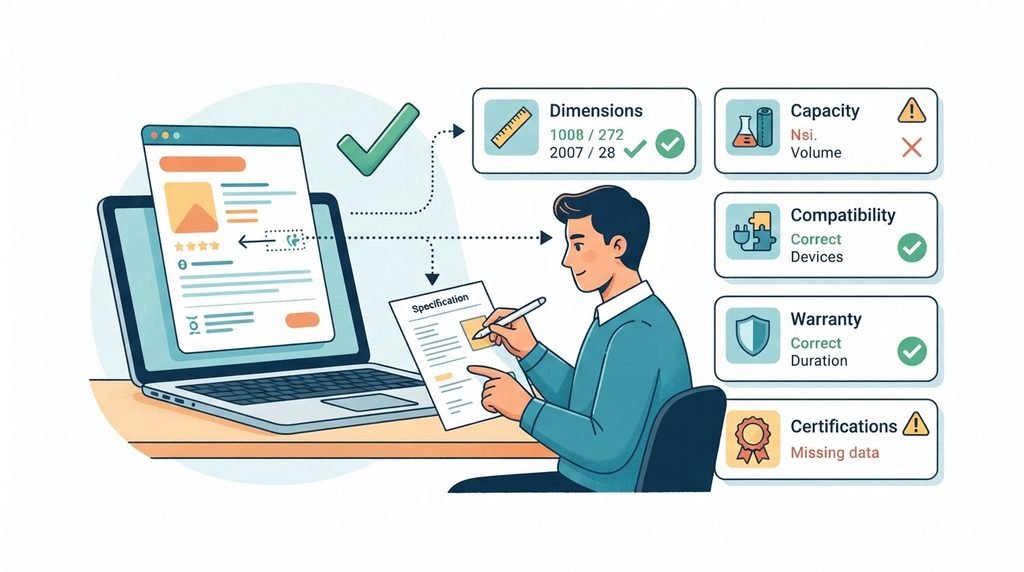
AI can help turn this information into a clean section that shoppers can scan quickly.
Depending on the product, specifications may include:
- Dimensions
- Weight
- Material
- Capacity
- Color
- Compatibility
- Package contents
- Warranty, if supplied
The important part is accuracy. AI should organize the information, not fill in missing details.
For example, if the product information does not provide the bottle’s weight, AI should not guess one based on similar bottles.
Copy-Ready Prompt: Product Specifications
Create a clear product specifications section from the information below.

PRODUCT INFORMATION:
[Paste product information]

Organize the information into a simple, easy-to-scan format.

Include only confirmed information such as:

- Dimensions
- Weight
- Material
- Capacity
- Color
- Compatibility
- Package contents
- Warranty

Rules:

- Use only the facts provided.
- Do not guess missing information.
- Do not change numbers or measurements.
- Do not create specifications based on similar products.
- If important information is missing, write “Not provided” instead of guessing.
Step 7: Explain Who the Product Is Best For
A product description can become more useful when it clearly explains who may find the product useful.
Depending on the product, this could include:
- Target customer
- Experience level
- Typical use situation
- Practical needs
- Appropriate use cases
For example, a beginner-friendly camera may be suitable for people who are learning photography, while a specialized tool may be designed for experienced users.
However, avoid making the audience too broad. Saying that a product is “perfect for everyone” usually gives the shopper very little useful information.
Copy-Ready Prompt: Best For / Target Customer
Based only on the product information below, explain who this product is best suited for.

PRODUCT INFORMATION:
[Paste product information]

Identify:

- Likely target customer
- Experience level, if relevant
- Common use situations
- Practical customer needs
- Appropriate use cases

Rules:

- Base every point on the supplied information.
- Do not say the product is suitable for everyone.
- Do not invent a target audience.
- Do not make medical, safety, performance, or other unsupported claims.
- Keep the explanation practical and easy to understand.
Step 8: Create Pros and Cons When Appropriate
Pros and cons can make some types of product content more useful, but they are not required for every ecommerce product description.
They may work well in:
- Product comparisons
- Buying guides
- Marketplace content
- Review-style content
For a simple product page, a normal description and specification section may be enough.
If you use pros and cons, make sure they come from real product information. AI should not invent a disadvantage just to make the review appear balanced.
Copy-Ready Prompt: Pros and Cons
Create a short list of practical pros and cons based only on the product information below.

PRODUCT INFORMATION:
[Paste product information]

Rules:

- Include only points supported by the product information.
- Do not invent disadvantages.
- Do not invent advantages.
- Do not make unsupported performance claims.
- Keep each point short and useful.
- If there is not enough information to identify a genuine pro or con, say so instead of guessing.

Format:

Pros:
-

Cons:
-
Step 9: Create FAQs From Real Product Questions
FAQs can help answer questions that customers may have before buying.
Useful questions may cover:
- Compatibility
- Size
- Usage
- Materials
- Care
- Included accessories
- Shipping or product-specific details, when reliable information is available
The questions should be based on real product information or common customer concerns. Do not add FAQs simply to make the product page longer.
Most importantly, AI should never invent an answer because it thinks an FAQ needs one.
Copy-Ready Prompt: Product FAQs
Create 5 useful FAQs for the product below.

PRODUCT INFORMATION:
[Paste product information]

Create questions that a real shopper may ask about:

- Size
- Compatibility
- Usage
- Material
- Care
- Included items
- Other important product details

Rules:

- Answer only from the supplied information.
- Do not invent answers.
- Do not invent shipping policies.
- Do not invent warranties.
- Do not invent product features.
- If the information needed to answer a question is missing, do not create that question.
- Keep each answer short and clear.
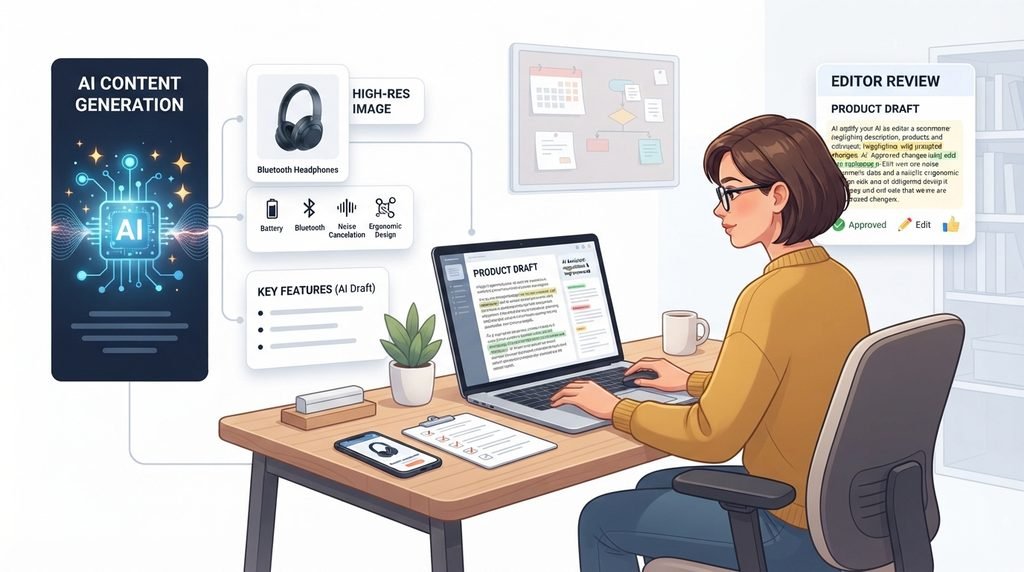
Step 10: Review and Fact-Check the AI Output
This is one of the most important steps when using AI for ecommerce content.
AI can produce writing that sounds confident even when a detail is wrong. That means you should compare the final description with the original product information before publishing it.
Check for:
- Incorrect features
- Invented materials
- Incorrect dimensions
- Fake certifications
- Unsupported warranties
- False guarantees
- Invented customer reviews
- Unsupported performance claims
- Incorrect compatibility
- Made-up comparisons
This review is especially important for product information because a small mistake can give customers the wrong idea about what they are buying.
Do not assume that a sentence is true simply because it sounds professional. Check it against your supplier information, product documentation, manufacturer’s information, or other reliable sources.
Copy-Ready Prompt: Product Description Fact-Check
Fact-check the AI-generated product description against the original product information.

ORIGINAL PRODUCT INFORMATION:
[Paste the confirmed product information]

GENERATED PRODUCT DESCRIPTION:
[Paste the AI-generated description]

Check every factual claim.

Look for:

- Incorrect features
- Invented materials
- Wrong dimensions
- Wrong measurements
- Incorrect capacity
- Incorrect compatibility
- Fake certifications
- Unsupported warranties
- False guarantees
- Invented reviews
- Unsupported performance claims
- Unsupported comparisons
- Information that was not included in the original product brief

For every problem, show:

1. The statement from the generated description.
2. Why it may be incorrect or unsupported.
3. The original information that should be used instead.
4. A corrected version of the statement.

If a statement is supported by the original information, mark it as “Supported.”

Do not rewrite the entire description unless I ask you to.
After this final check, review the corrected version yourself before publishing. AI can help with the writing process, but the product owner or content editor should remain responsible for making sure the final information is accurate.
The complete process is simple:
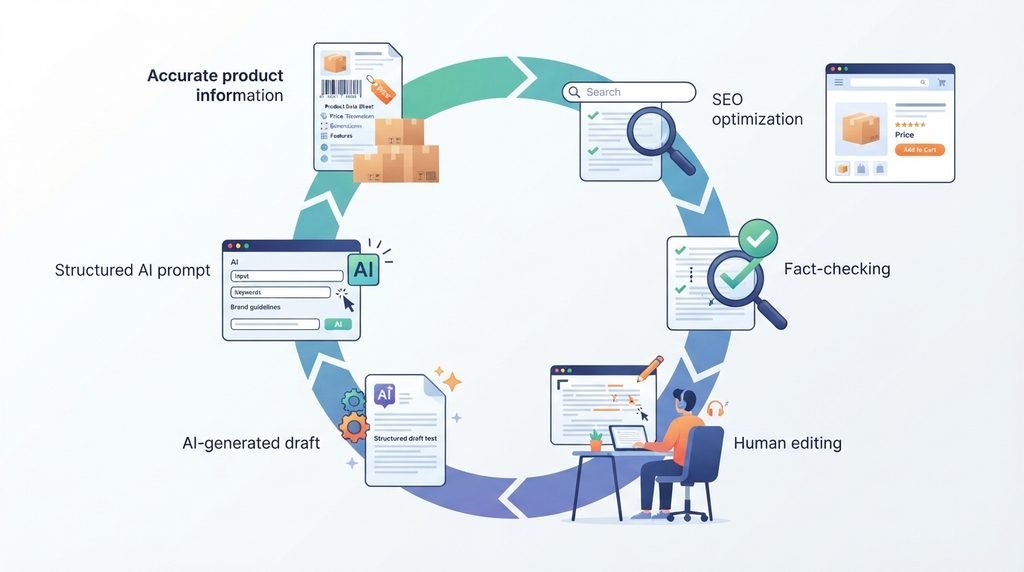
Give AI good information → give it clear instructions → generate the content → review the writing → fact-check every important claim → publish the final version.
How to Make AI Product Descriptions Sound Human
AI can create a product description in seconds, but fast does not always mean natural. Raw AI writing can sometimes sound repetitive, overly promotional, or too similar to descriptions written for other products.
For example, many AI-generated descriptions use phrases such as “revolutionary,” “game-changing,” or “take your experience to the next level.” These phrases may sound impressive, but they do not tell the customer much about the actual product.
A better approach is to make the description specific, useful, and connected to the real product.
Remove Generic Marketing Language
Avoid using strong marketing phrases when they do not add useful information.
Examples include:
- “Revolutionary”
- “Game-changing”
- “Unparalleled”
- “Perfect for everyone”
- “Take your experience to the next level”
These phrases are not automatically wrong, but they should only be used when they are genuinely appropriate and supported by real information.
Instead of:
“This revolutionary bottle will transform your daily hydration.”
write something more specific:
“This 750 ml stainless steel bottle is designed for everyday use at work, school, or while traveling.”
The second version gives the customer actual information instead of making a broad promise.
Use Specific Product Details
Specific details make a product description more useful and believable.
Instead of saying:
“This bottle has a convenient size.”
give the actual information:
“The bottle has a 750 ml capacity.”
If the product information includes the material, dimensions, weight, color, compatibility, or included accessories, use those details where they help the customer.
Specific information also helps prevent different product descriptions from sounding the same.
Focus on the Customer
A good description should not only talk about the product. It should also help the customer understand how the product fits their needs.
Think about:
- What problem does the product help with?
- Who may find it useful?
- Where might they use it?
- What information do they need before buying?
- What practical benefit does each important feature provide?
For example, instead of simply saying:
“The bag has three compartments.”
you could explain:
“The three compartments give you separate spaces for your laptop, accessories, and everyday items.”
This connects the feature to a practical use.
Match the Brand Voice
Your product descriptions should sound like they belong to your brand.
You might want a voice that is:
- Friendly
- Professional
- Minimal
- Premium
- Playful
For example, a premium brand may use a clean and simple style, while a children’s brand may use warmer and more playful language.
Give AI clear instructions about the voice before asking it to write.
Edit the AI Draft
The best approach is to treat AI as a writing assistant, not the final editor.
AI = first draft and writing assistance
Human review = accuracy, brand fit, and final quality
After AI creates the description, read it yourself. Remove repeated phrases, replace vague claims with specific details, correct anything inaccurate, and make sure the writing sounds right for your customers.
A few minutes of human editing can turn a generic AI draft into product content that feels much more specific and useful.

Complete AI Master Prompt for Ecommerce Product Descriptions
The steps above are useful when you want to control each part of the writing process separately. But if you want a faster workflow, you can combine those instructions into one all-in-one prompt.
You can give the AI your product information, paste the master prompt below, and ask it to create the complete product description. You can also change the brand voice, keyword, audience, or required sections for different products.
Copy-and-Paste Ecommerce Product Description Master Prompt
You are an experienced ecommerce copywriter. Write a clear, useful, accurate, and natural product description using only the information I provide.

PRODUCT INFORMATION:
Product name: [PRODUCT NAME]
Category: [CATEGORY]
Target audience: [TARGET AUDIENCE]
Main customer problem or use case: [PROBLEM / USE CASE]
Brand voice: [FRIENDLY / PROFESSIONAL / MINIMAL / PREMIUM / PLAYFUL]
Main SEO keyword: [PRIMARY KEYWORD]
Secondary keywords: [SECONDARY KEYWORDS]

PRODUCT FEATURES:
- [FEATURE 1]
- [FEATURE 2]
- [FEATURE 3]
- [FEATURE 4]

PRODUCT BENEFITS:
- [BENEFIT 1]
- [BENEFIT 2]
- [BENEFIT 3]

SPECIFICATIONS:
Material: [MATERIAL]
Size/dimensions: [SIZE]
Weight: [WEIGHT]
Capacity: [CAPACITY]
Color: [COLOR]
Compatibility: [COMPATIBILITY]
Included items: [PACKAGE CONTENTS]
Warranty: [WARRANTY, IF PROVIDED]

REQUIRED STRUCTURE:
1. Write a clear product title.
2. Write a short description of 2–3 sentences.
3. Explain the most useful product benefits.
4. Explain important features in customer-friendly language.
5. Include practical use cases.
6. Add important specifications in an easy-to-scan format.
7. Explain who the product is suitable for.
8. Add a short FAQ section if enough information is available.

WRITING REQUIREMENTS:
- Use simple, natural English.
- Write for real shoppers, not search engines.
- Keep sentences clear and easy to scan.
- Explain features through practical customer benefits.
- Use the primary keyword naturally.
- Use secondary keywords only when they fit naturally.
- Avoid unnecessary repetition.
- Do not use exaggerated marketing language.
- Do not make the product sound perfect for everyone.

ACCURACY RULES:
- Use only the information provided above.
- Do not invent specifications, features, materials, certifications, warranties, reviews, ratings, test results, or guarantees.
- Do not assume information that is missing.
- Do not make medical, safety, performance, or technical claims unless they are supported by the supplied information.
- Do not claim that this product is better, cheaper, stronger, or more durable than another product unless evidence is provided.
- If important information is missing, leave it out instead of guessing.

FINAL QUALITY CHECK:
Before giving me the final answer, check every factual claim against the product information. Remove unsupported claims, repeated phrases, keyword stuffing, and generic marketing statements.

Return the final product description in a clean, ready-to-edit format.
Sample Product Brief
Here is a simple example of how the prompt can be filled in:
Product: Stainless Steel Water Bottle
Audience: Office workers and students
Material: Stainless steel
Capacity: 750 ml
Color: Black
Use: Everyday hydration
Lid: Screw-top lid
Design: Simple cylindrical design
Primary keyword: 750 ml stainless steel water bottle
Brand voice: Friendly and practical
The important point is that the AI receives specific product information before writing. The more useful facts you provide, the less the AI needs to guess.
Example Output
750 ml Stainless Steel Water Bottle
Stay prepared for everyday hydration with this 750 ml stainless steel water bottle. Its simple design makes it suitable for use at work, school, or during everyday travel.
The stainless steel construction provides a practical material for regular use, while the 750 ml capacity gives you enough space for your everyday water needs. The screw-top lid helps keep the bottle closed when carrying it between places.
Key Features
- 750 ml capacity
- Stainless steel construction
- Black finish
- Screw-top lid
- Suitable for everyday use
Best For:
Office workers, students, and anyone looking for a simple bottle for regular daily use.
This example is intentionally short. In a real product listing, the final length should depend on the amount of useful information shoppers need.
Common AI Product Writing Mistakes
AI can make ecommerce product writing faster, but poor instructions can still produce weak or inaccurate descriptions. Avoid these common mistakes.
Giving AI Too Little Information
If you only enter a product name and ask AI to “write a product description,” the result will usually be generic. Give it useful details such as features, materials, size, audience, use case, and specifications. Better input gives the AI more useful information to work with.
Allowing AI to Invent Product Claims
AI may fill missing information with statements that sound reasonable but are not confirmed. It could invent a material, warranty, certification, feature, or performance benefit. Always compare important claims with your original product information before publishing.
Using the Same Description for Every Product
A template can save time, but copying the same wording across different products makes listings feel repetitive. Use templates for structure, while changing the details, benefits, examples, and wording for each product.
Keyword Stuffing
Adding the same keyword again and again can make a description difficult to read. Use keywords where they naturally fit and focus first on helping the shopper understand the product.
Publishing AI Output Without Reviewing It
AI-generated copy should not automatically become your final copy. Read the description yourself and check important facts, wording, tone, and customer relevance before publishing.
Making Unsupported Comparisons
Be careful with claims such as “better than competitors,” “the best,” “number one,” or “more durable than X.” These statements need reliable evidence. If you cannot support the comparison, leave it out.
With these mistakes avoided, AI becomes a writing assistant rather than a source of unverified product claims.
These two sections now fit the article flow without re-explaining the earlier 10-step workflow.
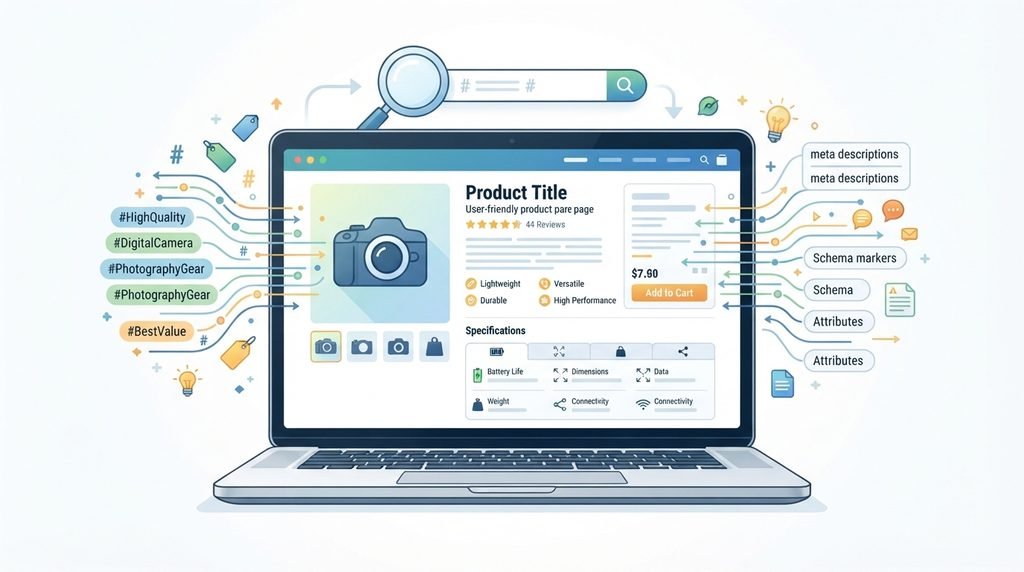
How to Optimize Ecommerce Product Descriptions for SEO
Writing a useful product description is the first priority. SEO optimization should then help search engines understand the product page without making the content difficult for shoppers to read.
Use the Main Product Keyword Naturally
Choose one main keyword that accurately describes the product and use it naturally in important places, such as the product title, opening description, and relevant body text. Do not repeat the keyword in every sentence. If it sounds forced when you read the description aloud, rewrite it.
For example, instead of repeating “750 ml stainless steel water bottle” several times, use related natural terms such as “stainless steel bottle,” “750 ml bottle,” or simply “water bottle” where appropriate.
Write Descriptive Product Titles
The product title should quickly tell shoppers what they are looking at. Include important identifying details when they genuinely help, such as product type, model, size, or material.
For example:
Weak: “Premium Bottle”
Better: “750 ml Stainless Steel Water Bottle”
A clear product title can also help search engines understand the subject of the page. Google recommends using descriptive information to help communicate what a page contains.
Include Relevant Product Terms
Use important product attributes naturally throughout the page, including:
- Product type
- Material
- Size
- Color
- Compatibility
- Model or version
- Important product attributes
- Relevant variations
Do not add an attribute simply because you want to target another keyword. Every term should accurately describe the product.
Make the Description Easy to Scan
Most shoppers do not read every word of a product page. Make important information easy to find with:
- Short paragraphs
- Bullet points
- Clear headings
- Product specifications
- Useful FAQs when appropriate
If your store has different sizes, colors, or other variants, make sure the information for each variant is accurate and clearly presented. Google also provides specific guidance for communicating product variants to Search.
Don’t Write for Search Engines Alone
The goal is not to create a description that contains as many keywords as possible. The goal is to help a potential customer understand the product and decide whether it fits their needs.
Google can use product information and structured data to better understand ecommerce pages, but structured data does not replace useful visible product information.
Keep Product Information Accurate
Never change factual information just to target a keyword. If the product is 750 ml, do not call it 1-liter simply because more people search for that phrase. Accurate product information protects customer trust and keeps your SEO work aligned with the actual product.
Frequently Asked Questions
Can AI write ecommerce product descriptions?
Yes. AI can create product descriptions from structured product information. It works best when you provide specific facts, the target audience, desired tone, and clear instructions. Always review the final copy before publishing.
What is the best AI prompt for product descriptions?
The best prompt is one that gives AI complete product information and clear rules. It should explain the product, audience, features, benefits, specifications, writing style, SEO keyword, and accuracy requirements.
How long should an ecommerce product description be?
There is no single ideal word count for every product. Write enough to answer the important questions a shopper may have without adding unnecessary text. Simple products may need less information, while technical or complex products may need more.
Can AI-generated product descriptions rank on Google?
AI-generated text is not automatically guaranteed to rank or perform well. What matters is whether the resulting page provides useful, relevant information and meets Google’s search guidelines. The description should be written for shoppers first, not simply generated to include keywords.
Should I edit AI-generated product descriptions?
Yes. Human review is important. Check product facts, specifications, claims, tone, grammar, and whether the description accurately represents the product before publishing it.
How do I make AI product descriptions sound human?
Give AI specific product details instead of vague instructions, choose a clear brand voice, avoid repetitive marketing phrases, and replace generic claims with real product information. Then edit the final draft so it matches the way your brand normally communicates.
Can AI write descriptions for hundreds of products?
Yes. AI can help create descriptions at scale, especially when you use a consistent prompt and structured product data. However, each description should still be checked for product-specific accuracy and unnecessary repetition before publication.
Final Takeaway
The most practical way to use AI for ecommerce product descriptions is to follow a simple process:
Good product information → structured prompt → AI draft → human editing → fact-checking → SEO optimization
AI can save a significant amount of writing time, but it should not replace product knowledge or human review. Give the AI complete and accurate information, tell it exactly what you need, and check every important claim before publishing.
The goal is not to make AI write more. The goal is to use AI to create clearer, more useful, accurate product descriptions faster.
OTHER ARTICLES
- Organic Search Optimization vs. Pay-Per-Click
- How to Create Better Digital Product Guides Using AI Prompts
- What Is SEO? A Complete Beginner’s Guide
- What Is Digital Marketing? A Complete Beginner’s Guide 2026
- What Is AEO (Answer Engine Optimization)?
- Write Ecommerce Product Descriptions with AI
- What Is GEO (Generative Engine Optimization)?