
Most people think starting an AI Automation Agency requires coding, technical skills, or a computer science degree.
That belief is completely outdated.
In 2026, businesses are losing thousands of dollars every month simply because they are not using automation systems—missed calls, slow replies, manual follow-ups, and outdated workflows.
The truth is simple: if you can understand basic tools and solve business problems, you can build a profitable AI automation agency from scratch—even with zero experience.
Starting a service-based business sounds deeply technical, especially when it involves artificial intelligence. However, the reality of the digital economy is surprisingly simple: you do not need to be a developer, a programmer, or a computer science expert to run a highly successful AI Automation Agency (AAA).
In fact, modern AI software has advanced so rapidly that the technical barriers to entry have completely vanished. Your primary role as an agency owner is not to write code or train complex algorithms from scratch. Instead, your job is to find real business problems, connect user-friendly software tools, and deliver clear, time-saving workflows to clients who are eager to pay for them.
This ultimate, step-by-step beginner guide will show you exactly how to build a profitable agency business model from scratch. Whether you want to escape your current job, launch an online business, or capitalize on the massive demand for digital transformation, this blueprint covers every stage of the journey.
What Exactly Is an AI Automation Agency?

An AI Automation Agency (AAA) is a modern, service-based business that helps other companies save time, cut operating costs, and increase their daily revenue by setting up smart, automated software workflows.
Every single day, business owners lose hours to manual, repetitive tasks. They spend their afternoons answering the same customer questions, typing out repetitive follow-up emails, copy-pasting customer details into databases, and trying to keep up with social media updates.
An AAA solves this exact problem. By introducing automated systems, you handle these time-consuming processes without requiring the business owner to lift a finger.
READ MORE
Core Automation Services to Offer:
- AI Chatbots for Customer Support: Smart assistants installed directly on a company’s website to answer customer questions instantly, 24/7.
- Automated Email Marketing Sequences: Workflows that automatically send personalized follow-ups to new leads or past customers based on their actions.
- Content Generation Systems: Automated setups that generate structured blog posts, marketing copies, or social media captions in bulk.
- Lead Capture and CRM Automation: Systems that instantly save new customer information into a Customer Relationship Management (CRM) platform the moment a form is submitted.
- Social Media Management Systems: Workflows that handle the scheduling, distribution, and basic tracking of social content across multiple platforms simultaneously.
- AI-Powered Data Processing: Tools that read, sort, and organize messy business data, receipts, or customer feedback sheets without human error.
The Golden Rule: You are not selling confusing code or raw technology. You are simply selling time-saving systems that allow businesses to run smoothly on autopilot.
Why the AAA Business Model Is Exploding

The corporate landscape is shifting rapidly. Small businesses and enterprise companies alike are rushing to adopt artificial intelligence. However, a massive gap exists between the creators of AI tools and the everyday business owners who need them. This gap represents a highly profitable opportunity for a brand-new agency owner.
The Three Biggest Problems Business Owners Face:
- They Don’t Know Which Tools to Use: There are thousands of new applications entering the market every month. The average local plumber, real estate agent, or e-commerce store owner feels completely overwhelmed by the choices.
- They Lack the Time to Learn: Running a physical or digital storefront demands full attention. A business owner cannot afford to spend 40 hours learning how to connect APIs or configure software workflows.
- They Want Immediate Results, Not Technical Projects: Business owners do not care about the underlying technology; they care about the business outcome. They want fewer missed calls, faster responses, and clearer tracking.
Because of this, you do not need to build custom software. You simply act as a knowledgeable guide who connects existing, powerful platforms—such as ChatGPT, Make, Zapier, and white-label CRM systems—and packages them into a clean, easy-to-understand monthly service.
Step 1: Choose One Simple Service to Sell First

The absolute biggest mistake a beginner can make is trying to offer every single automation service at the same time. When you tell a prospective client that you can automate their entire company, they will likely get confused, feel overwhelmed, and decline your offer.
Instead, achieve rapid business growth by focusing on one highly specific, high-value service. Once that initial service delivers clear results, you can easily offer additional workflows later.
Option A: The “Missed Call Text Back” System (Highly Recommended)
Statistics show that roughly 62% of incoming phone calls to small local businesses go completely unanswered. Local service providers—like plumbers, electricians, roofing contractors, and massage therapists—are usually hands-on with their work. When they are fixing a pipe or treating a client, they cannot answer the phone.
If a homeowner has a leaking toilet and the first plumber doesn’t answer, they don’t leave a voicemail. They immediately hang up and call the next competitor on Google. This means the business owner is losing thousands of dollars every single week simply by being busy.
[Customer Calls Business]
       │
       ▼
 [No Answer / Busy]
       │
       ▼
[System Automatically Triggers Instant Text]
"Hi, this is Expert Plumbing! So sorry we missed your call. How can we help you today?"
This simple solution takes less than five minutes to set up using modern CRM software, requires absolutely no coding, and provides an immediate return on investment for the client.

Option B: Website AI Chatbot Setup
Many businesses lose out on potential customers because their websites are completely passive. If a visitor lands on a website at 10:00 PM and has a quick question about pricing or operating hours, they want an answer right away. By using simple no-code bot platforms, you can build a helpful assistant that reads the client’s existing website pages, memorizes their data, and accurately texts back answers to visitors within seconds.
Option C: Lead Generation Follow-Up Automation
When a prospective customer fills out a contact form on a website, every minute they wait for a response reduces the chance of closing the deal. You can build a three-step workflow:
- A user submits a form.
- The system instantly sends their details to a Google Sheet or CRM database.
- An automated, highly professional text message or email is immediately sent to the lead to schedule a discovery call.
Step 2: Learn No-Code Software Tools (No Coding Required)
You do not need to spend months learning complex coding languages like Python or JavaScript to build a highly profitable agency. The modern automation ecosystem runs entirely on no-code and low-code visual interfaces. If you can navigate a regular web browser, click buttons, and drag elements across a screen, you have all the technical aptitude required to succeed.
To run an agency smoothly, focus on mastering just a handful of foundational tools:

┌────────────────────────────────────────────────────────┐
│               THE NO-CODE AI STACK                     │
├───────────────┬────────────────────────────────────────┤
│ Tool Category │ Core Business Purpose                  │
├───────────────┼────────────────────────────────────────┤
│ ChatGPT /     │ Text generation, customer support scripts,│
│ Claude        │ drafting emails, sorting unstructured text.│
├───────────────┼────────────────────────────────────────┤
│ Zapier /      │ The "glue" that connects apps. Moves data│
│ Make          │ between forms, sheets, and messengers. │
├───────────────┼────────────────────────────────────────┤
│ White-Label   │ All-in-one software for missed-call    │
│ CRM Platform  │ automation, text messaging, and reviews.│
├───────────────┼────────────────────────────────────────┤
│ Google Sheets │ Basic, secure database for organizing  │
│ / Notion      │ client leads and tracking work history.│
└───────────────┴────────────────────────────────────────┘
Understanding the Logic: “Input → Automation → Output”
Every automation system in the world, no matter how complex it looks from the outside, follows a simple three-step chain of events:
- The Trigger (Input): An event that starts the entire process. (Example: A new customer fills out a quote form on a website.)
- The Action (Automation): The behind-the-scenes movement of data. (Example: The automation tool sends the name and phone number to a database, then passes it to an AI language model to generate a custom greeting.)
- The Result (Output): The final completed action. (Example: The system automatically sends a friendly text message directly to the customer’s phone within 60 seconds.)
By viewing business problems through this simple framework, you can build incredibly valuable systems for local companies without ever looking at a single line of computer programming code.
Step 3: Select a Specific Niche to Target

When you try to speak to every single business type on Earth, your marketing messages become diluted and uninspiring. Saying “I build AI systems for companies” is vague and rarely grabs anyone’s attention.
However, saying “I help independent real estate agencies automate their property follow-ups so they never lose a home buyer” makes you look like a specialized expert. Choosing a target industry allows you to charge premium prices, speak confidently about specific problems, and rapidly copy-paste your successful workflows from one client to the next.
Top Five Beginner-Friendly Niches:
- Local Service Contractors (Plumbers, Roofers, HVAC Experts): They miss an enormous volume of live phone calls while working on-site, making them perfect targets for immediate missed-call automation.
- Real Estate Agents and Brokers: They juggle dozens of inbound property inquiries daily and need instant systems to pre-qualify buyers before setting up face-to-face property viewings.
- Boutique Gyms, Yoga Studios, and Wellness Salons: They rely heavily on constant class bookings, customer appointment reminders, and immediate answers regarding schedules or pricing.
- Independent E-Commerce Stores: They deal with repetitive customer inquiries regarding package tracking numbers, return policies, and basic product details.
- Independent Consultants and Coaches: They need automated funnels to capture leads, distribute informational PDFs, and book discovery sessions directly onto their digital calendars.
Step 4: Turn Your Service into an Irresistible, Outcome-Focused Offer
Most technical freelancers make the mistake of selling the process instead of the result. They use confusing industry jargon, listing terms like “API integrations,” “webhooks,” “LLM fine-tuning,” and “vector databases.” The typical small business owner does not understand these terms and will quickly lose interest.

To close deals easily, frame your business model around measurable financial results and hours saved.
   POOR, TECHNICAL PITCH               IRRESISTIBLE, OUTCOME PITCH
┌─────────────────────────┐           ┌───────────────────────────────┐
│ "I will configure a     │           │ "I set up an automated system │
│ web-hook via Zapier     │     vs    │ that instantly texts back     │
│ to integrate an openAI  │           │ missed calls, saving you 10+  │
│ API with your CRM."     │           │ hours of manual work a week." │
└─────────────────────────┘           └───────────────────────────────┘
The ROI Calculation Pitch (The “No-Brainer” Strategy)
The easiest way to sell a monthly service is to use a direct Return on Investment (ROI) calculation with the business owner. Sit down with them—or send a brief personalized video walk-through—and ask three simple questions using their own business numbers:
- What is the average lifetime financial value of a single customer to your business? Let’s assume they say $500.
- Realistically, how many phone calls or website inquiries do you miss each week because you are busy working? Let’s assume they conservatively estimate just 3 calls per day (about 20 calls a week).
- If you actually spoke to those missed opportunities immediately, what is your typical sales closing rate? Let’s say it is 35%.
Now, run those exact figures through a basic calculation:
$$\text{20 missed calls} \times 35\% \text{ closing rate} = \text{7 lost customers per week}$$
$$\text{7 customers} \times \$500 \text{ value} = \$3,500 \text{ lost revenue per week}$$
$$\$3,500 \times \text{4 weeks} = \$14,000 \text{ left on the table every month}$$
When you present this data clearly, showing them that they are losing thousands of dollars every single month, offering to completely fix the problem for a flat fee of $297 or $497 per month becomes an absolute no-brainer decision for the owner.
📈 Real-World Example: How a Local Plumbing Business Could Gain $8,000+ Monthly

To understand the real power of AI automation, let’s look at a simple example.
A local plumbing business receives around:
- 20–30 calls per day
- But nearly 40% of them go unanswered due to busy schedules
Before automation:
- Missed calls = lost customers
- No follow-up system
- No lead tracking
After implementing AI automation systems:
🔹 Missed Call Text Back System
Every missed call instantly receives a reply:
“Hi, sorry we missed your call! How can we help you today?”
🔹 AI Lead Follow-Up
All inquiries are automatically stored in CRM and followed up within seconds.
🔹 Result:
- 7–10 additional customers per week recovered
- Average customer value: $400–$600
- Monthly recovery: $6,000–$10,000+
👉 This is not theory — it is how small businesses are already using automation to increase revenue without increasing workload.
Step 5: Build a Basic Demo Portfolio (Even If You Have Zero Past Clients)
The most common hurdle for beginners is answering the classic client question: “Can you show me examples of your past work?” If you are just starting out, you don’t need to lie or feel discouraged. You can easily build a powerful, high-converting portfolio by creating simple Demo Projects (Mock Automations).
Before reaching out to any business, open up your software tools and build three basic setups designed for hypothetical companies.
1. The Mock Restaurant Customer Bot
Build a simple website chatbot trained on a fictional Italian restaurant’s menu, hours, and reservation rules. Take a free screen-recording video of yourself typing questions into the bot—such as “Are you open on Sundays?” or “Do you have gluten-free options?”—and show how perfectly and instantly the AI replies.

2. The Real Estate Lead-Capture Flow
Set up a simple three-step automation sequence where a fake user submits a form for a house listing, showing how their data instantly flows into a clean spreadsheet, followed by a screenshot of an automated welcome text message arriving on a smartphone.
3. The Local Contractor Missed-Call Simulator
Record a quick video showing your phone dialing a test number, the call going unanswered, and an immediate text message hitting the phone two seconds later saying: “Hi there! Sorry we missed your call. How can we help you out?”
Organize these video walkthroughs, simple case studies, and screenshots inside a clean, free layout using Notion or a basic Canva website template. When a prospective client asks for proof of your skills, send over this professional link to demonstrate exactly what you can build for their company.
Step 6: Proven Outreach Strategies to Land Your First Paying Client
You do not need to spend money on expensive digital advertisements to secure your first few agency clients. Instead, rely on direct, highly personalized outreach methods that cost absolutely nothing but consistent daily effort.

┌────────────────────────────────────────────────────────┐
│               AGENCY OUTREACH BLUEPRINT                │
├──────────────────┬─────────────────────────────────────┤
│ Strategy         │ Action Plan                         │
├──────────────────┼─────────────────────────────────────┤
│ Local Google Maps│ Search local services, identify     │
│ Audit            │ missing text-backs, call/email them.│
├──────────────────┼─────────────────────────────────────┤
│ Personalized     │ Record a 60-second video showing    │
│ Video Loom       │ their website's optimization gaps.  │
├──────────────────┼─────────────────────────────────────┤
│ Freelance        │ Apply to specific, small automation │
│ Marketplaces     │ tasks on Upwork or Fiverr to start. │
└──────────────────┴─────────────────────────────────────┘
Strategy 1: The Local Google Maps Audit
Open Google Maps and search for a specific service industry within a major city (e.g., “Roofers in Austin, TX” or “Day Spas in Miami, FL”). Scroll down past the first page of results to find businesses ranked in positions 10 through 30.
These business owners are often actively trying to grow but lack modern systems. Call their business lines directly during peak hours. If they fail to answer the phone, wait a few minutes, then call back or send an email stating:
“Hi [Owner Name], I tried calling your business to check your availability, but it rang out. I noticed you don’t have an automated missed-call text system set up on your line. I just ran the numbers for your industry, and you could be losing thousands of dollars a month to competitors who answer faster. I built a simple system that fixes this instantly. Can I send over a quick 90-second video showing you how it works?”
Strategy 2: The Personalized Video Outreach (Loom Strategy)
Instead of sending generic, spammy sales emails to hundreds of companies, select 5 high-quality businesses per day. Use a free screen-recording tool like Loom to record their current website.
Show them exactly where their customer experience is falling short—such as lacking a live chat widget or having slow contact forms. In the video, pull up your demo portfolio to show them the exact solution you can install for them in less than 48 hours. Send the short video link over via email or LinkedIn messages. This high level of personalization stands out instantly.
Strategy 3: Freelance Platform Optimization
Create clean, dedicated service listings on platforms like Upwork and Fiverr. Instead of creating a broad profile called “AI Expert,” make highly specialized gig titles such as:
- “I will set up a customer support AI chatbot for your Shopify storefront.”
- “I will configure your Zapier workflows to connect web forms to your CRM database.”
These specific listings match exactly what desperate business owners are searching for when they need immediate technical help.
Step 7: How to Deliver the Automation Service Professionally
Once a client says “Yes, let’s do it!” and submits their initial payment, your onboarding and setup process should be smooth, systematic, and stress-free. Let’s break down the exact execution steps using the highly profitable Missed Call Text Back and Website AI Chatbot combination as our core example.
Part 1: Quick Technical Implementation
- Connect Client Accounts: Have your new client securely log into their Google Business Profile and connect their core customer management channels directly to your automation software platform.
- Activate the Missed-Call Workflow: Navigate to the core settings menu of your white-label software template, scroll down to the automation toggles, and enable the missed-call text response feature.
- Draft a Tailored Response Script: Customize the immediate outbound text to perfectly match the company’s voice. Keep it concise, friendly, and open-ended to encourage an immediate reply:“Hi there, this is the team at [Business Name]! 🛠️ We saw that we just missed your call because we are currently helping a customer on-site. What project or service can we help you out with today?”
[Inbound Client Response] -> "I need a quote for a broken pipe."
                                      │
                                      ▼
                      [Conversation AI Bot Triggers]
                                      │
                                      ▼
                      [Scans Website Knowledge Base]
                                      │
                                      ▼
[Automated Assistant Reply] -> "We handle emergency pipe repairs in Utah! Would you like to book an open slot tomorrow at 10 AM or 2 PM?"

Part 2: Training the Conversation AI Model
To make the system fully autonomous so you and the business owner don’t have to manually monitor responses, navigate directly to your software’s AI settings panel:
- Set to Autopilot Mode: Toggle the conversation settings from manual review to complete autopilot across your client’s core channels (SMS, website chat widgets, Facebook Messenger, and Instagram DMs).
- Scrape the Data Source: Simply copy the client’s public website URL, paste it into the bot’s text training field, and click “Get Data.” The AI system will instantly scan every sub-page, reading their service listings, operating hours, service locations, and pricing rules within a few seconds.
- Input Specific FAQ Workarounds: Every business handles the same five or six basic customer questions every day. Manually add these clear Q&A pairs directly into the software to train the bot exactly how to behave. For example:
- Question: “Do you provide free estimates?”
- Answer: “Yes, we provide 100% free structural estimates across the local tri-state region.”
- Rigorous System Testing: Before publishing the system live, open up the software’s interactive testing simulator. Type out common customer phrases like “What services do you offer?” or “Can you fix a commercial boiler?” Check the speed and tone of the AI response. If it makes an error, simply adjust the training data and click save to perfect the system.
Step 8: Scale Your Agency into a Long-Term Business
Once you successfully secure your first 2 to 5 paying clients, you no longer have a simple side hustle—you have a legitimate, scalable agency business. To grow your monthly income without working more hours, you must shift your focus toward smart scaling strategies.
1. Pivot from One-Time Projects to Monthly Recurring Revenue (MRR)
Never sell your automation setups as just a single, one-time creation fee. If you charge a one-time fee of $500 to build a chatbot, you have to constantly hunt for new customers every single month just to stay profitable.
Instead, charge a accessible setup fee (e.g., $297) paired with an ongoing monthly service and maintenance package (e.g., $197 to $497 per month). Explain to the business owner that this monthly fee covers secure software hosting, continuous AI adjustments, performance optimization, and regular text messaging data fees.
┌────────────────────────────────────────────────────────┐
│               AGENCY INCOME SCALING MODEL              │
├──────────────────┬─────────────────────────────────────┤
│ Milestone        │ Business Strategy                   │
├──────────────────┼─────────────────────────────────────┤
│ 1-5 Clients      │ Focus heavily on manual outreach    │
│                  │ and perfect service delivery.       │
├──────────────────┼─────────────────────────────────────┤
│ 5-10 Clients     │ Increase prices, introduce upsells  │
│                  │ (like full email sequences).        │
├──────────────────┼─────────────────────────────────────┤
│ 10+ Clients      │ Outsource basic setups to virtual   │
│                  │ assistants; focus on macro growth.  │
└──────────────────┴─────────────────────────────────────┘

2. Introduce Advanced System Upsells
Once a client sees that your missed-call text system actively brings in new revenue every week, they will trust you implicitly. You can then schedule a quick review session and offer to implement higher-level automations, such as:
- Automated review generation systems to boost their rankings on Google.
- Full email marketing and newsletter distribution flows.
- Complete automated pipeline tracking systems to monitor their entire sales floor.
3. Outsource Repetitive Technical Tasks
When you reach a point where managing client data setups takes up too much of your time, hire a budget-friendly remote virtual assistant (VA) through platforms like Upwork or OnlineJobs.ph. Spend a few hours recording training videos showing them exactly how to connect the software accounts and test the bots. This completely frees you up to focus entirely on bringing in new clients and scaling the brand.
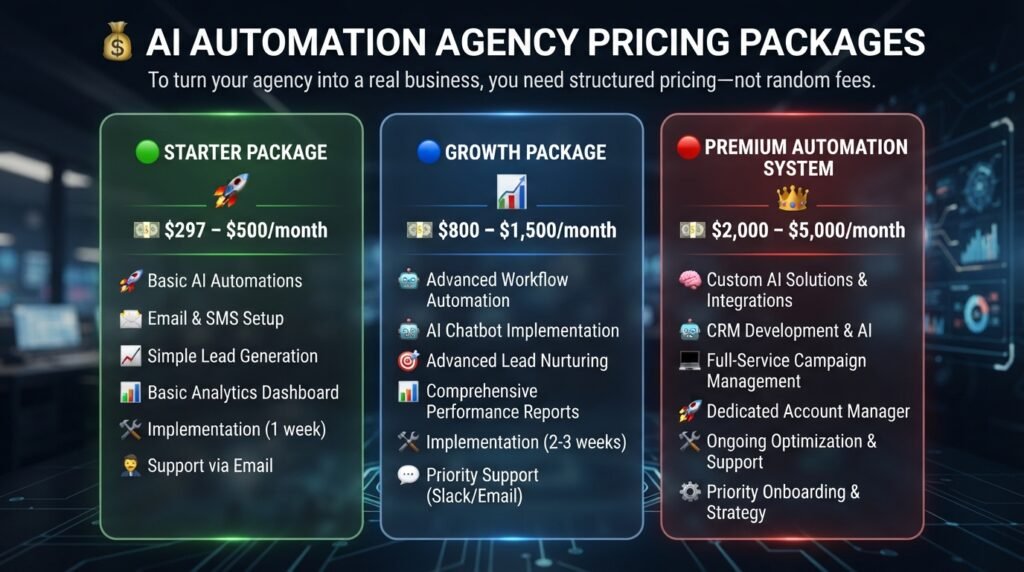
💰 AI Automation Agency Pricing Packages (Realistic Model)
To turn your agency into a real business, you need structured pricing—not random fees.
🟢 Starter Package ($297–$500/month)
- One automation system (missed calls OR chatbot)
- Basic setup + integration
- Email or SMS automation
- 7-day support
🔵 Growth Package ($800–$1,500/month)
- 2–3 automation systems
- CRM integration
- Lead follow-up system
- Monthly optimization
- Priority support
🔴 Premium Automation System ($2,000–$5,000/month)
- Full business automation suite
- AI chatbot + CRM + email + SMS workflows
- Advanced reporting dashboard
- Ongoing optimization + scaling support
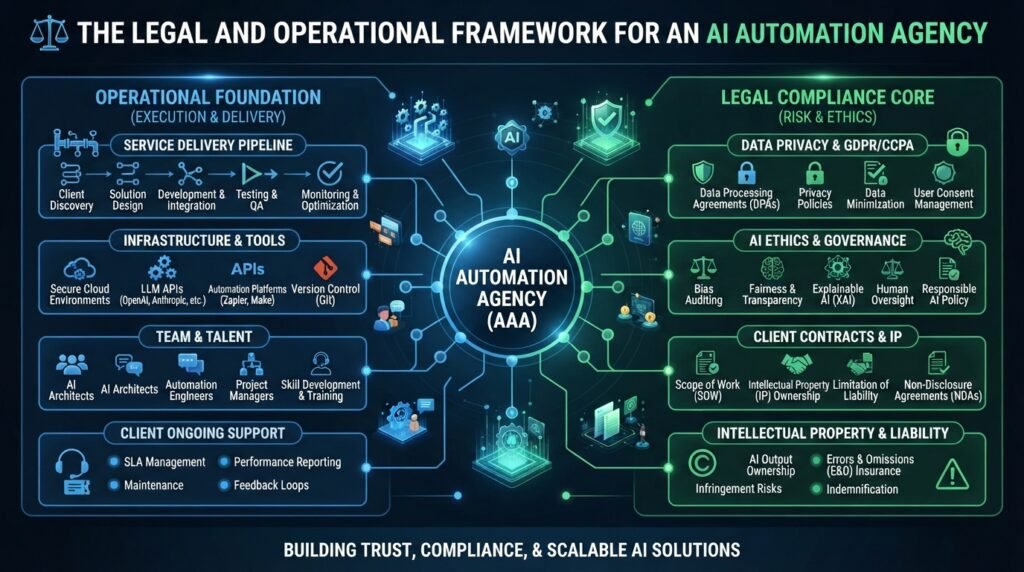
⚖️ The Legal and Operational Framework for an AI Automation Agency
Once your AI automation agency starts getting clients, the real business shift happens: you move from “freelancer setup mode” into a proper service-based company structure.
This is where most beginners fail—not because of AI tools, but because of weak legal and operational foundations.
🔹 1. Client Contracts (Non-Negotiable)
Every client relationship should start with a written agreement that clearly defines:
- Scope of work (exact automation systems you will build)
- Payment terms (one-time or monthly)
- Revision limits
- Delivery timelines
- Ownership of workflows and assets
- Termination conditions
👉 Without a contract, you risk scope creep, unpaid work, and disputes.
🔹 2. Service Level Agreements (SLAs)
An SLA defines what level of performance and reliability you guarantee.
For AI automation agencies, SLAs often include:
- Response time for client support (e.g., 24–48 hours)
- System uptime expectations (for bots or workflows)
- Maintenance frequency
- Error correction timelines
This builds trust and positions your agency as a professional operation, not a freelancer gig.
🔹 3. Secure Software Access Management
AI automation often requires access to sensitive business tools like:
- CRMs
- Email platforms
- Website dashboards
- Customer databases
To stay safe and professional:
- Use password managers (like shared vaults)
- Avoid direct password sharing
- Create role-based access when possible
- Revoke access after project completion
👉 This protects both your client and your agency from security risks.
🔹 4. Agency Structure (Solo vs Team)
You can start solo, but structure matters as you grow:
- Solo founder (early stage)
- Micro-agency (1–3 contractors)
- Full agency (specialized roles: automation, sales, support)
Clear structure helps you scale without breaking systems.
🧠 Advanced Conversation AI & Prompt Engineering for Business Bots
One of the most powerful services in an AI automation agency is building customer-facing AI chat systems.
But most beginners make a critical mistake: they treat AI like a normal chatbot instead of a controlled business assistant.
🔹 1. System Prompt Design (Core Intelligence Layer)
A system prompt defines how your AI behaves.
For business bots, it must include:
- Brand personality (professional, friendly, formal, etc.)
- Scope limitations (what it can and cannot answer)
- Response style rules
- Escalation rules (when to pass to human)
Example structure:
“You are a customer support assistant for a real estate company. You must never guess pricing. If unsure, ask for clarification or escalate to support.”
🔹 2. Preventing Hallucinations (Critical for Business Use)
AI hallucinations happen when the model invents incorrect information.
To prevent this:
- Restrict responses to verified knowledge base only
- Use retrieval-based systems (RAG architecture)
- Force “I don’t know” responses when data is missing
- Never allow the model to generate pricing unless explicitly provided
👉 This is what separates hobby bots from enterprise-grade AI systems.
🔹 3. Memory Constraints & Context Control
Business AI systems must NOT remember everything.
You should define:
- What data is temporary (chat session only)
- What data can be stored (lead info, preferences)
- What must never be stored (payment details, sensitive data)
Proper memory control ensures compliance and trust.
🔹 4. Multi-Intent Handling (Real-World Chat Behavior)
Advanced bots must detect:
- Support requests
- Sales inquiries
- Complaint handling
- Lead qualification
Then route them correctly instead of giving generic replies.

🧩 White-Label CRM & Automation Stack Comparison Guide
As your AI automation agency grows, you will eventually need to scale beyond manual setups.
That’s where white-label CRM systems become powerful.
A white-label CRM allows you to:
- Rebrand software under your own agency name
- Sell automation as your own product
- Control pricing and subscriptions
- Build recurring revenue
🔹 1. What Makes a Good White-Label CRM?
A strong platform should include:
- Automation workflows
- Email/SMS marketing
- Lead management
- Pipeline tracking
- API integrations
- Custom branding (logo, domain, UI)
🔹 2. Types of Platforms You Can Use
There are typically three categories:
🟢 All-in-One CRM Platforms
Best for agencies that want everything in one place:
- Sales funnels
- Email marketing
- Automation
🟡 Automation-Focused Platforms
Best for backend workflows:
- API integrations
- AI task execution
- Workflow automation
🔵 Hybrid AI CRMs (Future Trend)
New generation platforms combining:
- AI chatbots
- CRM pipelines
- Predictive analytics
- Smart automation triggers
🔹 3. Why White-Label Systems Matter
Instead of charging only for setup services, you can:
- Charge monthly subscription fees
- Sell packaged automation systems
- Offer SaaS-like services under your brand
👉 This shifts your agency from “service income” to recurring revenue business model.
🔹 4. Long-Term Agency Scaling Strategy
Once you use white-label systems, your agency evolves into:
- Productized services business
- Subscription-based model
- Semi-SaaS company structure
This is how advanced agencies scale to 6–7 figures annually.

Common Mistakes Beginners Must Avoid
To save yourself months of unnecessary frustration and protect your business reputation, keep these essential rules in mind:
- Stop Trying to Learn Everything Before Launching: You do not need a perfect understanding of every automation framework on earth before reaching out to prospective clients. Lean into hands-on execution. Secure a client first, and then confidently use simple tutorials to learn how to build the specific workflow they need.
- Avoid Target Industry Hopping: Do not target a restaurant on Monday, a plastic surgeon on Wednesday, and a commercial real estate agent on Friday. Stick with one clear industry for at least 30 consecutive days. This allows you to deeply understand their specific vocabulary, main business stresses, and perfect software settings.
- Sell the Clear Financial Result, Not the Complex Tool: A business owner does not care about the name of the software or how many visual paths you drew inside your automation tool. They only care about two metrics: How much time will this save me? and How much extra revenue will this make my business? Keep your sales pitches focused entirely on those answers.
- Do Not Overcomplicate the Automations: Beginners often try to build massive, 20-step software workflows that easily break. Keep your early agency setups short, simple, and effective. A streamlined, two-step automation that runs flawlessly for a full year is vastly more valuable to a business than a massive, fragile system that breaks every week.
Strategic Website Growth Strategies
If you are publishing articles and educational content on your agency website to draw in organic Google traffic, you should strategically link your articles together. This builds high topical authority, helping you rank prominently on both traditional search engine pages and modern AI summary search results.
Essential Internal Linking Framework:
- When deep-diving into technical workflows, link directly to an educational guide detailing the Best AI Automation Tools for Beginners.
- When guiding clients on content generation strategies, link over to a comprehensive breakdown comparing ChatGPT vs Claude for Small Businesses.
- Provide inspiration to aspiring service providers by linking to a deep-dive tutorial focused on How to Make Money with AI Systems.
- When pitching to local service providers, draw them in by linking directly to a resource tracking the top AI Tools for Small Business Growth.
Lucrative Affiliate and Software Monetization Options:
An incredible benefit of the agency model is the ability to generate secondary revenue through software affiliate partnerships. When building custom workflows for clients, you can have them register for their core accounts—like Zapier, Make, Notion, or premium email systems—using your dedicated affiliate links. This allows you to earn a recurring monthly commission check for the entire lifetime of their software usage, creating an additional, highly passive revenue stream alongside your agency fees.
Frequently Asked Questions (FAQ)
1. Do I need a formal background in computer science or coding to start an agency?
Absolutely not. The modern ecosystem is built completely on user-friendly visual interfaces. If you know how to operate standard web applications, use drag-and-drop tools, and connect basic accounts together, you have all the technical ability needed to deliver high-quality services to clients.
2. Realistically, how much can a beginner charge for these automation services?
Most beginner agency owners start by charging a flat monthly recurring retainer fee between $297 and $497 per client. As you build a stronger track record, gather real-world case studies, and target larger corporate businesses, you can easily scale your rates to $1,500 or even $3,000+ per month for comprehensive automated systems.
3. What specific software tools should I focus on learning first?
Dedicate your first week to mastering three core pillars: ChatGPT or Claude for high-quality text generation and prompt crafting, Zapier or Make for building smooth data connections between different apps, and a comprehensive white-label CRM software platform to manage text messaging, client pipelines, and phone tracking.
4. How long does it typically take to secure your very first paying client?
If you commit to sending out 10 to 15 highly personalized, valuable outreach messages every single day, many persistent beginners land their first active paying client within 2 to 4 weeks of launching their business.
5. Is the AI automation agency model sustainable over the next decade?
Yes, absolutely. While the tools themselves will continue to evolve and become more powerful, the core problem remains exactly the same: everyday small business owners do not have the time, desire, or technical patience to manage, connect, and optimize their digital systems. The demand for clear, reliable human experts who can install and manage these time-saving workflows will continue to grow rapidly for years to come.
Key Takeaways for Success
- Focus entirely on the business value: Never sell the complex technology; always sell the clear result—more hours saved and extra revenue generated.
- Start with one simple, high-value service: Master the missed-call text back system or basic website chatbot setups before expanding into complex enterprise workflows.
- Choose a dedicated industry niche: Specialize early to build deep authority, charge higher fees, and copy-paste your successful setups easily.
- Transition into recurring revenue streams: Protect your monthly cash flow by charging a accessible monthly retainer rather than relying on inconsistent, one-time project fees.
Conclusion
Launching an AI Automation Agency is one of the most accessible and highly profitable online business models available today. You don’t need to be a developer, you don’t need a huge starting budget, and you don’t need years of marketing experience.
Success in this industry comes down to one clear attribute: the ability to spot practical daily problems and use existing no-code tools to solve them. By focusing on high-impact services like missed-call text backs and AI chatbots, you provide massive, measurable value to business owners who are desperate for help.
Stop waiting for the “perfect” time or trying to learn every single piece of software on the market. Pick a target niche, build a few simple demo projects, and start reaching out to local businesses today. The market is wide open, the demand is growing exponentially, and the opportunity to build a highly scalable, recurring-revenue business is yours for the taking.