
Freelancing in 2026 is no longer just about your raw skills. It has completely changed. Today, the game is all about speed, smart setups, and automated workflows.
The freelancers who are quietly doubling or even tripling their money are not burning themselves out with extra hours. They are simply working in a completely different way.
The big secret? They use artificial intelligence (AI) tools as invisible team members. These digital assistants handle their research, write out their drafts, edit their work, pitch new clients, and manage their daily emails. Surprisingly, the vast majority of freelancers still use these tools the wrong way—asking basic questions and getting generic, robotic results.
This deep, step-by-step guide reveals the hidden, highly practical ways modern freelancers use AI to make more money, win high-paying clients, and scale their businesses without hitting a wall of exhaustion.
Why AI Is Changing Freelancing Forever

In the past, the math of freelancing was simple: if you wanted to make more money, you had to take on more clients. But that old model hits a physical wall very quickly. There are only so many hours in a single day, and trying to do everything yourself leads directly to extreme burnout.
In 2026, top tech leaders and successful founders point out a massive shift. AI has broken the old link between time and money. Look at how the entire landscape has transformed:
- Ultra-Fast Delivery: Completing projects 3 to 5 times faster means you can take on more projects every single month without working late into the night.
- Premium Quality Output: Using AI as a deep thinking partner allows you to deliver better strategies, leading to much higher pricing power.
- Zero Manual Admin Grunt Work: Automating boring tasks gives you free time to focus entirely on growing your business.
- Built-in Passive Income: Freelancers are using AI tools to build digital assets that bring in money even while they sleep.
Instead of replacing human workers, AI is creating an entirely new class of solo workers. These individuals operate as highly efficient “one-person agencies” who can handle massive workloads that used to require a team of five people.
READ MORE
- How to Invest in Stock Market in USA 2026
- Best Credit Cards for Beginners in USA + Credit Score Guide
1. Freelancers Use AI to Deliver Work 3–5x Faster

The absolute fastest way to boost your freelance income is to speed up your daily production. Top freelancers use advanced AI assistants, design engines, and coding tools to cut down their creation time from days to mere minutes.
Real-World Examples across Niches
- Content Writers: Instead of staring at a blank page for hours, they generate deeply researched, comprehensive outlines and first drafts within seconds.
- Graphic Designers: They use AI image tools to generate 10 unique visual concepts instantly to show a client, skipping hours of manual sketching.
- Web Developers: They use code copilots to find bugs, write repetitive scripts, and optimize code blocks instantly.
- Digital Marketers: They produce 50 different ad text variations for A/B testing (testing two versions to see which performs best) in one click.
By turning AI into a production engine, you can clear your project queue faster than ever before. This means more completed invoices each week and a massive jump in your monthly earnings without adding an ounce of extra stress.
2. AI Helps Freelancers Charge Higher Prices (Not Lower)

A lot of beginner freelancers are terrified that AI will make their services cheap and useless. But the smartest freelancers are actually using AI to raise their prices confidently.
The secret lies in changing how you position your services. Low-paid freelancers sell simple tasks. High-paid freelancers sell complete business solutions.
| Old Low-Price Approach | New Premium AI-Powered Approach |
| “I write simple 1,000-word blog posts for $50.” | “I deliver a data-backed SEO content strategy, perform comprehensive keyword research, and provide high-retention, AI-optimized articles for $500.” |
| “I design basic social media graphics.” | “I build a complete visual brand asset kit, including AI-enhanced templates and a 30-day automated content calendar.” |
When you use AI to double the depth and strategy of your work, you stop looking like a basic gig worker. You become a premium service provider, and clients are gladly willing to pay a premium for high-level execution.
3. Deep AI-Powered Client Research Before Every Pitch

The most successful freelancers never send out a random, generic message to a potential client. They use AI to do deep homework before they ever make contact.
Before reaching out to a company, they feed the client’s website URL and competitor data into an AI tool to analyze exactly what is going wrong. The AI helps them:
- Identify major gaps in the client’s current content or website design.
- Uncover the exact high-traffic keywords their competitors are stealing from them.
- Understand the psychology and pain points of the client’s specific target audience.
Armed with this deep data, their pitch becomes an irresistible business offer. Instead of saying, “Please hire me to write blogs,” they say: “I analyzed your top three competitors. They are ranking for these specific keywords, causing you to lose traffic. Here is a clear strategy to recapture those users and improve your website conversion rates.”
This instantly builds high trust, proves your expertise, and turns cold leads into high-paying clients.
4. Winning More Clients Through Hyper-Personalized Proposals

Winning a freelance project on platforms like Upwork or Fiverr is often much harder than doing the actual work. Most freelancers ruin their chances by sending out copied-and-pasted proposals that clients ignore instantly.
High-earning freelancers use AI to completely customize every single outreach message. By feeding the client’s exact job posting into their AI workspace, they generate an optimized proposal that directly addresses the client’s hidden needs.
The AI formats the message to lead with immediate value, includes clear data-backed suggestions, and focuses heavily on the return on investment (ROI) the client will receive. This hyper-targeted approach dramatically increases response rates, helping freelancers land premium contracts while others get lost in the noise.
5. Turning One Freelancer Into a “Mini Agency”

This is where true income scaling happens. In 2026, you do not have to limit yourself to offering just one isolated service. AI lets a single freelancer easily cross-train and bundle multiple high-value skills together.
[Traditional Freelancer] ──> Sells 1 Service (e.g., Only Copywriting) ──> Low Retainer

[Mini Agency Freelancer] ──> Bundles: Copywriting + SEO + Design ──> High Premium Retainer
Because AI platforms drastically lower the time it takes to execute tasks, you can confidently sell bundled packages to your clients. For example:
- The Content Suite: Blog writing + SEO keyword optimization + custom featured visuals.
- The Web Package: Core website design + professional copywriting + user experience (UX) layout optimization.
- The Video Engine: Full video scriptwriting + AI-assisted editing + high-click thumbnail creation.
By selling an all-in-one solution that solves a client’s entire problem, your package value skyrockets. You make significantly more revenue from a small handful of clients rather than chasing dozens of low-paying gigs.
6. Creating Automated Streams of Passive Income

The smartest freelancers in 2026 know that relying solely on trading time for money is a trap. They use their spare time to build digital assets that generate revenue around the clock using AI engines.
They use advanced systems to create and launch profitable side streams:
- Digital Products: They generate high-quality Notion workflows, specialized AI prompt packages, or instructional ebooks to sell easily on platforms like Gumroad.
- Faceless Media Channels: They utilize automated video tools to build niche YouTube channels and TikTok pages, generating consistent monthly ad revenue.
- Affiliate Sites: They quickly research and build niche informational websites, filling them with helpful, high-quality reviews that earn passive affiliate commissions.
This creates a stable financial safety net. Even if you decide to take a week off from client projects, your AI-built digital assets continue generating daily income.
7. Eliminating Burnout with Agentic Automation

The absolute most underrated benefit of AI is saving your mental energy. A massive amount of a freelancer’s day is eaten up by boring administrative tasks—answering repetitive emails, setting up calendars, organizing project feedback, and sorting through endless client files.
In 2026, advanced freelancers set up simple AI agents that run quietly in the background while they sleep. These digital assistants can scrape your email inbox, prioritize messages based on true urgency, and draft highly accurate replies for you to review in the morning.
By removing the exhausting weight of admin grunt work, you keep your mind fresh and full of energy. You can spend your best hours focusing purely on high-level business strategy, creative problem-solving, and building deep relationships with premium clients.
The Secret AI Playbook: Insights from 50+ Tech Leaders
To truly understand how the world’s most successful operators make money with AI, we looked closely at deep interviews with over 50 top tech founders, investors, and elite AI builders. They do not treat AI as a cheap trick to write short sentences. They treat it as an executive infrastructure.
Here are the four game-changing strategies used by elite digital professionals to maximize their output and income.
Playbook Strategy 1: Treat AI as Your Executive Thinking Partner

Yang Xiao, the CEO of Opus Clip—an incredibly successful AI video company that reached 50 million users and a $215 million valuation in just two and a half years—reveals that the absolute most important AI skill is using it as a high-level thought partner.
Instead of typing a quick, lazy line into a chatbot, elite operators throw massive amounts of business context into the tool. They upload entire strategy documents, project histories, and screenshots of group discussions. They then engage in 20 to 30 rounds of deep, back-and-forth communication to break down complex issues.
The Monthly Ritual: Top professionals maintain a single, long-running chat thread with their AI where they document every major business decision they make. Over months, the AI learns their exact patterns, habits, and mistakes. It turns into a personalized executive coach that can review past choices and warn them of risks before they make a costly business mistake.
Playbook Strategy 2: Pit Multiple AIs Against Each Other for the Truth

Mo Gawdat, the former Chief Business Officer at Google X, warns that relying on just one AI model can make you lazy and misinformed. He points out that different AI models have unique “personalities” and cultural biases. For example, some models act like highly polite assistants that simply want to tell you what you want to hear, while others act like rigid, analytical scientists.
To find the absolute best strategy for a business project, you should use a multi-AI pipeline:
Step 1: Get raw scientific insights from Gemini
                  │
                  ▼
Step 2: Feed that output to DeepSeek ──> Ask: "What cultural or business flaws are missing?"
                  │
                  ▼
Step 3: Feed the refined data to Claude ──> Shape into a premium business strategy
By forcing different models to criticize and improve each other’s work, you extract the absolute highest level of factual truth and strategic brilliance.
Playbook Strategy 3: Build Custom Guidelines Collections

The reason average freelancers get generic, incredibly robotic results from AI is that they do not give the tool any personal context. Elite teams completely eliminate robotic phrasing by feeding three foundational anchor documents into their AI workspace projects:
- The Anti-AI Writing Style Guide: A list of strict rules that outlaws cliché AI words (like “delve,” “crucial,” “furthermore,” “in conclusion”), forces short and varied sentence structures, and bans empty filler.
- The Personal Voice Profile: A document filled with your real writing samples, showing the AI your exact tone, natural vocabulary, favorite rhythm, and unique way of starting and ending pieces.
- The Complete Fact Dossier: A single source of absolute truth containing all verified data about your business, past success metrics, audience demographics, and core brand rules.
When these three anchor documents are locked into an AI project space, every single draft generated comes out sounding perfectly human, completely customized, and ready for publication.
Playbook Strategy 4: Embrace the Era of “Vibe Coding”

One of the most disruptive financial opportunities in 2026 is a massive trend called Vibe Coding. This means you no longer need to know complex computer programming languages to build software products. You simply describe what you want to build in everyday, normal language, and specialized AI workspaces write the entire code for you.
Legendary tech investor Gary Vaynerchuk emphasizes that this trend creates a golden window to build micro-wealth. Even if you have zero background as a programmer, you can use AI tools like Cursor to build simple, highly useful web applications—such as quick document tools, passport photo croppers, or custom calculators—and charge users a small monthly subscription.
Even the world’s largest companies are using this exact method. For example, the popular education app Duolingo recently launched a highly successful chess learning course that grew to 7 million daily active users. This entire course was fully prototyped in just six months by two team members who did not know how to code and did not even know how to play chess. They simply used AI to research the market, build the prototypes, and train the system using open databases. Vibe coding allows any smart freelancer to transition from a simple service provider into a software product founder.
Step-by-Step: How to Talk to Your AI Using Voice Workflows
If you want to get the absolute best results out of an AI tool, you need to stop typing long prompts manually. When humans type, they tend to be lazy, short, and leave out critical details.
The most advanced professionals now use high-quality speech-to-text tools (like WhisperFlow) to verbally talk to their devices.
The 3-Step Voice Prompting Framework
1.The Context Dump (The Verbal Vent):2-3 Minutes of Unfiltered Speech.
Turn on your voice-to-text tool and simply talk to the AI naturally. Complain about your project, explain your exact frustrations, and lay out all the raw details of what your client is asking for. Speaking naturally allows you to effortlessly provide ten times more background detail than you would ever bother to type out by hand.
2.The Signal Extraction:AI Filters the Data.
Instruct the AI to take your long, messy voice dump, filter out the useless rambling, and extract the core business problem. Ask the AI to respond with the top three highest-signal questions it needs answered to perfectly execute the task.
3.The Strategic Execution:Final Polish.
Answer those three specific questions using your voice tool. The AI will combine your deep personal context with its strategic database to output a highly personalized, human-sounding piece of work that is completely free of generic AI fluff.
The 2026 Freelancer AI Tool Stack
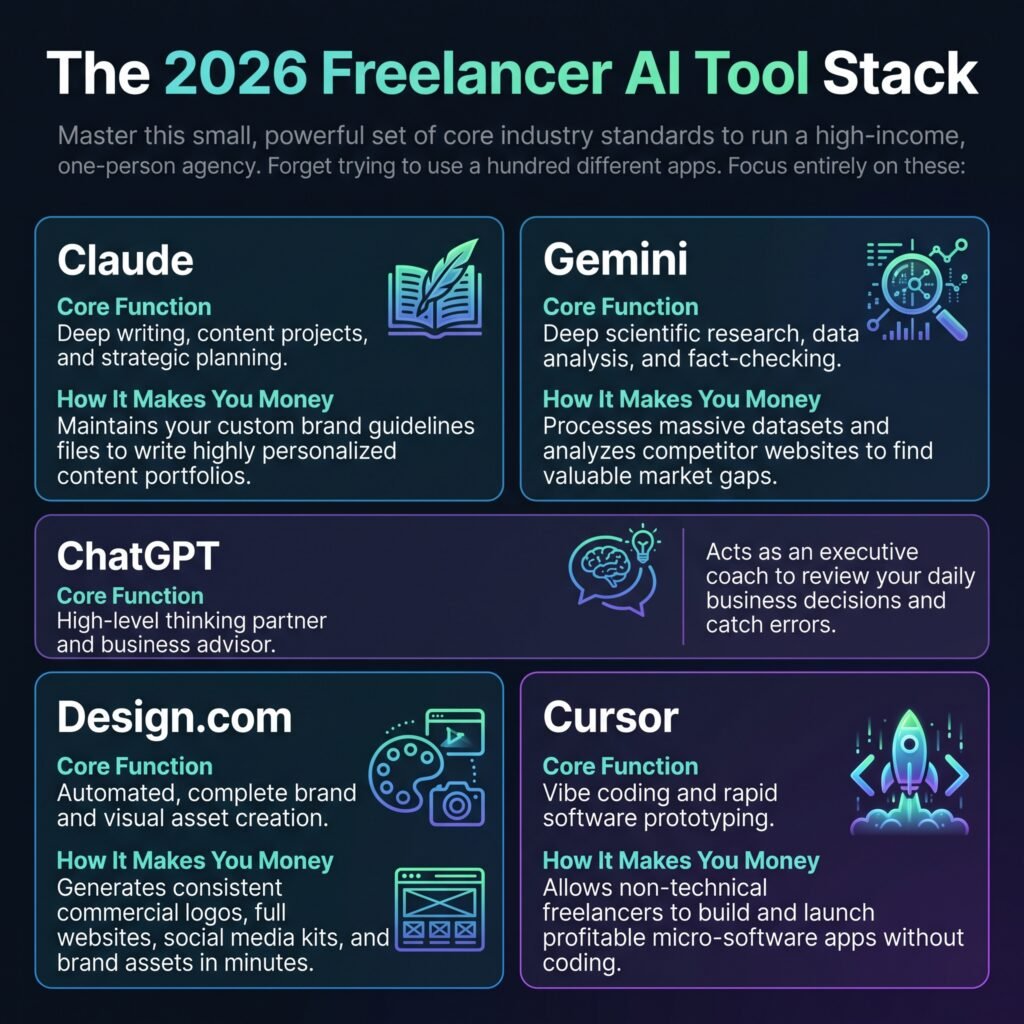
To effectively run a high-income, one-person agency, you need to master a small, powerful set of core tools. Forget trying to use a hundred different apps. Focus entirely on these industry standards:
| Tool Name | Core Function in Your Business | How It Makes You Money |
| Claude | Deep writing, content projects, and strategic planning. | Maintains your custom brand guidelines files to write highly personalized content portfolios. |
| Gemini | Deep scientific research, data analysis, and fact-checking. | Processes massive datasets and analyzes competitor websites to find valuable market gaps. |
| ChatGPT | High-level thinking partner and business advisor. | Acts as an executive coach to review your daily business decisions and catch errors. |
| Design.com | Automated, complete brand and visual asset creation. | Generates consistent commercial logos, full websites, social media kits, and brand assets in minutes. |
| Cursor | Vibe coding and rapid software prototyping. | Allows non-technical freelancers to build and launch profitable micro-software apps without coding. |
How to Rank on Google AI Results (Generative Engine Optimization)

In 2026, standard search engine optimization (SEO) has fundamentally changed. Millions of users no longer scroll through a long list of blue links on Google. Instead, they read a single, highly accurate summary generated directly by Google’s AI interface.
If you want your freelance business or your clients’ websites to get traffic, you must rank inside these AI-generated summaries. This new practice is called GEO (Generative Engine Optimization). Here are the clear, non-negotiable rules to make your content completely irresistible to AI search engines:
1. Lead with High-Density Information (Drop the Fluff)
AI search engines are designed to answer user questions as fast as possible. If your article starts with long, empty introductions like “Since the dawn of time, freelancing has been an important way to work,” the AI crawler will completely ignore your page. Start your content with immediate, direct facts, concrete statistics, and clear answers.
2. Design for GEO Crawlers
AI models love clear organization. Use highly descriptive, keyword-rich header tags (H2 and H3 structures). Break down complex data into simple Markdown tables and numbered sequences. The easier your page is to scan structurally, the more likely the AI engine will clip your text and showcase it as a trusted source.
3. Establish Deep EEAT Authority
AI search engines are strictly trained to display trustworthy information. To prove your authority to the algorithm, your content must showcase deep EEAT (Experience, Expertise, Authoritativeness, and Trustworthiness):
- Include real-world case studies with precise numbers and percentages.
- Quote verified industry experts and founders by name.
- Incorporate unique, original angles and frameworks that cannot be found anywhere else on the web.
4. Create Comprehensive FAQ Sections
AI search engines frequently grab direct answers from website FAQ lists to display inside their search widgets. Always include a dedicated, clean FAQ section at the bottom of your articles. Use natural, conversational questions that users actually say out loud into their phones, and follow them immediately with a sharp, clear, single-paragraph answer.
Internal Linking Recommendations
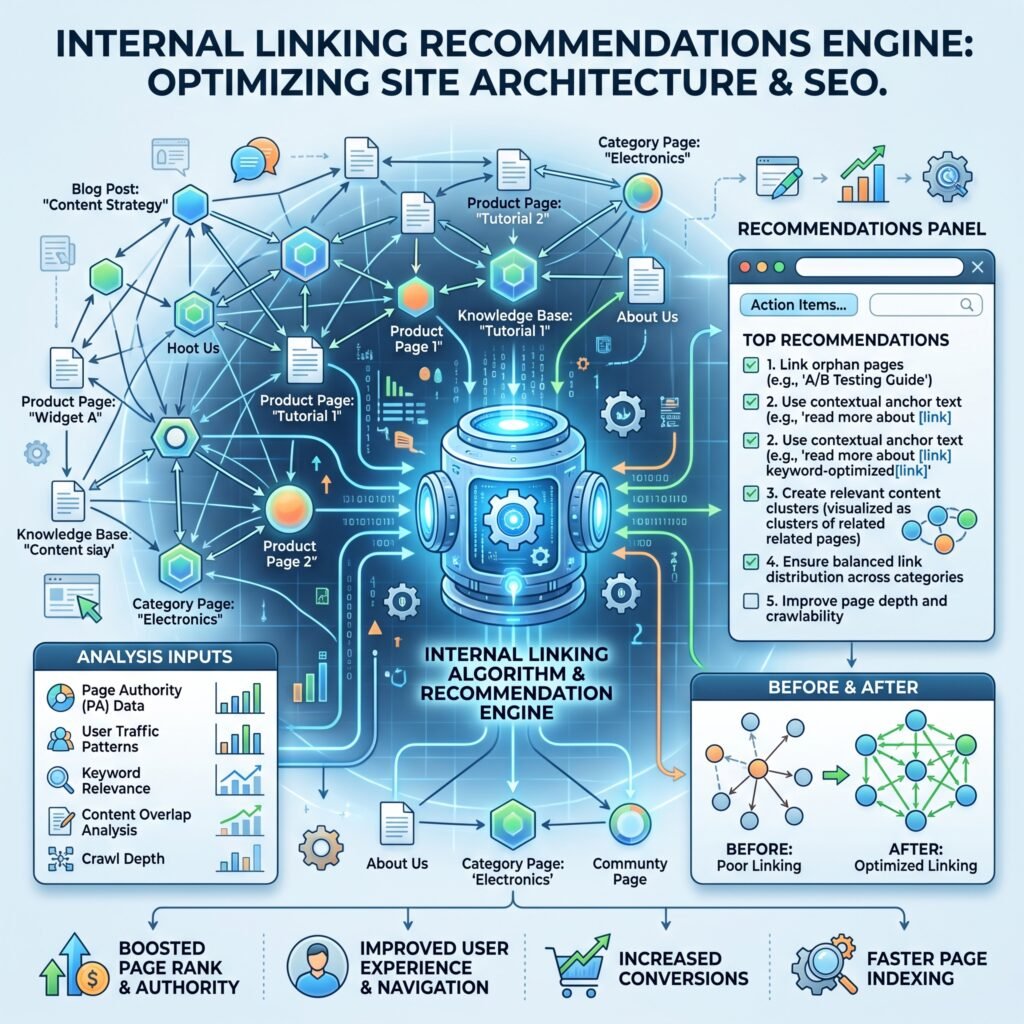
To build a highly powerful SEO content network that keeps both human readers and AI crawlers on your website longer, ensure you link this article to these foundational guides:
- Best AI Tools for Freelancers in 2026 (Deep dive into tool setups)
- How to Start an AI Freelance Business (A comprehensive roadmap for beginners)
- AI Tools for Content Writing (How to train models on your unique human voice)
- How to Make Money with AI Tools (A breakdown of micro-software monetization)
- Best AI Productivity Tools (Advanced guides on setting up autonomous background agents)
Frequently Asked Questions
Can AI really double a freelancer’s monthly income?
Yes. AI does not double your income by magically doing all your work for you. It doubles your income by drastically increasing your production speed, allowing you to finish projects three to five times faster. This gives you the free time to take on more clients, bundle your skills into premium agency packages, and build automated streams of passive income.
Do premium clients accept AI-assisted freelance work?
Yes, premium clients gladly accept AI-assisted work as long as the final product is highly original, deeply accurate, and delivers real business results. The key is to never hand over raw, unedited AI output. Top freelancers use AI for research and structural outlines, but always infuse the final work with human expertise, real-world case studies, and a unique personal voice.
What specific freelance jobs benefit the most from AI tools?
The freelance niches experiencing the biggest financial boom from AI include digital content writing, graphic design, social media marketing, video editing, web development, and virtual administrative assistance. In all these fields, AI completely handles the boring, repetitive tasks, freeing the human to focus entirely on high-level strategy.
Is freelancing still highly profitable in 2026?
Absolutely. Freelancing is incredibly profitable in 2026, but only for professionals who adapt and weave AI tools into their daily workflows. Freelancers who try to do everything manually are struggling to compete with the speed and pricing of modern workflows, while AI-powered freelancers are scaling their businesses faster than ever before.
Conclusion
AI is absolutely not replacing human freelancers. Instead, it is creating a massive, permanent gap between traditional, old-school freelancers and smart, AI-driven professionals.
The individuals who choose to ignore these automation systems will find themselves constantly struggling with slow delivery speeds, low pricing power, and intense market competition. But the freelancers who actively embrace AI as an executive thinking partner are quietly building highly scalable systems, locking in premium client retainers, and securing reliable streams of passive income. The golden window of opportunity is open right now—and the smartest operators are moving fast.