
Saving money quickly can feel impossible when bills and daily expenses keep piling up. But the truth is, with the right strategy, you can save a significant amount of cash in just 30 days without completely changing your life or giving up everything you enjoy.
Many people struggle to save because of a massive financial blind spot. In fact, studies in behavioral economics show that most people underestimate their monthly spending by 25% to 40%. That is not just a small mistake—it is a huge blind spot that can completely stop you from making real financial progress.
This guide is designed specifically for a U.S. audience. It breaks down practical, realistic, and proven steps that actually work in today’s economy. Whether you are saving for your first big milestone—like $1,000, $5,000, or $10,000—building an emergency fund, or trying to pay off high-interest debt, this comprehensive 30-day plan will help you take total control of your money fast.
Week 1: Track Every Dollar and Build Awareness
The absolute foundation of saving money fast is understanding exactly where every single dollar goes. You cannot fix a problem if you do not know where the leak is. Week one is all about shining a light on your actual spending habits.

The “Think-Want-Do” Framework
To beat the common blind spot where people undercount their spending, you can use a simple tool called the Think-Want-Do Framework. This method bridges the gap between what you assume you spend and reality.
To use this framework, take a piece of paper or open a clean document and break your money habits into three distinct parts:
- Think: Write down what you think you spend each month by category (like groceries, dining out, and entertainment).
- Want: Write down what you want or ideally hope to spend in those same categories.
- Do: Look at your real bank statements and write down what you actually did spend over the last month.
Comparing these three columns forces your brain to fine-tune its financial instincts. It creates a natural feedback loop. Once you see the shocking difference between what you “think” you spend and what you “do” spend, you instantly become more aware of your habits. This awareness makes it much easier to make smart money choices over the next 30 days.
Action Steps for Week 1
- Review Your Bank Statements: Log into your bank and credit card accounts. Look closely at every transaction from the past 30 to 60 days.
- Track Daily Expenses: Use a simple budgeting app or keep a manual notebook in your pocket. Write down every single purchase, no matter how small. Even a $4 snack counts.
- Identify Wasteful Spending: Look for hidden fees, double charges, or automated bills you forgot existed.
Core Focus Areas
- Unused Subscriptions: Look for streaming platforms, apps, digital magazines, or gym memberships you have not used in the last month.
- Convenience Spending: Track how much you spend on daily coffee runs, food delivery apps, and fast food.
- Impulse Shopping: Identify target areas where you tend to browse and buy things you do not need, especially online shopping apps.
Week 1 Goal: Identify at least 10% to 20% of wasteful or accidental spending that you can stop immediately.

Week 2: Cut Expenses and Use Frictionless Technology
Now that you have mapped out your true spending patterns from week one, it is time to cut out the waste and set up systems that make saving completely automatic.
Let Technology Do the Hard Work
Building a new habit is tough when you rely entirely on willpower. Instead of forcing yourself to remember to save every day, lean heavily into technology. Just like people use specific apps to block social media or track their fitness steps, you should use smart money apps to make saving completely effortless.
Look for a personal finance app or automated banking tool that fits your natural tendencies. Excellent features to look out for include:
- Automated Saving Brains: Many modern financial apps analyze your checking account habits over a short period. They estimate exactly how much money you can safely afford to sit aside, and then automatically transfer small amounts into a separate savings account every few days.
- Savings Mode Levels: Some apps let you adjust your automated settings based on your current financial mood. You can keep it on a “chilled” setting for standard times, or switch it to an aggressive “beast mode” when you want to maximize your savings fast during this 30-day challenge.
- Frictionless Separation: The key to saving success is making the process frictionless to start, but adding friction if you try to spend the money. Move your savings into a separate high-yield account where you cannot easily see it or swipe it with a debit card.
Quick Cuts You Can Make Immediately
U.S. monthly bills are famously high, which means they offer a golden opportunity for instant savings. Make these aggressive cuts today:
- Cancel Subscriptions Temporarily: If you have Netflix, Hulu, and Disney+, pick just one for the next 30 days and pause the rest. You can always turn them back on later.
- Trim Dining Out and Delivery: Food delivery apps charge massive fees, service tips, and menu markups. Pause the apps for two weeks and choose to pick up your food directly if you must buy takeout.
- Pause Non-Essential Shopping: Put a complete freeze on buying new clothes, home decor, gadgets, or hobbies for the rest of the month.

Week 3: Save on Daily Living Costs and Practice “Easy Wins First”
By week three, you have cleared out the obvious subscription leaks and automated your savings. Now, it is time to optimize your mandatory daily living costs like groceries, transportation, and home utilities.
When cutting back, always focus on doing what is easy first. A recent major banking survey found that the absolute easiest areas for people to cut back on when trying to save money quickly are:
- Eating out
- Alcohol purchases
- New clothing
- Takeaway coffees
These are all “discretionary spending”—things you choose to buy but do not actually need to survive. Focus your energy on these easy wins before trying to change your entire lifestyle.
If you absolutely love certain habits and do not want to change your lifestyle, ask yourself the most important personal finance question: “How can I get the exact same thing for less money?”
Smart Grocery Savings
You do not need to starve to save money on food. You just need a practical strategy before you walk through the grocery store doors.
| Saving Strategy | How It Works | Estimated 30-Day Savings |
| Buy Store Brands | Swap name-brand cereal, canned goods, and spices for generic store brands. They usually have identical ingredients. | $50 – $150 |
| Meal Planning | Check your fridge and pantry first. Write down a solid plan for every lunch and dinner before shopping to avoid food waste. | $100 – $300 |
| Use Cashback Apps | Use free tools like Ibotta or Fetch Rewards to scan your grocery receipts for instant cash back. | $20 – $50 |
Transportation Optimization
Car expenses can drain a budget quickly. Optimize your daily travel with these quick shifts:
- Combine Errands: Never drive out for just one item. Group your grocery shopping, bank trips, and post office runs into a single, efficient loop to save gas.
- Carpool or Use Public Transit: If you live near a coworker or have access to reliable public buses or trains, use them for your daily commute this week.
- Check Better Insurance Rates: When was the last time you actually compared car insurance quotes? Most people stick with the same provider out of habit. Spending 15 minutes on a comparison website can save you hundreds of dollars a year for the exact same coverage.
Simple Energy Reductions
Small changes around the house add up over a 30-day period. Turn off all lights when you leave a room, unplug large electronics that consume standby power, and adjust your thermostat or air conditioning by just two degrees to lower your utility bill.

Week 4: Make Saving Emotionally Accessible and Lock Your Cash
As you enter the final week of your 30-day plan, the focus shifts to two critical areas: breaking down your goals so you do not give up, and keeping your saved cash completely safe from your own temptation.
Overcoming “Goal Overwhelm”
When people set massive financial goals—like saving a $10,000 house deposit or a $5,000 emergency fund—they often fail to make any progress. They set the goal, get completely overwhelmed by the size of the number, and their brain simply shuts down. Psychologists call this Goal Overwhelm. Your mind cannot easily process how to reach a huge mountain from a standing start, so it chooses to do nothing instead.
To beat goal overwhelm, you must make your savings emotionally accessible by breaking the big goal down into tiny, digestible bits. Look at how manageable a large goal becomes when you break it down into daily actions:
- The $10,000 Yearly Goal: This breaks down to saving $193 a week, or just $27 a day.
- The Adjustment Rule: If saving $27 a day still feels too heavy for your current budget, do not change the goal—just stretch out your timeline.
- Spread $10,000 over 18 months = $18 a day.
- Spread $10,000 over 24 months = $14 a day.
When you look at your savings as just $14 or $27 a day, your brain realizes, “Wait, I can totally do that!” Suddenly, hitting your target is just a matter of skipping an expensive lunch or packing a home-prepped meal. You can visibly see and celebrate your progress every single afternoon.
Lock Your Savings Permanently
Once the money is saved, you need to protect it from impulse spending.
- Open a High-Yield Savings Account: Keep your money in an account that pays a strong interest rate (look for accounts offering around 4% to 5% interest). This ensures your cash grows safely and stays completely tax-free if held in specific savings accounts.
- Set Up Automatic Transfers: Schedule your bank account to move a set amount of money into your savings the exact same day you receive your paycheck.
- The Out-of-Sight Rule: Do not link your savings account to your everyday checking debit card. If it takes 24 to 48 hours to transfer the money back to your checking account, you are far less likely to spend it on a whim.

How to Scale Your Savings: The Income Equation
Cutting expenses is the fastest way to save money this month, but you must remember a vital rule of personal finance: You can only save as much as you earn, but you can always earn more money.
To supercharge your 30-day plan, look at the other side of the equation and find ways to boost your income.
1. Leverage the Gig Economy
If you have a reliable car and a few spare hours on the weekend, use delivery or rideshare apps like DoorDash, Uber, or Instacart. Redirect 100% of your earnings from these gigs straight into your locked savings account.
2. Sell What You Do Not Use
Walk through your home and look for clothes, electronics, shoes, or furniture you have not touched in six months. Clean them up, take clear photos, and list them on local online platforms like Facebook Marketplace or eBay. This is a fast way to generate $200 to $500 in a single weekend.
3. Maximize Your Main Career
If you love your job because it gives you purpose, stability, and peace of mind, it is completely valid to stay put—even if the pay is not perfect. It just means accepting that your long-term financial goals might take a bit more time to reach.
However, if you do not love your job and you are there primarily to earn money to fund your real life outside of work, you owe it to yourself to squeeze every dollar you can out of your career.
- Ask for a Pay Rise: Prepare a clear list of your recent achievements, show how you add value to the company, and schedule a professional meeting with your manager to ask for a raise.
- Switch Jobs: If a pay rise is not possible, start looking elsewhere. Switching companies remains one of the most reliable, proven ways to secure a major salary jump in the U.S. corporate market.
Bonus Tips to Save Money Even Faster
If you want to maximize your results and save even more cash before your 30 days are up, try these rapid-fire financial habits:
- Use the Cash Envelope System: For discretionary categories like groceries and entertainment, withdraw a specific amount of physical cash at the start of the week. Put the cash in an envelope. Once the envelope is empty, your spending in that category is completely done for the week. Physical cash creates psychological pain when you hand it over, which naturally slows down your spending.
- Delete Shopping Apps From Your Phone: Remove Amazon, Target, and fashion apps from your smartphone for the next 30 days. Removing the temptation to scroll prevents accidental impulse buys when you are bored late at night.
- The 48-Hour Rule for Wants: Whenever you feel the sudden urge to buy something that is not an absolute necessity, force yourself to wait a full 48 hours. Most of the time, the emotional urge will fade, and you will realize you did not actually need the item.
- Set a Hard Daily Spending Limit: Give yourself a strict daily allowance for miscellaneous items. If you go over your limit today, you must subtract that exact amount from your allowance tomorrow.

Final Review: Your 30-Day Checklist
Use this clear chronological breakdown to stay on track from day one to day thirty.
[Day 1 - 7: Tracking Phase]
 └── Fill out the Think-Want-Do Framework
 └── Download a tracking app or carry a pocket notebook
 └── Pull your last 2 bank statements to find hidden leaks

[Day 8 - 15: Cutting Phase]
 └── Cancel at least 2 unused digital subscriptions
 └── Turn on automated transfers in your money app
 └── Pause all food delivery services and cook at home

[Day 16 - 22: Optimization Phase]
 └── Swap all grocery shopping to low-cost store brands
 └── Run a quote check on a car insurance comparison site
 └── Plan your meals out fully before entering a store

[Day 23 - 30: Boosting & Locking Phase]
 └── Break down your large financial goal into a small daily target
 └── Move your saved cash into an isolated high-yield account
 └── List 3 unused household items for sale online
Key Takeaways
- Awareness Stops the Leak: Tracking your spending using tools like the Think-Want-Do framework removes the financial blind spot that causes people to waste 25% to 40% of their cash.
- Automation Beats Willpower: Letting smart financial technology handle your savings transfers makes building a strong habit completely frictionless.
- Smash Goal Overwhelm: Never focus on a massive, scary savings number. Break your financial targets down into small, daily milestones that feel easy to achieve.
- Attack High-Interest Debt First: Trying to save money while carrying high-interest credit card debt is like filling a bucket with a massive hole in the bottom. Clear the debt first to get ahead faster.
- Earn More to Save More: Cutting back on bills is incredibly effective, but combining those cuts with side hustles or career growth removes the ceiling on how much you can save.
Frequently Asked Questions (FAQ)
How much money can I realistically save in 30 days?
Most average earners in the U.S. can comfortably save anywhere from $300 to $2,000 within a 30-day period. The exact number depends heavily on your current income level, how closely you track your leaks, and how aggressively you cut back on temporary discretionary expenses like dining out and subscriptions.
What is the absolute fastest way to save money?
The fastest way to save money immediately is to eliminate convenience spending and pause recurring automated bills. This means canceling unused app subscriptions, stopping all food delivery orders, cooking simple meals at home using store-brand ingredients, and putting a strict 48-hour freeze on all impulse shopping.
Do I need a high annual income to save money quickly?
No, you do not need a massive income to build a great savings habit. Saving money fast is much more about controlling what flows out of your bank account than it is about what flows in. High earners often struggle with money because they fall into the trap of lifestyle inflation, while disciplined savers succeed by managing their daily habits.
Is this 30-day plan realistic for absolute beginners?
Yes, this plan is specifically designed for anyone starting completely from scratch with zero previous financial discipline. By starting with simple tracking in week one and moving to easy spending cuts in week three, you build your financial confidence slowly without shocking your system or feeling deprived.
Should I build a savings account or pay off my credit cards first?
If you have high-interest credit card debt, you should always prioritize paying that off first. For example, if you have $5,000 in credit card debt costing you 18% interest, and $5,000 in a savings account earning 4% interest, you are actively losing $700 every single year. Pay off the high-interest debt first to stop the bleeding, then redirect those exact same monthly payments into your personal savings account.
Conclusion
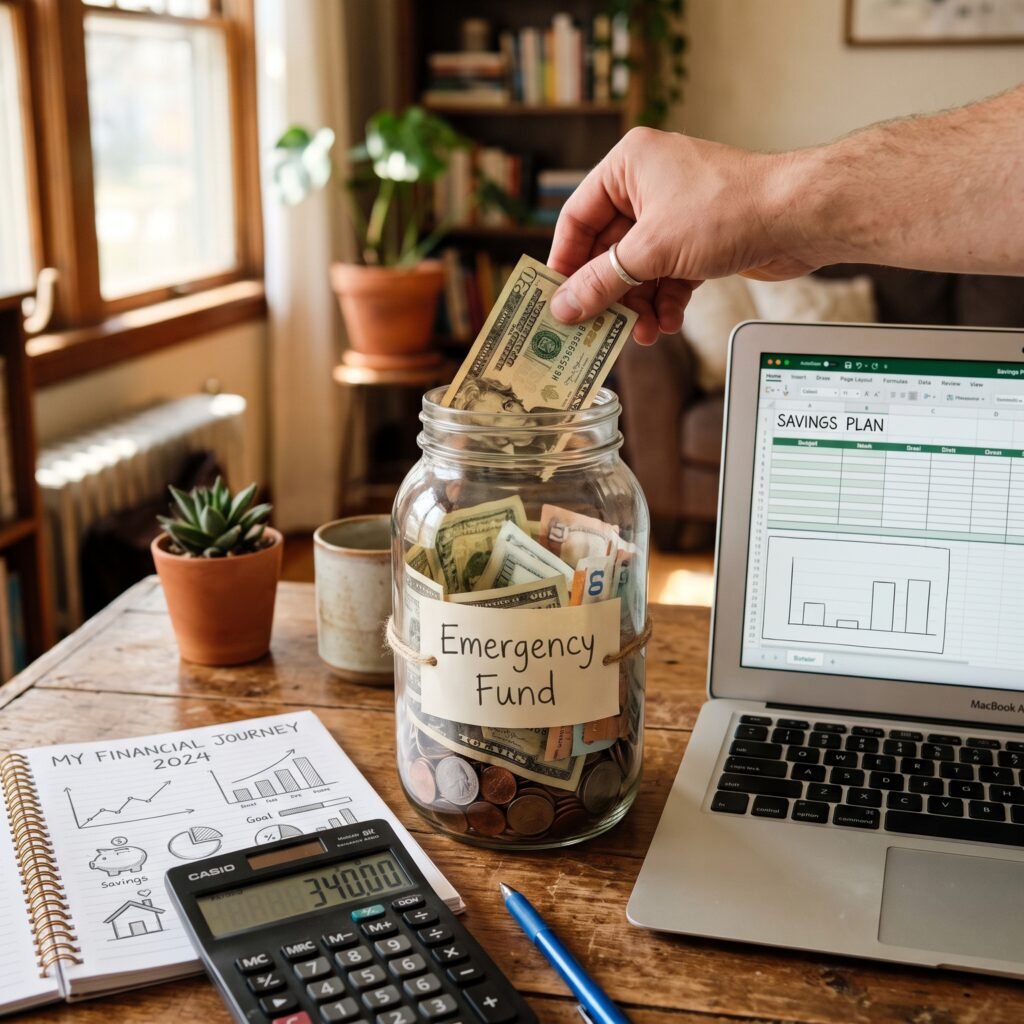
Saving money fast in 30 days is completely achievable if you follow a structured, step-by-step plan. Taking control of your personal finances does not require massive sacrifices that make you miserable; it simply requires deep awareness, smart automation, and consistent daily action.
By using the Think-Want-Do framework to uncover your hidden spending blind spots, using helpful technology to make saving frictionless, and breaking your big goals down into small, daily pieces to beat goal overwhelm, you can build a powerful financial safety net in record time.
Do not wait for a perfect moment or a higher paycheck to start your journey. Take action today, track your very next purchase, and you will be amazed by how much money, control, and peace of mind you can gain over your life in the next 30 days.