



A House Built on Invisible Labor
The morning air in Fort Wayne was crisp, the kind of Indiana cold that bites through a flannel shirt and reminds you that winter is coming. I stood in my kitchen, watching the steam rise from my coffee.
My hands were stained. No matter how hard I scrubbed with Orange Goop or pumice soap, the black lines remained etched into the creases of my palms. They were the permanent record of thirty years in HVAC—of crawling through fiberglass insulation and wrenching on rusted boilers.
“Rick, could you move those boots?”
Karen’s voice was like a violin string stretched too tight. She didn’t look at me. She was busy polishing the “good” silver, her movements surgical.
“They’re just boots, Karen,” I muttered, but I moved them anyway.
Shadows of the Shop Floor
I closed my eyes for a second and I wasn’t in a suburban kitchen. I was six years old, sitting on a stool at the GM plant in Anderson. I could see my father, Jack Dalton, leaning over a massive engine block.
The sparks from the welder looked like falling stars. To a little boy, Jack Dalton wasn’t just a mechanic; he was a magician who could make dead things roar back to life.
I remembered how he’d come home, his blue coveralls darkened with sweat and oil. He’d scoop me up, and I’d bury my face in his chest. He smelled like iron, tobacco, and hard work.
“You’re going to use your head, Ricky,” he’d tell me, his voice gravelly. “But never be ashamed of your hands.”
The Performance of Perfection
Karen’s parents, the Whitmores, were arriving at four. To them, Thanksgiving wasn’t a meal; it was an audition. They dealt in real estate and law. They spoke in hushed tones about market trends and country club memberships.
For fifteen years, I had tried to fit into their frame. I wore the sweaters Karen bought me. I nodded at the right times. I suppressed the urge to talk about the satisfaction of a perfectly brazed copper line.
I thought we were a team. I thought we understood that my “blue-collar” income was exactly what paid for the granite countertops she was currently disinfecting for the third time.
I went to the mudroom to call Dad. I wanted to see if he needed a ride or if he was bringing his famous bourbon sweet potatoes.
“Hey, Pop. I’ll be there in twenty to grab you,” I said, leaning against the doorframe.
There was a long silence on the other end. The kind of silence that makes your stomach drop.
“Rick… I think I’ll just stay home today,” he said. His voice sounded smaller than I’d ever heard it. “Karen called last night. Said the table was a bit cramped. Said her folks might be… uncomfortable.”
The blood in my veins turned to ice. “She said what?”
“It’s okay, son. I’ve got some leftovers. You have a good time with the family.”
He hung up before I could protest. My father, a man who had never backed down from a fight in his life, sounded defeated.
The Line in the Sand
I walked into the dining room. The table was set for six. Karen, her sister Elena, and the Whitmores. My father’s name card was nowhere to be seen.
“Karen,” I said, my voice low. “Why did you call my father and tell him not to come?”
She didn’t stop arranging the centerpieces. “Rick, let’s not do this now. We discussed the guest list.”
“We didn’t discuss uninviting my father.”
She finally looked at me. Her eyes were cold, filled with a sudden, sharp elitism that I had spent years pretending wasn’t there.
“His hands are always black, Rick. He smells like a garage. My parents are refined people. They shouldn’t have to sit across from a grease-stained mechanic while they’re trying to enjoy a holiday meal.”
The Breaking Point
The words hit me like a physical blow. Grease-stained mechanic.
She wasn’t just insulting his job. She was insulting the man who had worked double shifts for twenty years so I could go to college. She was insulting the man who had spent his weekends fixing her car for free so we could save money for our down payment.
“He smells like work, Karen,” I said, my heart hammering against my ribs. “He smells like the life he gave us.”
“He’s an eyesore at this table,” she snapped, her composure slipping. “I want one day—just one day—where we look like the people we’re supposed to be. If you can’t see that, maybe you’re more like him than I thought.”
I stared at her. I realized in that moment that I didn’t know the woman standing in front of me. Or worse, I did know her, and I had been lying to myself for a decade.
“Alright,” I said quietly.
She blinked, surprised by my sudden compliance. “Alright?”
“I understand perfectly,” I said.
The Quiet Departure
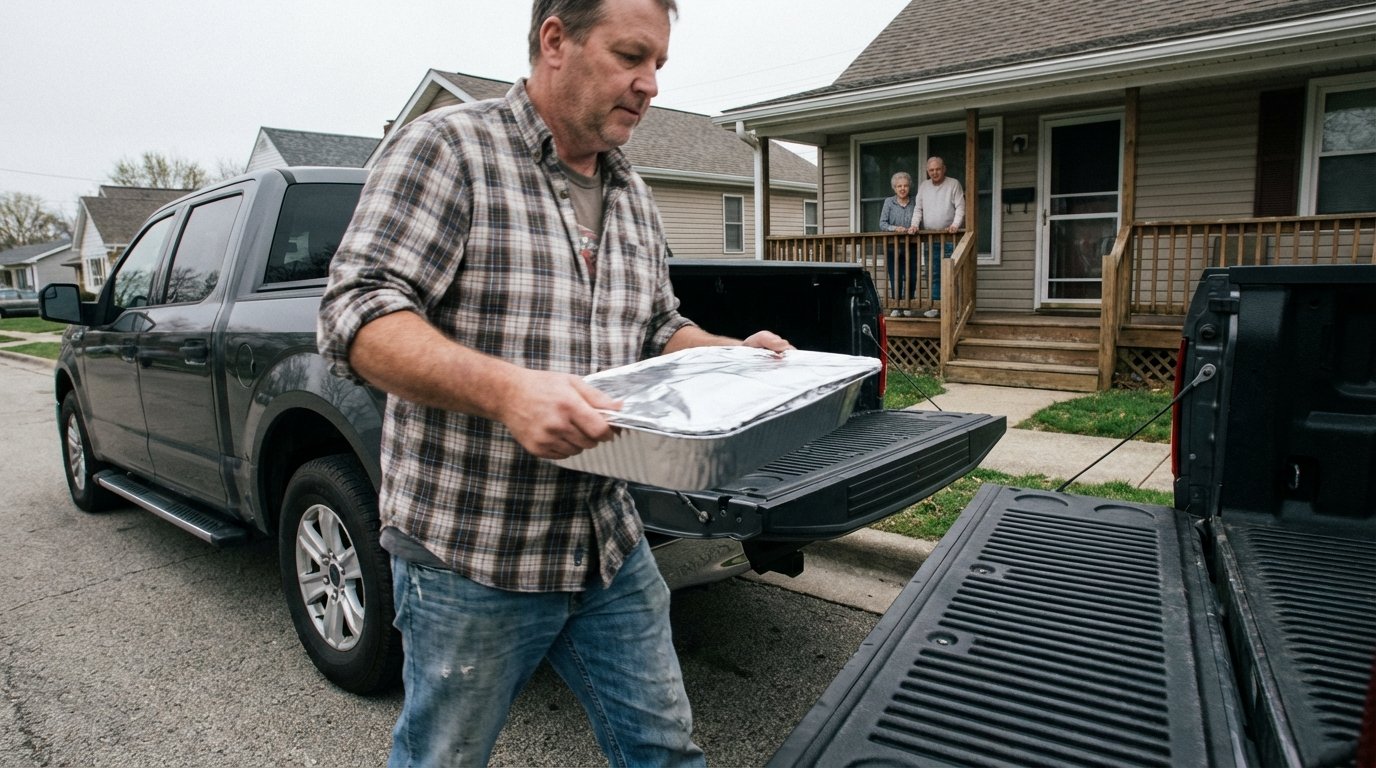
I didn’t yell. I didn’t break a plate. I simply walked into the kitchen and grabbed the heavy-duty foil trays I usually kept for work potlucks.
I pulled the turkey out of the oven. It was beautiful—golden-brown and glistening. I carved it with practiced precision.
I scooped the stuffing, the mashed potatoes, the green bean casserole, and the rolls into the trays.
“Rick? What are you doing?” Elena, Karen’s sister, walked in, clutching a glass of white wine. She looked at the empty serving dishes and the growing pile of foil.
“I’m taking my dinner to go,” I said.
Karen rushed in, her face turning a blotchy red. “You are not taking that food out of this house! My parents will be here in an hour!”
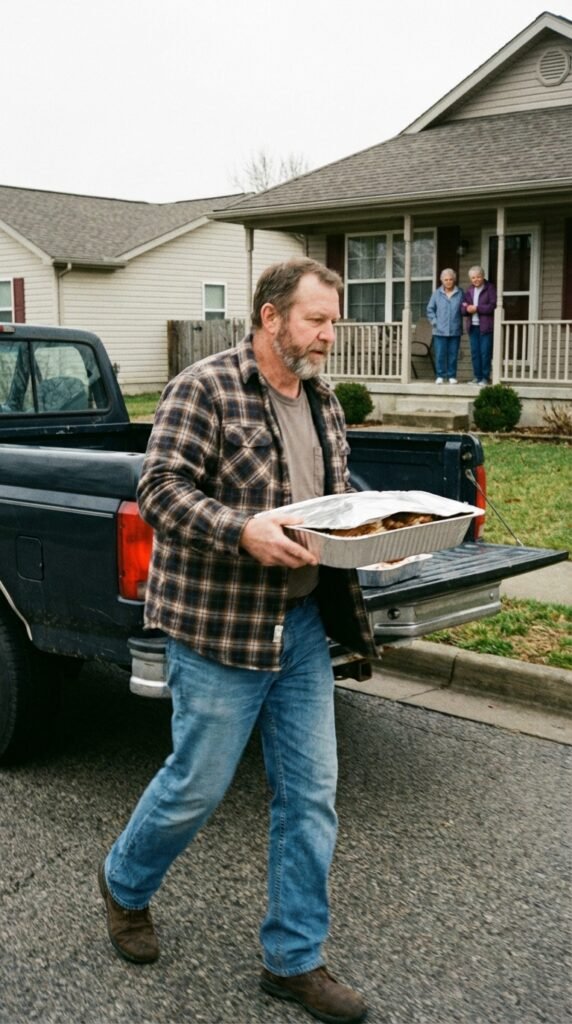
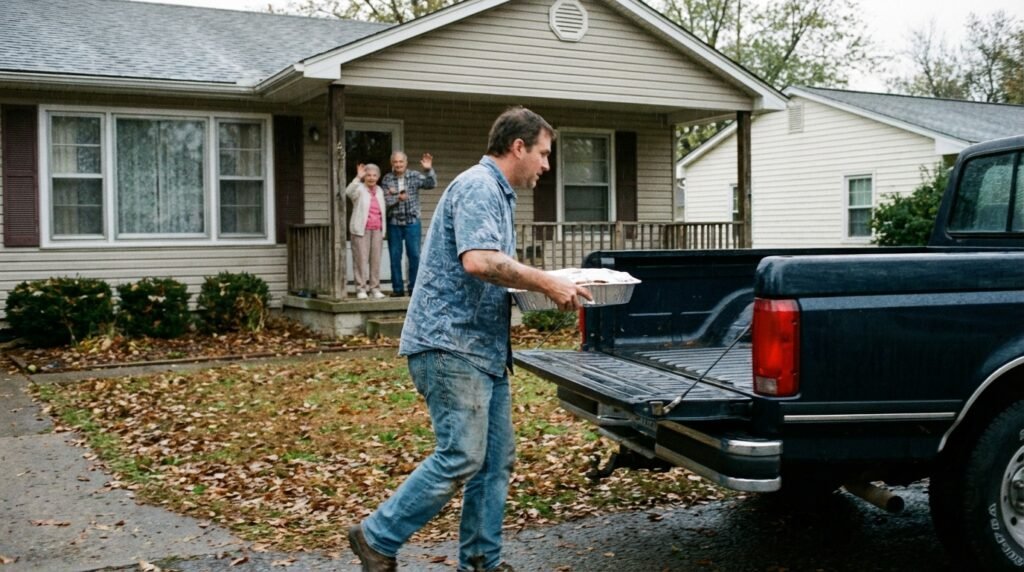
“Then I suggest you call a caterer,” I said, sliding the last tray into a cardboard box. “Because the ‘grease-stained mechanic’ is the one who paid for this turkey. And I’m going to go eat it with the man who taught me how to earn it.”
I walked out the door, the weight of the boxes heavy in my arms. As I backed the truck out of the driveway, I saw Karen standing on the porch, her mouth open in a silent scream of fury.
I didn’t look back.
A House of Memories
The drive to my father’s small bungalow on the edge of town felt like a pilgrimage. The streets were quiet, the smell of woodsmoke drifting from chimneys.
When I pulled into his gravel driveway, I saw him through the front window. He was sitting in his recliner, a TV dinner on a tray in front of him. He looked so small.
I didn’t knock. I just walked in with the boxes.
“Rick? What the hell are you doing here?” He stood up, his knees popping.
“The table was too small at my house, Pop,” I said, setting the food down on his laminate kitchen table. “So I brought the table to you.”
The First Shadow of a Secret
We ate in a comfortable silence at first. The turkey was still hot.
“You shouldn’t have left your wife, Rick,” Dad said, chewing slowly. “A man stays with his wife.”
“Not when she treats my father like trash, he doesn’t.”
He looked down at his hands—the same stained hands I had inherited. “She’s right, you know. I do smell like the shop. It gets in your bones. You can’t ever really wash it off.”
“I like the smell, Dad.”
After dinner, Dad went to the closet. He pulled out an old, beat-up metal toolbox. Not the one he used for work—this one was tucked behind his Sunday shoes.
“I was going to wait,” he said. “But after today… maybe you need to know who you really are.”
He pulled out a thick, yellowed envelope. On the front, in elegant, looping cursive that definitely wasn’t my father’s, was written: For Rick, when the world feels too loud.
“Your mother wrote this before she passed,” he said. “She told me to give it to you when I felt you were losing your way. I think you’ve been lost for a while, son. Ever since you started trying to be a Whitmore.”
A Mother’s Voice
I took the letter. My mother had died when I was twelve. My memories of her were soft-focus—the smell of lavender, the sound of her humming “Amazing Grace,” the way she’d tuck me in.
I sat at the kitchen table, the grease-stained mechanic watching me with eyes full of a strange, weary sadness. I broke the seal.
The Letter and the Truth
The letter was long—nearly ten pages of cramped, emotional script. As I began to read, the world outside the bungalow faded away.
My dearest Rick,
If you are reading this, you are a man grown. I hope you are a kind man. I hope you are a man who knows that value isn’t found in a bank account, but in the callouses on your palms.
There is something I never told you. Something your father made me promise to keep secret to protect you from the burden of expectation.
Everyone in town knows Jack Dalton as the man who fixed their cars. They know him as the man who never missed a shift at GM. But they don’t know why he stayed there.
The Real Jack Dalton
The letter went on to detail a history I never knew. My father wasn’t just a mechanic. Before I was born, he had been a brilliant structural engineer. He had designed bridges. He had been a rising star in a massive firm in Chicago.
But there had been a disaster. Not his fault—a cost-cutting measure by the board of directors led to a structural failure on a project he had warned them about.
When the dust settled, the company looked for a scapegoat. They tried to pin it on him. My father fought them, but he realized the “refined” world of boardrooms and blueprints was filled with vipers.
He walked away, Rick. He took the blame to protect the younger engineers who had families. He lost his license, his reputation, and his fortune. He moved us here and took a job at the plant because he wanted a life where things were simple. Where a man’s word was his bond and you could see the work of your hands at the end of the day.
The Twist in the Secret
My heart was racing. My dad? An engineer?
But then I reached the final pages of the letter, and the real shock hit me.
But here is the truth, Rick. Your father never actually lost the money. He won a massive defamation lawsuit against that firm years later. He didn’t want the life of luxury. He said it would ‘spoil the soul’ of a child to grow up thinking money was the point of living.
He put it all into a trust. Not for him. For you. But only if you became a man who didn’t need it. Only if you became a man who would choose a person over a position.
I looked up at my father. He was staring out the window at the dark Indiana night.
“Dad?” I whispered.
“I didn’t want you to be like them, Rick,” he said, his voice thick. “I saw how those people treated each other. Like chess pieces. I wanted you to know the value of a hard day’s work. I wanted you to be a man who would walk out on a Thanksgiving dinner if it meant doing the right thing.”
The Confrontation
Just then, the front door burst open.
Karen marched in, followed by Elena. They both looked like they had been crying—not out of sadness, but out of social humiliation.
“You’ve ruined everything!” Karen screamed. “My parents are sitting in a silent house with no food! You look like a child, Rick! Running away to this… this hovel!”
Elena sneered, looking at my father. “Look at him. He probably doesn’t even realize how much he’s holding you back, Rick. You could have been someone.”
I stood up. I felt a calm I hadn’t felt in years. I looked at the letter in my hand, then at my wife.
“You’re right, Karen,” I said. “I finally realized how much he was holding me back. He was holding me back from becoming a monster like you.”
“Don’t you dare speak to me like that!”
“He’s not just a mechanic,” I said, my voice gaining strength. “He’s a man who gave up a fortune to make sure I grew up with a conscience. And funny enough, he’s actually the wealthiest man in this room. In more ways than one.”
I handed her the first page of the letter—the part where it mentioned the trust fund. It was a staggering amount. Millions of dollars that had been sitting, untouched, for decades.
Karen’s eyes widened. The anger vanished, replaced by a terrifying, predatory greed.
“Rick… baby… I didn’t know,” she stammered. “We can fix this. We can move. We can get your father a better place—a nice assisted living facility with a garden—”
“Get out,” I said.
“Rick, listen to reason—”
“Get. Out.” I stepped forward. “And don’t worry about the money. The trust is clear. It’s for me, and for the people I choose to call family. And as of ten minutes ago, that list is very, very short.”
A New Kind of Grace
The silence that followed their departure was the most beautiful thing I had ever heard.
My father sat back down. He looked tired, but the weight seemed to have lifted from his shoulders, too.
“You shouldn’t have told her about the money, Rick,” he sighed. “She’ll fight you for it.”
“Let her try,” I said. “I’ve got the best mechanic in Indiana to help me build a defense.”
The Emotional Closure
We sat there for hours. I asked him about the bridges he’d designed. He told me about the physics of tension and the beauty of a well-placed beam. I saw a light in his eyes I’d never seen before—the light of a brilliant mind that had been hiding in plain sight.
I realized that my father hadn’t been “just” a mechanic. He was an artist who chose a different medium. He chose to build a son instead of a skyscraper.
As the clock struck midnight, I looked at my hands. They were still stained with grease. I looked at my father’s hands, gnarled and scarred.
“Happy Thanksgiving, Dad,” I said.
“Happy Thanksgiving, Rick.”
I felt a sense of relief wash over me. I had lost a wife, a house, and a “refined” life. But for the first time in fifty-two years, I knew exactly who I was.
I was Rick Dalton. I was the son of a man who smelled like a shop. And I had never been more proud.
The Morning After
The next morning, the sun rose over the frost-covered fields of Indiana. I stayed on my dad’s couch. We woke up and had leftover turkey sandwiches for breakfast.
I called a lawyer, yes. But first, I called my crew.
“Hey guys,” I said into the phone. “I’m taking a few weeks off. I’ve got some work to do at my dad’s place. We’re going to build that workshop he always wanted.”
I hung up and looked at my dad. He was smiling. A real, genuine smile that reached his eyes.
The grease wasn’t a stain. It was a badge of honor.