



The Day the Foundation Cracked
The air in the church basement smelled of stale coffee and floor wax.
I was fifteen, an age where you start to see your parents as people, but you still believe they are indestructible.
My mom sat in a folding metal chair, her hands resting on the high arc of her belly. She was eight months pregnant with her tenth child.
Ten.
My father had always called us his “tithe to the heavens.” He said a large family was a fortress.
But that afternoon, the fortress crumbled.
“I’ve prayed on this,” he said, his voice carrying that practiced, melodic tremor he used when leading Sunday service. “And I feel the Spirit calling me to a different path. A new mission.”
I remember the way the light caught the sweat on his upper lip. He wasn’t looking at us. He was looking at the exit sign.
“What about the baby, Elias?” my mom whispered. Her voice was thin, like paper being torn.
“God provides for the faithful, Martha,” he replied.
The “mission” wasn’t a mission at all. It was Elena.
She was twenty-two, a soprano in the choir with hair the color of harvested wheat and eyes that never looked at the floor.
He left that night in the silver minivan he’d bought for family road trips. He took the checkbook, the dignity of our name, and the oxygen from the room.
The Decade of Silent War
The years that followed were a blur of cold cereal and the sound of the front door clicking shut at 11:00 PM.
My mom didn’t have a degree. She had a heart that had been carved out, yet she refused to let the vacuum collapse her chest.
I watched her scrub the floors of the local dental clinic until her knuckles bled.
I watched her line up at the food bank, her head held high, wearing a coat that was two sizes too small because she’d given hers to my sister, Sarah.
“Why don’t you hate him?” I asked her one night. I was seventeen then, bitter and sharp-edged.
She was folding a mountain of laundry, her movements rhythmic and tired.
“Hate is a luxury, Chloe,” she said softly. “I don’t have the energy to carry him and you ten at the same time. So I dropped him.”
But she never officially divorced him. Not out of hope, but out of a strange, archaic loyalty that made my blood boil.
Memories of the Ghost
Sometimes, the younger ones would ask where he was.
“Is Daddy at work?” little Toby would ask, clutching a frayed teddy bear.
My mom would just stroke his hair. “He’s away, honey. But you have us.”
I hated that she shielded him. I wanted her to tell them the truth—that he was five miles away in a condo, buying jewelry for a girl who wasn’t much older than I was while we shared bathwater to save on the utility bill.
I remember the Christmas of 2018. We had nothing.
Mom had managed to get a small tree, and we decorated it with popcorn strings.
She sat us down and gave us each a handwritten letter telling us why she was proud of us. No toys. No gadgets. Just her words.
That night, I saw her crying in the kitchen over a jar of peanut butter.
I vowed then that if he ever crawled back, I would be the one standing at the gate.
The Return of the Prodigal Failure
Ten years.
Three thousand, six hundred and fifty days of his absence.
The phone rang on a Tuesday. I was visiting mom to help her with the grocery shopping.
She stared at the screen, her breath hitching. “It’s him,” she whispered.
I snatched the phone. “What do you want?”
“Chloe? Is that you? You sound so grown,” his voice was raspy, stripped of its former Sunday-morning silk.
“I am grown. I grew up the night you left. Talk fast.”
He sighed, a sound full of self-pity. “Elena… she’s gone. She wasn’t prepared for… well, I’ve had some health scares. My back. The doctors say I need a steady hand at home. I’ve realized my mistakes. I want to come home to your mother.”
I looked at my mom. She was trembling, her hand covering her mouth.
“He says he’s sorry,” she mouthed.
My heart hardened into a diamond. He didn’t want a family; he wanted a nurse. He didn’t want forgiveness; he wanted a free retirement plan.
“Let me talk to her,” he pleaded.
I hung up.
The Seed of the Plan
“He deserves a chance to explain,” my mom said, her voice wavering. “The Bible says seventy times seven, Chloe.”
“He didn’t just miss a payment, Mom. He missed a decade. He missed Toby’s first steps. He missed my graduation. He missed your life.”
She looked so tired. The years of scrubbing and sacrificing had etched lines into her face that no apology could erase.
“I’ll handle it,” I said, my voice eerily calm. “I’ll arrange a dinner. We’ll do it right.”
I took her phone that night. I sent the text that would set the stage.
“I thought about your proposal. Come to a family reunion dinner on Sunday at 7 PM. All the kids will be there. Wear your best suit. I’ll send you the address.”
His reply came back within seconds.
“Dear, thank you for this second chance. I can’t wait to become a family again. I’m bringing flowers for my beautiful wife.”
I felt a surge of literal nausea. “Beautiful wife.” The woman he had discarded like a used rag.
The Discovery of the Secret
Sunday arrived with a heavy, humid heat.
I didn’t take him to our house. Our house was a sanctuary he no longer had the right to enter.
I sent him an address to a rented community hall—the same one where he used to give his “family values” seminars before the fall.
I arrived early. My siblings were already there, dressed in black.
They were confused. “Why are we here, Chloe? Why is Mom wearing her wedding veil?”
My mom stood in the back room, draped in the lace she had worn thirty-five years ago. It was yellowed with age, but she looked like a queen.
“Is he really coming?” Sarah asked, her voice trembling.
“He’s coming,” I said. “But this isn’t a reunion.”
The Confrontation with Elena
As I walked to the front of the hall, I saw a car pull up. But it wasn’t my father.
It was Elena.
She looked haggard. The “soprano” glow was gone. She walked up to the door, eyes red-rimmed.
“Is he here?” she asked, seeing me.
“Why do you care?” I spat.
“He took everything,” she whispered. “He told me he had a pension. He told me he was a man of God. He’s a parasite, Chloe. He spent my inheritance, and when I told him I was leaving, he tried to sue me for ’emotional abandonment.’ I’m here to make sure he doesn’t do it to her again.”
I looked at her, and for the first time, I didn’t see a villain. I saw another victim of the same silver-tongued predator.
“Stay in the back,” I told her. “Watch the show.”
The Revelation in the Hallway
At 7:00 PM sharp, a black sedan pulled into the lot.
My father stepped out. He was wearing an old suit that hung loosely on his frame. He carried a bouquet of cheap carnations.
He walked toward the doors, a practiced smile on his face. He expected a table set with roast beef and weeping children begging for his blessing.
I met him at the threshold.
“Where is everyone?” he asked, squinting into the dim light of the hall. “Where’s your mom?”
“She’s inside, Dad. Waiting.”
He walked in, and the smile died.
The hall wasn’t set for dinner. It was set for a funeral.
Ten chairs were lined up in the front row. My siblings sat there, stone-faced. In the center of the room was a podium, and behind it, a large photo of my mom—not as she was now, but as she was the night he left. Pregnant, exhausted, and broken.
“What is this?” he hissed. “This isn’t funny, Chloe.”
“It’s not a joke,” I said, stepping onto the stage. “It’s a memorial service. For the man we thought you were.”
The Letter
I pulled a thick envelope from my pocket.
“Mom wrote you a letter,” I said. “She wanted me to read it to you in front of the witnesses of your ‘mission’.”
He tried to turn away. “I’m leaving!”
“Sit down, Elias,” my mom’s voice rang out from the shadows.
She stepped into the light, wearing the veil. She didn’t look soft anymore. She looked like justice.
He sat.
I opened the letter. My voice didn’t shake.
“To the man who shared my bed but never my burden,” I began.
“You asked to come home because your new life ran out of money and your body ran out of youth. You spoke of ‘mistakes.’ A mistake is forgetting your keys. A decade of abandonment is a choice.
I stayed married to you for ten years because I wanted to see if God would change your heart. But while I waited, I realized God didn’t want to change you—He wanted to change me.
You think you are coming back to a ‘wife.’ But that woman died in the church basement ten years ago. You killed her. The woman standing here today is a business owner. She is a mother who raised ten children on the strength of her own spine.
You didn’t miss a family, Elias. You missed a target. You need someone to bleed for you. But my veins are dry.”
The room was silent. I could hear his heavy, wheezing breath.
“There’s more,” I said, turning the page.
“I am granting you the ‘return’ you asked for. But not to this house. I have filed the papers. You are now legally responsible for 50% of the debt I accrued keeping our children alive while you were ‘on mission.’ The back child support has been calculated. The court date is Tuesday.
Welcome home to the consequences.”
The Final Ending
My father stood up, his face purple. “You can’t do this! I’m a man of the cloth!”
“You’re a man of the cloth who left his pregnant wife to starve,” my brother Toby stood up. He was nineteen now, taller than our father. “Get out.”
My father looked around the room. He looked at Elena, who had stepped out from the shadows, watching his humiliation. He looked at my mom, who slowly reached up and pulled off her wedding veil.
She let it drop to the floor.
“I forgave you years ago, Elias,” she said, her voice steady. “But forgiveness doesn’t mean I have to let the wolf back into the sheepfold. I forgive you. Now leave before I call the police for trespassing.”
He shuffled out. He didn’t look like a patriarch. He looked like a small, hollow man who had traded a kingdom for a whistle.
The Closure
We didn’t have a reunion dinner.
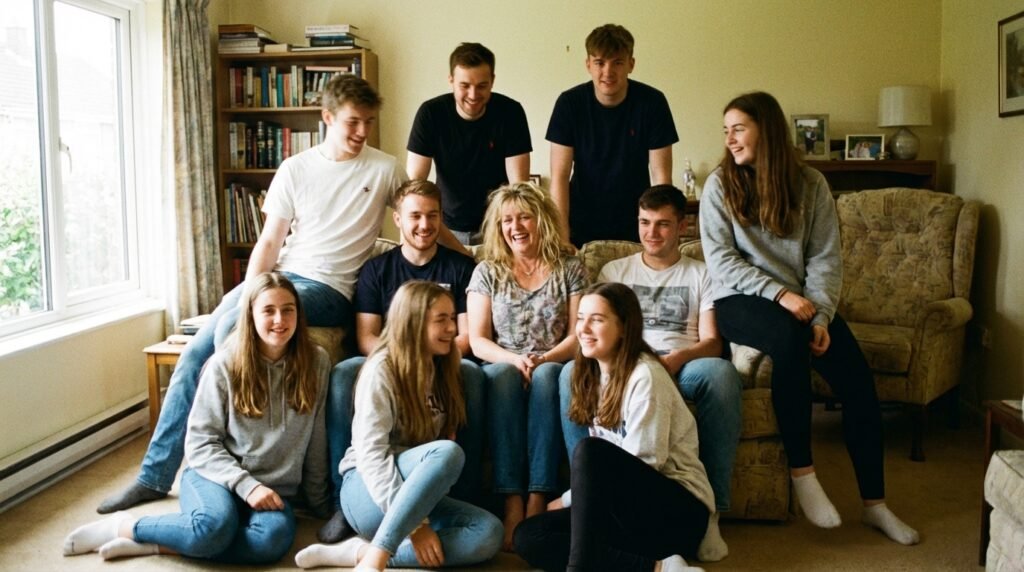
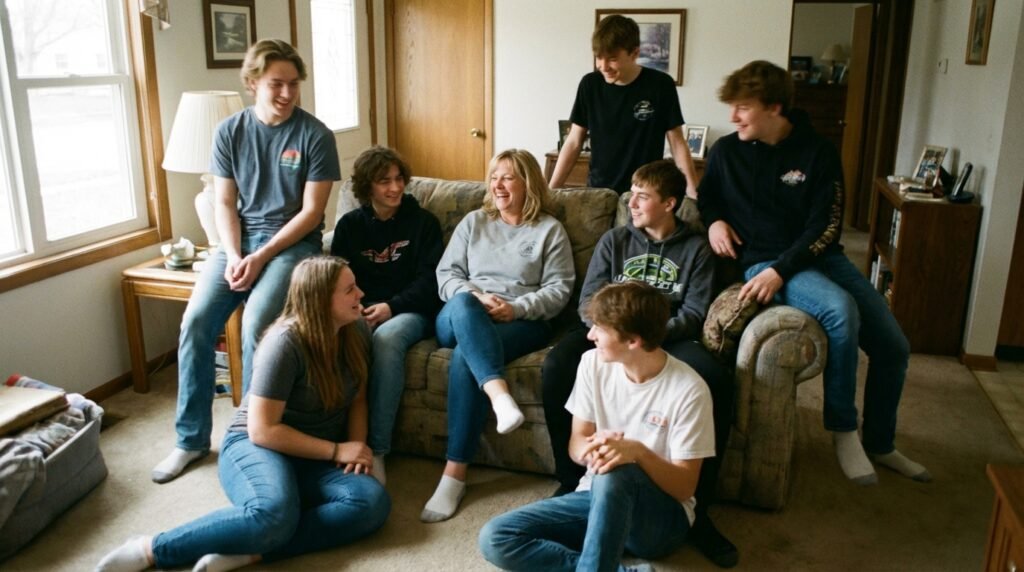
We went to a local diner—all eleven of us. We sat at a long table, and for the first time in ten years, we didn’t talk about him.
We talked about Sarah’s law school applications. We talked about Toby’s art. We talked about the way the light looked in the garden my mom had finally found time to plant.
As the sun set, my mom leaned over and squeezed my hand.
“Are you okay?” I asked.
She looked at her reflection in the window—a woman who was no longer defined by who had left her, but by who had stayed.
“I’m more than okay,” she said. “I’m free.”
The legacy of my mom wasn’t the pain she endured; it was the fact that she taught us how to survive it.
We walked out of that diner together, a fortress that no one would ever crack again.