


The wind in New York City doesn’t just blow; it bites. It searches for the gaps in your clothing, the holes in your shoes, and the cracks in your spirit. On that Tuesday in November, I felt every single jagged edge of it. I adjusted the collar of my thin denim jacket, a garment that had seen better decades, and looked down at my daughter.
Chloé was sick.
That word—sick—felt too small for the monster living inside her bone marrow. Leukemia had stripped the gold from her hair and the roses from her cheeks. At five years old, she looked like a fragile porcelain doll that had been dropped and glued back together too many times. Her grip on my hand was a ghost of what it used to be, but she walked with a stubbornness that kept my own heart beating.
We had three days.
Three days until the eviction notice on our door became a reality. Three days until our “home” became a rusted 2009 sedan with a heater that coughed more than it blew. My wallet held exactly seven dollars. I had used five of them to buy Chloé a soft pretzel from a street vendor.
“Aren’t you eating, Daddy?” she asked, her voice thin as parchment.
“I had a big lunch while you were napping, baby,” I said.
That was lie number one. My stomach was a hollow cavern, echoing with the dull ache of hunger, but I would have eaten glass before I took a bite of her only meal.
The Man in the Anthracite Coat
As we neared the Sheep Meadow, the usual bustle of the park seemed to hit a dead zone. People were veering off the path, pulling their leashed dogs tight, and lowering their voices. I saw why.
Sitting on a wrought-iron bench was a man who looked like he owned the world but hated everything in it. He wore an anthracite wool coat—the kind of fabric that looked like it could repel bullets. His face was a mask of cold, chiseled granite. His jaw was set so tight I thought his teeth might shatter.
He radiated a silent, vibrating fury. He was the most feared-looking man I had ever seen in Central Park. He wasn’t just a stranger; he was a warning.
“Come on, Chloé,” I whispered, tugging her hand. “Let’s go see the ducks.”
But Chloé didn’t move. She was staring at him. Her large, sunken eyes were fixed on the man’s face with an intensity that made my skin crawl.
“Daddy,” she said. “That man is breaking.”
“He’s just busy, honey. Let’s go.”
“No,” she insisted, slipping her hand out of mine. “His heart hurts like mine.”
Before I could grab her, she started walking. My heart hammered against my ribs—a frantic, panicked rhythm. I watched, paralyzed, as my sick little girl, wearing a faded beanie and oversized sneakers, walked straight up to the man who looked like he could crush a soul with a glance.
The Confrontation of Souls
I rushed forward, my breath hitching in my throat. “Chloé! Stop!”
The man’s head snapped up. His eyes were dark, bloodshot, and terrifying. He looked at me, then down at the small child standing inches from his expensive leather boots. I reached for her shoulder, ready to apologize, to beg, to run.
“I’m so sorry, sir,” I blurted out. “She’s… she’s not herself. We’re leaving right now.”
The man raised a gloved hand. One finger pointed at me. “Stop.”
The word wasn’t a request. It was a command that carried the weight of a mountain. I froze. The silence between us was heavy, filled only with the distant sound of city traffic and the whistling wind.
He turned his gaze back to Chloé. He scanned her. He saw the pale skin, the dark circles, the way the oversized beanie sat on her hairless head.
“Why are you looking at me like that?” he asked. His voice was a low growl, like shifting gravel.
Chloé didn’t flinch. She pointed a small, trembling finger at the center of his chest. “Because you’re broken inside. Does your heart hurt like mine?”
The man’s rigid posture didn’t just soften—it collapsed. It was like watching a skyscraper implode in slow motion. His shoulders sank, and the terrifying mask of anger evaporated, revealing a hollow, haunted vacuum of grief.
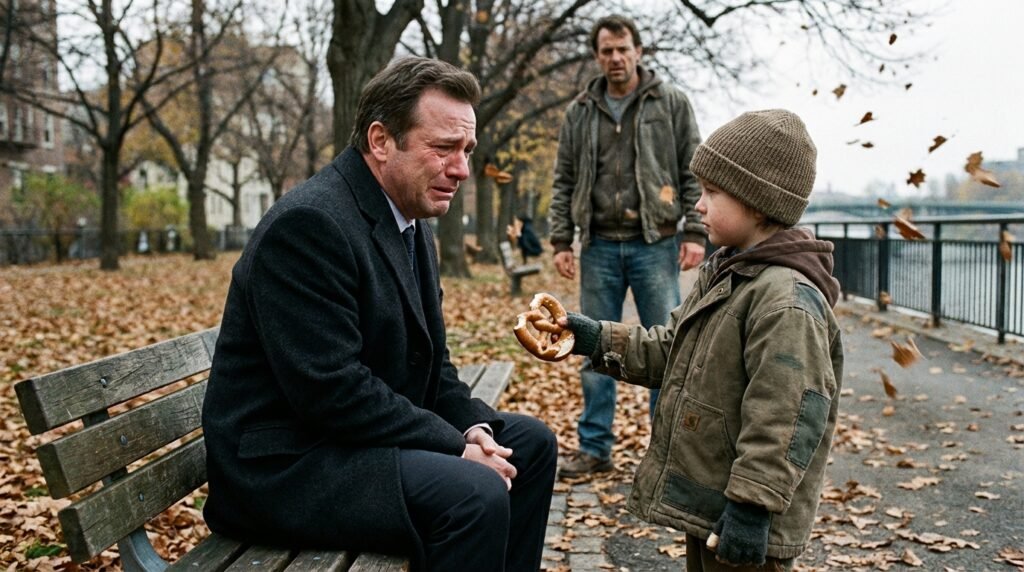
“Can I sit here?” Chloé asked, gesturing to the empty space on the bench.
The man closed his eyes for a second, a single shuddering breath escaping his lips. “Sit,” he rasped.
A Memory of Better Days
As Chloé climbed onto the bench, her legs dangling, my mind flashed back to a year ago. We were in a different park, under a warmer sun. Chloé had been running, her blonde pigtails bouncing, her laughter loud enough to drown out the world. I remembered her mother, Elena, laughing with her.
Elena was gone now. She hadn’t died; she had just… left. When the diagnosis came, when the bills started piling up like a mountain of salt, she couldn’t take the pressure.
“I can’t watch her die, Mark,” she had screamed at me in our tiny kitchen. “I can’t be part of this.”
She had walked out, leaving me with a sick child and a broken heart. I had fought every day since then to be enough for both of us. But standing here, watching a stranger look at my daughter, I realized how close I was to the edge.
The Shared Pretzel
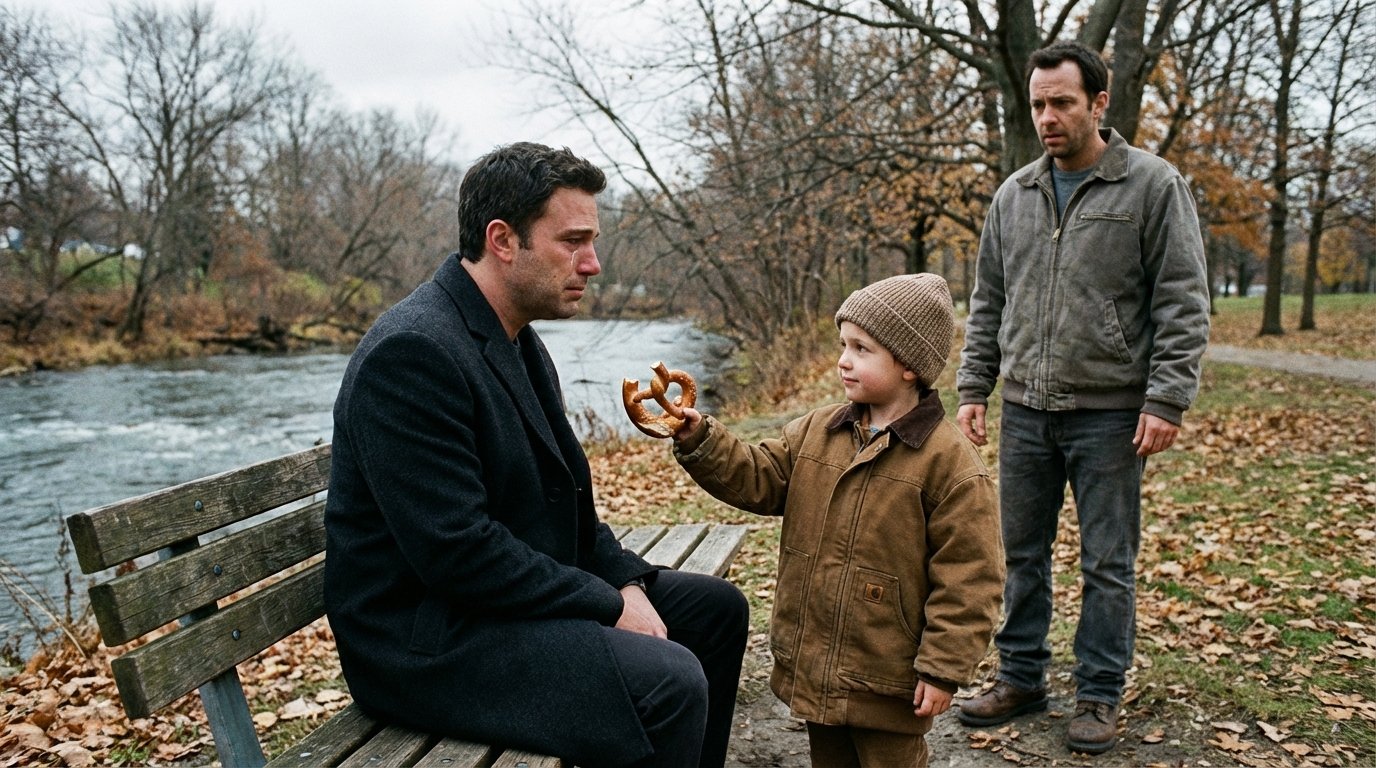
Chloé reached into her pocket and pulled out the remaining half of her pretzel. It was cold, saltless, and slightly smashed.
“Do you want some?” she offered. “My daddy says sharing makes the pain go away.”
The man stared at the piece of dough. He looked at me, his eyes searching mine. I saw it then—not just wealth, but a profound, agonizing recognition.
“I have millions,” he whispered, his voice cracking. “I could buy this entire park. I could buy the buildings surrounding it. But I cannot buy a single second of time.”
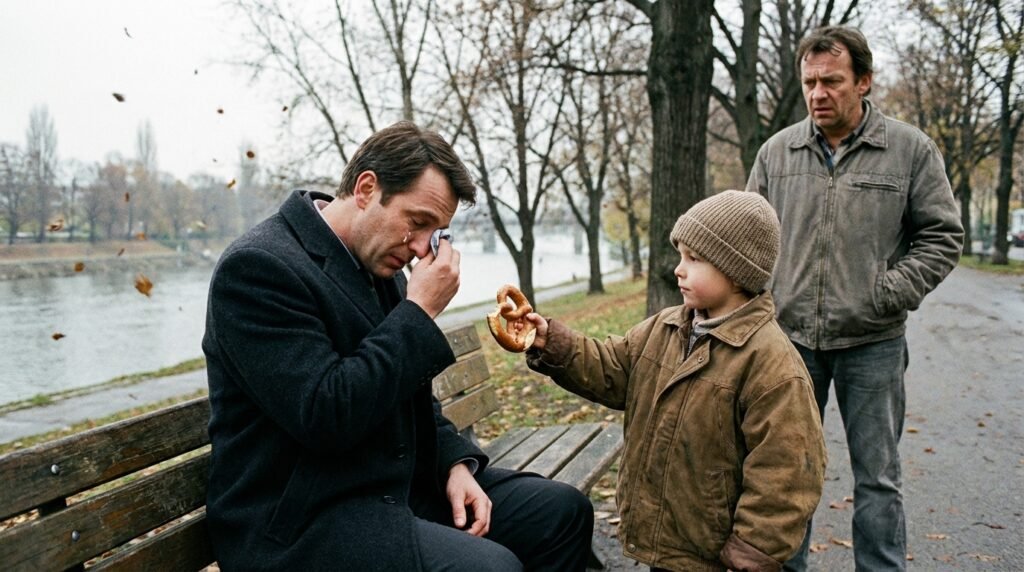
He took the piece of pretzel. His fingers were trembling so violently he almost dropped it. He took a bite, chewed slowly, and then looked at the frozen pond.
“What is your name, little one?”
“Chloé. I’m five. I have leukemia, but my daddy says I’m a fighter. I’m going to be a dancer when I grow up.”
The man bowed his head. A single tear escaped, tracing a path through the stubble on his cheek.
“My name is Arthur,” he said. “And I had a little girl too. Her name was Sarah.”
The air around us grew still. I felt a chill that had nothing to do with the November wind.
“Where is she?” Chloé asked with the devastating innocence only a child possesses.
Arthur looked at his watch, then back at the pond. “She’s gone,” he whispered. “She passed away… yesterday. She was exactly your age.”
The Revelation of Arthur Sterling
The world seemed to tilt. This man wasn’t a monster. He wasn’t some cold-hearted tycoon hiding from the world. He was a father who had just lost his soul. He was sitting in the cold because the warmth of his home was likely unbearable now.
“I’m so incredibly sorry,” I said, my voice barely audible. “I… I had no idea.”
Arthur looked at me. Really looked at me. He saw my frayed sleeves. He saw the way I stood—the posture of a man who had spent months sleeping in hospital chairs and skipped meals to pay for prescriptions.
“You’re struggling,” he said. It wasn’t an insult; it was a cold observation.
“We’re fine,” I lied. Lie number two.
“Don’t lie to me,” Arthur said. The steel returned to his voice, but it was tempered with empathy. “I know the look of a man who is losing everything. I am losing my mind. You are losing your ground.”
He reached into the inner pocket of his coat. I expected a wallet. I expected him to hand me a hundred-dollar bill to make himself feel better.
Instead, he pulled out a phone. He tapped a contact and held it to his ear, his eyes never leaving mine.
“James?” Arthur said. “Bring the car to the south entrance. Immediately. And call Dr. Miller, the Chief of Pediatric Oncology at Mount Sinai. Tell him Arthur Sterling is on his way. Tell him I’m bringing a VIP patient. We will be there in twenty minutes.”
He hung up and stood. He was a tall man, imposing and powerful.
“You will not sleep in a car tonight,” Arthur said, his voice ringing with a newfound purpose. “And Chloé will not fight this battle in a public ward ever again.”
The Letter and the Twist
The next six months were a blur of white hallways, high-tech machinery, and the best medical care money could buy. Arthur didn’t just pay the bills; he became a shadow in our lives. He visited every Tuesday. He brought Chloé books. He sat with her during the long, grueling rounds of chemotherapy that finally, miraculously, began to work.
But there was always a distance in him. A secret he held close.
On the day Chloé was declared in remission, Arthur didn’t show up. Instead, his assistant, James, handed me a thick cream-colored envelope.
“Mr. Sterling asked that you read this only when you were home,” James said.
We weren’t going back to the car. Arthur had arranged a small apartment for us near the hospital. I sat at the kitchen table, my hands shaking as I tore open the seal.
Mark,
By the time you read this, I will be out of the country. Being near Chloé was the only thing that kept me from following Sarah into the dark. She saved my life that day in the park. She saw a ‘broken’ man and offered him a piece of a five-dollar pretzel. It was the most expensive meal I’ve ever had.
But there is something you need to know. Something I couldn’t tell you while she was still fighting.
My daughter, Sarah, didn’t just die of an illness. She died because of a failure in a medical logistics system—a company I owned. I was so focused on profit margins that I overlooked a flaw in the distribution of a specific clinical trial drug. By the time I realized the error, it was too late for her.
I spent months in that park looking for a reason to keep breathing. When Chloé walked up to me, I thought God was playing a cruel joke. But then she asked me if my heart hurt like hers.
I realized then that I couldn’t save Sarah, but I could save the child who was suffering because of the world I helped build. The drug Chloé received at Mount Sinai? It was the corrected version of the medicine my daughter never got.
In the desk drawer of the apartment, you will find the deed to this home and a trust fund in Chloé’s name. It is not a gift. It is a debt. I am not a hero, Mark. I am a father trying to earn his way back to his daughter.
Take care of her. She is the bravest soul I have ever known.
— Arthur
Finding Closure
I let the letter fall to the table. The “feared man” of Central Park wasn’t a benefactor; he was a man seeking penance. He had looked at my sick daughter and seen the ghost of his own failure, and he had spent millions to ensure that no other father felt the weight of the “frozen silence” he carried.
I walked into Chloé’s room. She was sleeping, her breath deep and even. A fine fuzz of new, dark hair was beginning to sprout on her head. She looked peaceful.
I thought about the pretzel. I thought about the bitter wind.
I realized then that life isn’t about the tragedies that break us, but about the tiny, half-eaten pieces of ourselves we offer to others when they are broken, too.
Arthur Sterling gave us a future, but Chloé gave him his humanity back. And in the end, that was the greatest trade ever made in the heart of New York City.