


A Widow’s Last Gamble
The mountain house stood at the edge of the world, a jagged silhouette of rotting timber and cracked adobe against a bruising purple sky.
Hope stood at the foot of the driveway, her knuckles white as she gripped the handle of a cardboard suitcase that held her entire life. Every breath felt like swallowing needles. At five months pregnant, her body was a heavy, aching reminder of a future she wasn’t sure she could provide for.
The Mantiqueira Mountains didn’t welcome visitors; they endured them.
“Is this it?” she whispered, her voice lost to the howling wind. “Is this where we start, little one?”
Her husband, João, had been a man of quiet strength, a man who smelled of sawdust and honest toil. But honesty hadn’t paid the medical bills when his lungs began to fail. He had died in a hospital bed that smelled of bleach and indifference, leaving Hope with a hollow heart and a bank account that mocked her.
She remembered the funeral—a blur of grey rain and the heavy thud of earth against wood. Her mother, Elena, had stood there with eyes like flint, refusing to hold Hope’s hand.
“I told you he was a dreamer, Hope,” Elena had hissed under the black umbrella. “Now you’re a widow with a belly full of nothing. Come home. Scrub floors for the colonel’s wife like I do. It’s the only life for people like us.”
But Hope couldn’t go back to that life of servitude. She had taken her remaining 3,000 reais—every cent meant for the baby’s birth—and bought a deed to a property no one wanted.
The clerk at city hall had laughed when she signed the papers. “That mountain house hasn’t seen a soul in a hundred years, señora. The ghosts own it now.”
Hope didn’t care about ghosts. She was more afraid of the living.
The Conflict: Survival in the Shadows
The first week was a masterclass in misery.
The mountain house was a skeletal wreck. Rain leaked through the roof like tears, and the floorboards groaned under her weight, complaining about the sudden intrusion of life.
She spent her mornings hauling water from a nearby creek, her back screaming as she lugged the heavy pails. Her meals were meager—cold beans and hard bread—but she ate every crumb, patting her belly with a hand that had grown rough and calloused.
“We’re okay,” she’d whisper into the darkness of the master bedroom. “We’re together.”
But the silence was the hardest part. It was a thick, physical thing that settled over the house at night. In that silence, her mother’s voice returned to haunt her.
You’ll fail, Hope. You’re just like your father. A runner. A fool.
To drown out the thoughts, Hope began to clean. She scrubbed the grime of a century from the walls until her fingers bled. She tore down moth-eaten curtains and swept away the desiccated remains of insects that had claimed the house as their tomb.
On the tenth day, she tackled the study. It was a room that felt heavier than the others, tucked away in the back of the house where the sun rarely reached.
Centered on the far wall was a painting.
It was a massive, oil-on-canvas landscape of the valley below, but it was so choked with dust and soot that the colors looked like bruises. Hope reached out to pull it down, expecting it to slide off a nail.
It didn’t move.
She tugged harder. The entire wall seemed to shudder.
“What are you hiding?” she muttered, her curiosity finally outweighing her exhaustion.
The Discovery: Behind the Canvas
Hope grabbed a rusted crowbar she had found in the shed. She wedged it behind the heavy wooden frame and heaved with all her strength.
With a sound like a bone snapping, the frame didn’t fall—it swung.
It was a door. A perfectly concealed, shallow vault carved directly into the adobe and reinforced with ironwood.
Hope’s breath hitched. Her heart hammered against her ribs, a frantic bird trapped in a cage. Behind the painting lay a cavity, and inside that cavity sat a small, leather-bound trunk and a stack of letters tied with a faded blue ribbon.
The leather was cracked, smelling of ancient cedar and something metallic.
She reached in, her fingers trembling. As she pulled the trunk out, a small, heavy object fell to the floor.
It was a key. Solid gold.
Hope sank to the floor, her legs giving out. She stared at the key, then at the trunk. This house had been sold for taxes—abandoned by a family that had vanished a century ago. How had this stayed hidden? Why hadn’t the previous owners claimed it?
She fumbled with the lock. It clicked open with a hauntingly smooth sound.
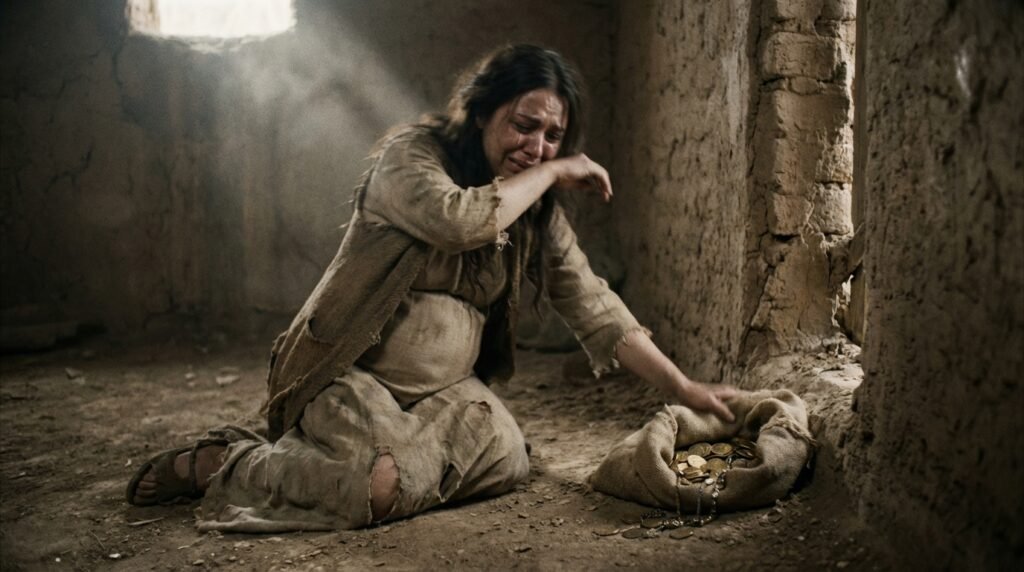
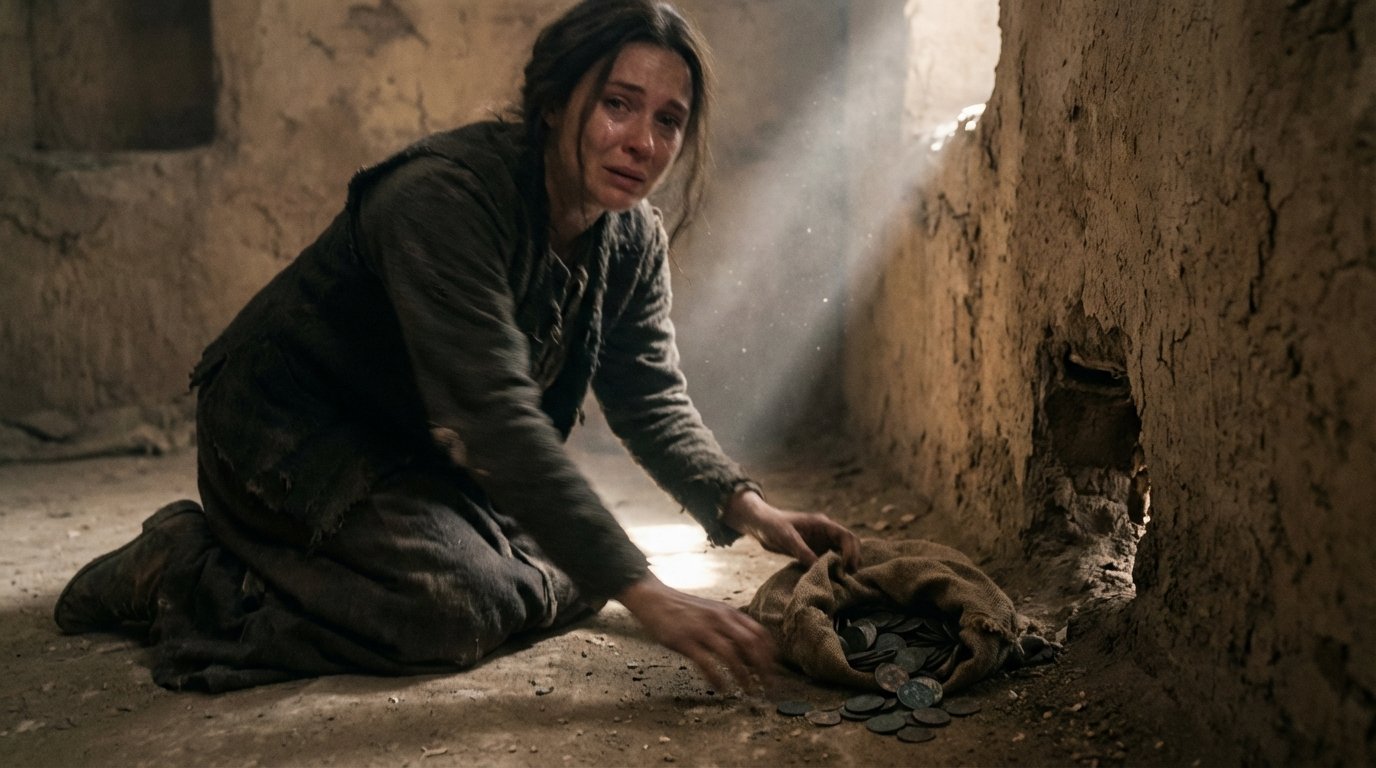
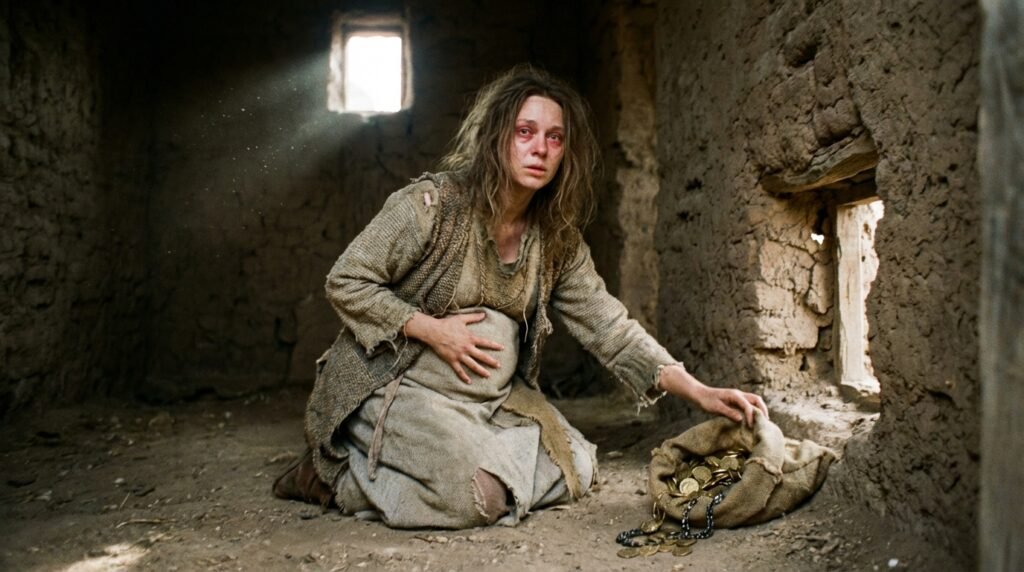
Inside, nestled in rotting velvet, were rows of gold coins—Imperial Reais from the time of the Monarchy. But it wasn’t the gold that stopped her heart.
It was the photograph tucked into the lid.
It was a woman. She was wearing a high-collared lace dress, her hair pinned back in a style from the late 1800s. She looked remarkably like Hope’s grandmother.
But it was the man standing behind her that made Hope gasp. He had the same arched eyebrows, the same stubborn set of the jaw as Hope herself.
And around the woman’s neck was a locket Hope recognized. A locket her mother, Elena, still wore every single day.
The Revelation: A Century of Lies
Hope didn’t sleep that night. She sat by a single candle, reading the letters.
The handwriting was elegant but frantic, the ink fading into the yellowed parchment. They were letters from a woman named Clara to a man named Mateo.
As she read, the pieces of a jagged history began to fit together.
Mateo hadn’t been a random stranger. He was the son of a wealthy landowner who had fallen in love with a servant—Hope’s great-great-grandmother. They had built this mountain house in secret, a sanctuary away from the judgmental eyes of the valley.
The gold was Mateo’s inheritance, stolen from his father to fund a life of freedom for his bride.
But the final letter, dated October 1926, changed everything.
“Mateo, they are coming. Your father’s men have reached the lower pass. I have hidden the coins and the deed behind the valley painting. If I am taken, find our daughter. Take her to the coast. Do not let them turn her into a slave as they did me.”
Hope realized with a jolt of horror that Clara hadn’t escaped.
She remembered the stories her mother told—stories of a “great-aunt” who had disappeared, leaving the family in poverty. But the letters told a different story. The family hadn’t been victims of bad luck; they had been victims of a calculated betrayal.
Elena knew.
Hope stood up, the letters clutched to her chest. The anger burned through her cold bones, hotter than any fire. She understood now why her mother had been so bitter, why she had tried to keep Hope small and subservient.
Elena hadn’t been protecting her. She had been hiding the shame of a legacy she was too afraid to claim.
She packed the gold and the letters into her bag. The sun was beginning to rise, painting the mountains in hues of gold and blood.
The Ending: The Price of Truth
Three days later, Hope stood on her mother’s porch in the valley.
Elena looked older, her face a map of disappointments. She looked at Hope’s dusty boots and her swollen belly with a sneer.
“Back already?” Elena asked, wiping her hands on her apron. “I told you that mountain house would break you. Did you come to beg for your old job back?”
Hope didn’t say a word. She reached into her bag and pulled out the gold locket from the trunk—the sister to the one Elena wore. She held it up.
Elena’s face went white. The color drained from her lips until she looked like a ghost.
“Where did you find that?” Elena whispered, her voice cracking.
“In the house you told me was worthless,” Hope said, her voice steady and cold. “In the house where our family’s freedom was buried because you were too cowardly to go looking for it. You let us live in dirt, Mom. You let João work himself to death for pennies while this was sitting up there.”
“I was protecting us!” Elena screamed, tears finally breaking through the flint. “The colonel’s family… they would have killed us if they knew we had Mateo’s gold! I chose life over money!”
“You chose fear over legacy,” Hope countered.
She stepped off the porch, turning her back on the woman who had tried to keep her in the shadows.
“I’m keeping the house,” Hope said over her shoulder. “I’m fixing the roof. I’m planting a garden. And my child will grow up knowing exactly who they are. We aren’t servants, Mom. We’re the owners of the mountain.”
Hope walked away, her head held high.
She returned to the mountain house, but it didn’t feel crumbling or wounded anymore. It felt like a fortress.
With the gold, she hired men from the village to repair the beams and install windows that sparkled like diamonds. She bought soft wool for the baby’s blankets and a stove that hummed with warmth.
Months later, as Hope held her newborn son by the fireplace, she looked up at the painting of the valley. The secret was out, the weight was gone, and for the first time in a hundred years, the house was full of light.