

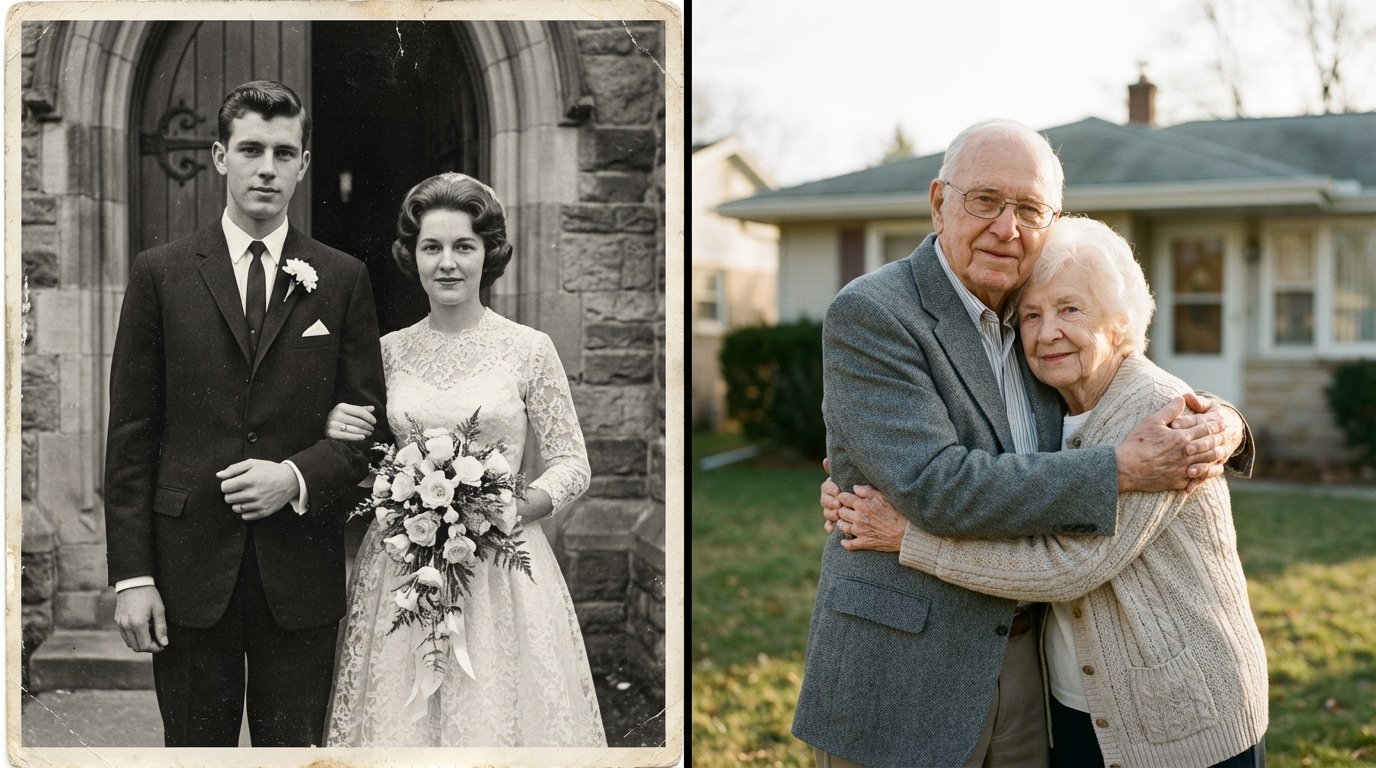
The morning my husband died, the silence in our bedroom was heavier than the grief itself. For sixty-two years, Harold’s breathing had been the rhythmic metronome of my life. When it stopped, the world lost its pulse.
The Beginning: A Love Built on Certainty
The funeral was a blur of black lace and polite whispers. I stood by the mahogany casket, my fingers tracing the polished wood. My legs felt like lead, barely supporting the weight of my eighty-year-old frame.
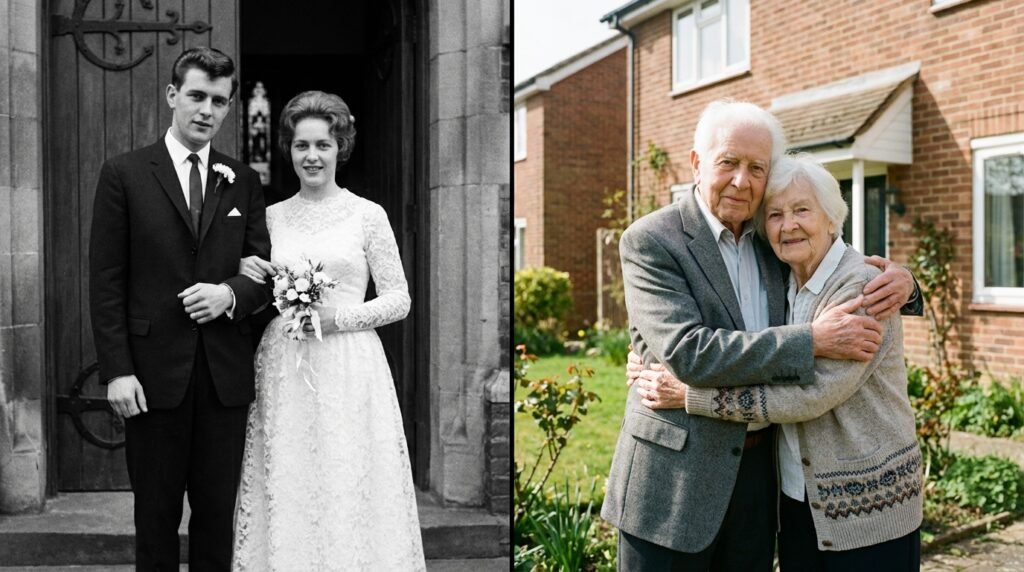
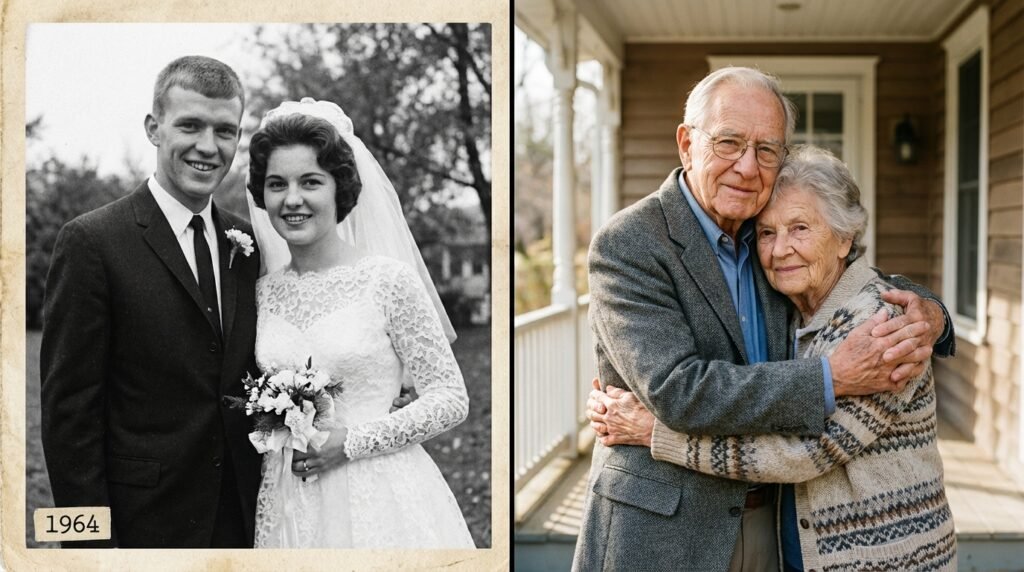
I remembered the first time those hands held mine. I was eighteen, a girl with ribbons in her hair and a heart full of unwritten poems. Harold was twenty-one, smelling of peppermint and old books.
We had married within a year. It was a whirlwind of youthful certainty. We built a life out of modest paychecks and immense dreams. Two sons, three grandchildren, and six decades of shared coffee and Sunday drives.
I thought I knew every crease on his face. I thought I knew every shadow in his soul. I was wrong.
The Girl in the Shadows
As the service ended and the mourners began to trickle toward the exit, a figure appeared at the back of the church. She was young—no more than twelve or thirteen—with wild dark curls and eyes that looked too old for her face.
She didn’t belong here. She wasn’t family, and she wasn’t from our small, tight-knit circle. She walked toward me with a purpose that made the air in the room feel thin.
“Are you Harold’s wife?” she whispered. Her voice was steady, lacking the tremor of a grieving child.
I nodded, unable to find my voice. My heart began to drum a frantic rhythm against my ribs.
She reached into a small satchel and handed me a thick, cream-colored envelope. The paper felt heavy, almost cold.
“Your husband asked me to give this to you on this exact day,” she said. “At his funeral.”
Before I could ask her name, or how she knew a man who had been bedridden for months, she turned and ran. She vanished through the heavy oak doors like a ghost retreating from the light.
The Conflict: The Weight of the Envelope
I sat in the back of the black sedan on the way home, the envelope burning a hole in my purse. My daughter, Elena, sat beside me, her eyes red from weeping.
“Who was that girl, Mom?” Elena asked, wiping her nose with a damp tissue. “I saw her talk to you.”
“I don’t know,” I lied. The lie tasted like copper in my mouth.
I didn’t want to share this. Not yet. Harold had always been a man of simple truths, or so I believed. But the secrecy of this delivery felt like a crack in a dam.
A House Full of Ghosts
When we arrived home, the house felt cavernous. Every clock seemed to tick louder. Elena stayed to help me change, her movements frantic and nervous.
“You need to rest, Mom. The doctor said your blood pressure is too high,” she scolded, though her hands were shaking as she folded a blanket.
“I’m fine, Elena. I just need a moment alone,” I snapped. It was harsher than I intended.
She looked at me, hurt flashing in her eyes. “He was my father, too. You act like you’re the only one who lost him.”
The confrontation hung in the air, bitter and jagged. I wanted to scream that her father had sent a messenger from the grave, but the words wouldn’t come. I pushed her out gently, promising to call her in the morning.
Once the door clicked shut, I retreated to Harold’s study. The room still smelled of his tobacco and the leather of his favorite chair.
The Discovery: The Letter and the Key
I opened the envelope with a silver letter opener. My hands shook so violently that I nearly tore the paper.
A heavy, brass key tumbled out. It hit the desk with a dull thud.
I unfolded the pages. It was Harold’s handwriting—the familiar, slanted script that had decorated every birthday card and grocery list for a lifetime. But the words were different. They were heavy with a guilt I didn’t recognize.
The Letter from the Grave
“My dearest Martha,” it began.
“If you are reading this, I am gone, and the girl has found you. Do not be angry with her; she is merely the final link in a chain I forged sixty-five years ago.”
My breath hitched. Sixty-five years? That was three years before we even met.
“I have lived a lie every single day we were married. Not a lie of love—for I loved you with every fiber of my being—but a lie of identity. Before I was Harold, I was someone else. Someone who did something unforgivable.”
The room felt like it was spinning. I gripped the edge of the desk.
“In the outskirts of the city, there is a storage facility. Garage No. 122. The key is in your hand. Please, Martha, go there. See what I have kept. I couldn’t die with it still hidden, but I couldn’t live if you knew the truth while I was still here to see the look in your eyes.”
The Taxi Ride into the Unknown
I didn’t call a friend. I didn’t call my sons. I called a taxi.
The driver was a silent man, for which I was grateful. We drove away from the manicured lawns of our suburb and into the industrial grayness of the city’s edge.
The sun was setting, casting long, bruised shadows across the rows of corrugated metal doors. My mind raced through every memory. Was he a criminal? A runaway? A man with another family?
We pulled up to “Blue Sky Storage.” I asked the driver to wait. My legs felt stronger now, fueled by a terrifying surge of adrenaline.
The Revelation: The Enormous Box
I found Garage No. 122. The lock was rusted, but the brass key turned with a smooth, oily click.
The door groaned as I slid it upward. The air inside was stale, thick with the smell of motor oil and ancient dust.
In the center of the concrete floor stood an ENORMOUS BOX.
It was built of heavy plywood, reinforced with steel bands. It was nearly seven feet tall and just as wide. Cobwebs draped over it like a funeral veil.
I approached it with a sense of impending doom. I found a crowbar leaning against the wall, as if Harold had placed it there specifically for me.
The Truth Unveiled
I pried the first board loose. Then the second.
“OH GOD… WHAT HAVE YOU DONE, HAROLD?”
I collapsed onto the cold floor. My vision blurred, and a wave of nausea washed over me.
Inside the box wasn’t a body. It wasn’t money.
It was a masterpiece.
It was a statue, carved from white marble, of a woman. But it wasn’t me. It was a woman with sharp, haunting features, holding a child. The craftsmanship was breathtaking—the kind of work seen in the great galleries of Europe.
Tucked into the base of the statue was another note, yellowed with age.
The Secret of the Sculptor
“Her name was Julianne,” the note read.
“In 1961, I was an artist in a small village. I was reckless. I was driving too fast on a rain-slicked road. I hit a car. Julianne didn’t survive. The child in her arms—a miracle—did.”
“I fled. I was a coward. I changed my name, moved three states away, and buried my tools. I met you, and you saved me from my own darkness. But I could never stop carving her. I spent sixty years coming to this garage, hour by hour, inch by inch, carving my guilt into stone. I used the money from my ‘overtime’ at the firm to support the child I orphaned—anonymously. The girl who gave you the letter? She is Julianne’s great-granddaughter.”
I stared at the marble eyes of the woman Harold had killed. He hadn’t been working late all those years. He had been here, in the cold, bleeding his soul into a rock.
The Ending: Forgiveness in the Dust
I sat in that dusty garage for hours. The anger came first—a hot, searing rage that he had kept such a massive part of himself hidden.
But then, the sadness followed. I thought of my husband, a man I deemed “simple,” carrying the weight of a death for sixty-two years. Every kiss, every laugh, every holiday—he had been carrying a ghost.
A Final Goodbye
I reached out and touched the marble cheek of the woman. It was cold, but the lines were filled with a strange kind of love—not romantic love, but the love of a man seeking penance.
I realized then why he waited until his funeral. He wanted me to have the memories of a happy life first, untainted by the shadow of his sin. He gave me sixty-two years of peace before asking me to carry his burden for the last few of mine.
Emotional Closure
I called Elena.
When she arrived at the garage, she screamed, then she cried. We sat together on the floor, two generations of women leaning against the evidence of a man’s greatest shame and his greatest art.
“What do we do, Mom?” she asked softly.
“We finish it,” I said.
We didn’t call the police. The statute of limitations on his crime had passed decades ago, but the debt was still being paid. We set up a trust for the young girl and her family, funded by the sale of the house Harold had worked so hard to provide.
The day my husband died, I thought I lost him. But in that garage, I finally truly met him.
I sold the statue to a museum under the name “The Penitent.” I visit it sometimes. I look into the marble eyes and I whisper to Harold that I forgive him.
The silence in our bedroom isn’t heavy anymore. It’s just quiet. And in the quiet, I finally found the man I loved.