



The 38th-floor door slammed shut, the sound echoing through the sterile, glass-walled corridor of Siqueira Prime. In the heart of Curitiba, where the city lights glittered like fallen diamonds against the Brazilian night, the billionaire Otavio Siqueira lived for that sound. It was the sound of closure. The sound of a world perfectly aligned.
The echo, however, wasn’t the loudest thing in the room tonight.
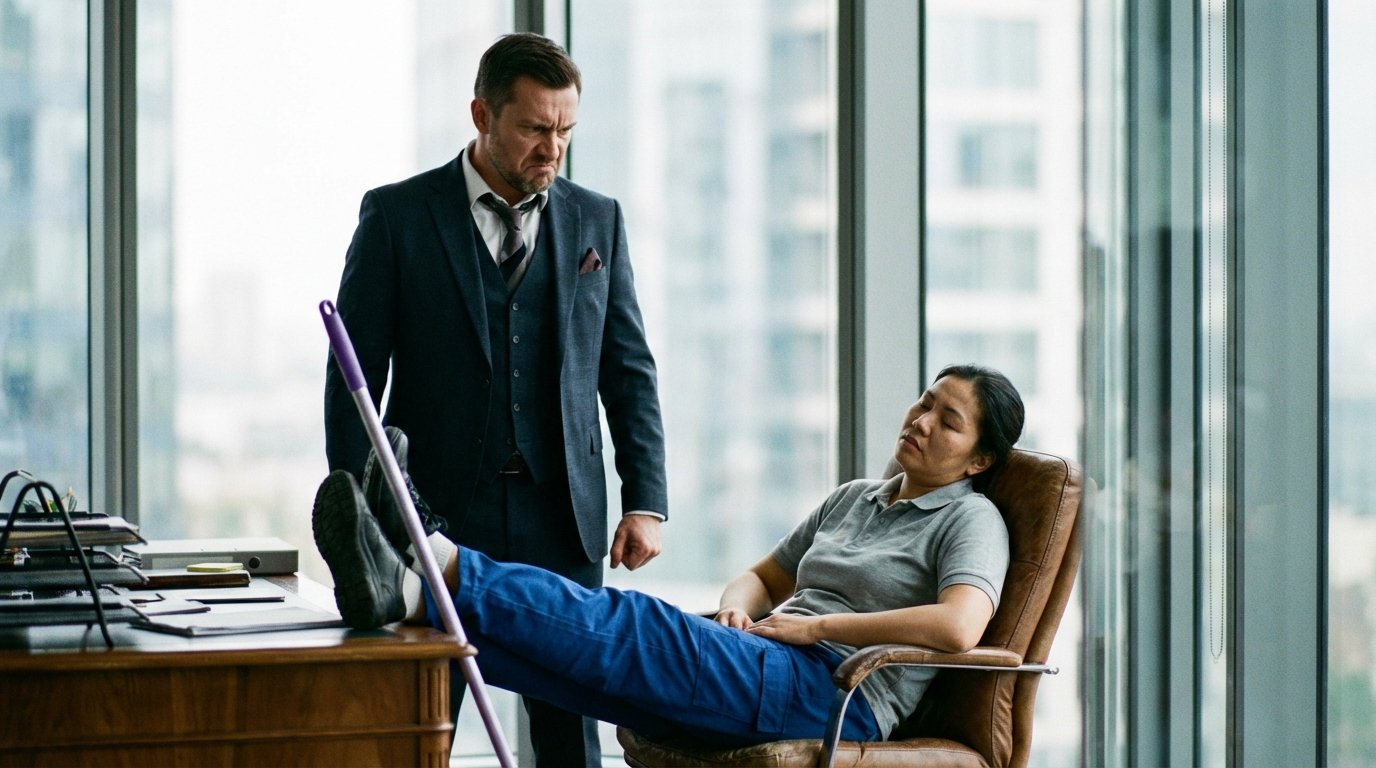
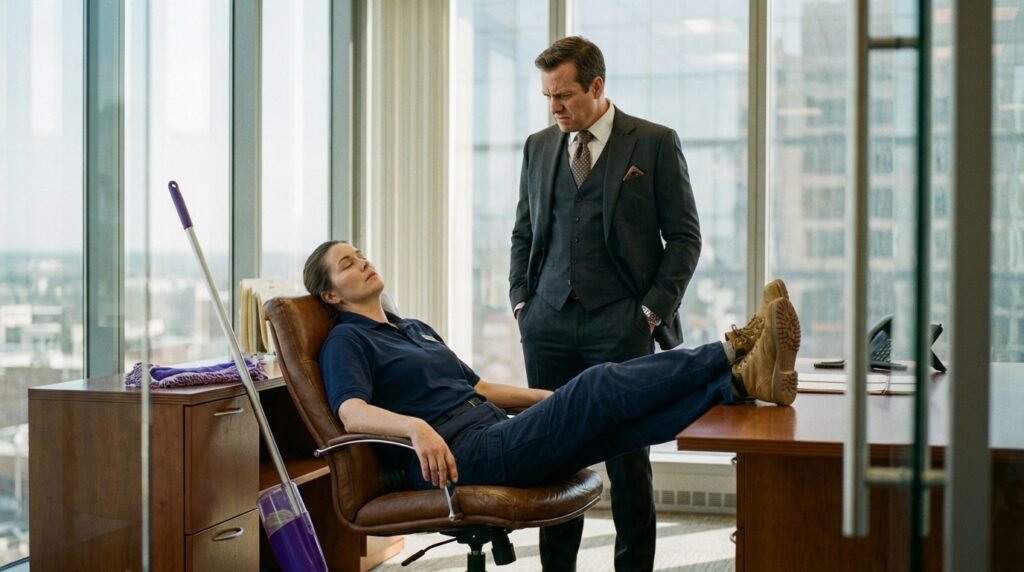
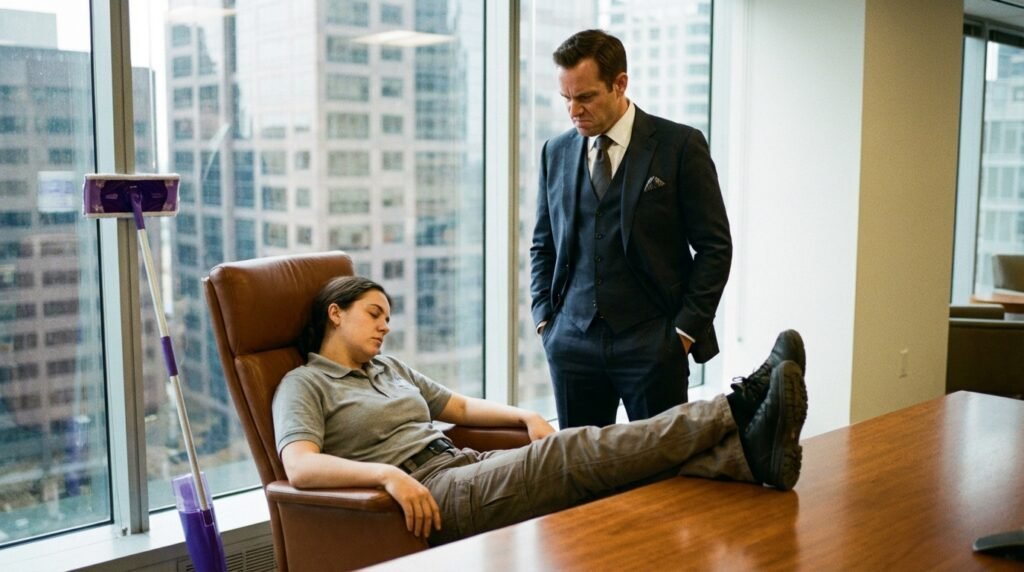
The loudest thing was the sight of a woman passed out in the most expensive leather chair in the entire building.
Otavio stopped mid-step. His leather briefcase, handcrafted in Italy, felt suddenly heavy. That chair—an “untouchable” throne of mahogany and calfskin—was sacred territory. It was more than furniture; it was a monument to his father’s legacy and his own ruthless ascent. Nobody touched it. Nobody sat in it. His executives didn’t even hover near it without an explicit invitation.
But there she was.
The janitor wore a faded blue cleaning uniform that had seen too many wash cycles. Her ID badge hung crooked against her chest, and her dark hair, once pinned in a tight, professional bun, had surrendered to gravity, strands sticking to her forehead with the salt of honest sweat. Her hands rested on the chair arms like the world had finally hit pause, her fingers curled slightly as if clutching at a dream she couldn’t afford to keep.
The Collision of Two Worlds
Otavio felt a slow, searing heat crawl up his neck. He ran Siqueira Prime like a high-precision Swiss watch. He was a man who straightened crooked picture frames with a ruler and measured success by the silence of his subordinates. To him, this wasn’t just a breach of protocol; it was an invasion.
He took three predatory steps forward. His shadow fell over her, obscuring the moonlight. He reached out, his grip on her shoulder hard and devoid of softness.
“Wake up,” he commanded, his voice a low vibration of suppressed rage.
She jolted. Her eyes snapped open—large, amber-colored, and clouded with the fog of deep exhaustion. But she didn’t flinch. She didn’t scramble to her feet or offer a frantic apology. Instead, she sat up straight, pulled in a jagged breath, and met his stare with a quiet, terrifying dignity.
“I worked eighteen hours,” she said. Her voice didn’t tremble. It was flat, forged in the furnace of a long day. “If you want to fire me, fire me. But I needed to sit.”
Otavio blinked, feeling as though he’d been physically slapped. Eighteen hours? He searched her face for the familiar signs of a corporate grifter—the exaggerated drama, the practiced excuse. He found nothing but the drained, greyish pallor of someone who had been pushed past the human breaking point.
“Your name?” he asked, his tone shifting from a sentence to a question.
“Renata Lopes.”
“Two days on the job and you’re sleeping in my chair, Renata?”
Renata lifted her chin. “Tonight, the supervisor made me clean three floors because the night shift didn’t show. I started at six a.m. My leg locked up. I finished your office last.” Her breath hitched, just once. “I just… I shut down.”
A Perfection Built on Pain
Otavio looked around his sanctuary. The room was flawless. The glass desk was a mirror; the floor-to-ceiling windows were so clear they seemed invisible. Not a single paper was out of place. The desk looked like a photograph from a high-end architecture magazine.
The only thing “wrong” in the entire 5,000-square-foot suite was this woman’s body giving out.
“Why didn’t you ask to stop?” Otavio asked, his brow furrowing.
Renata’s mouth twitched into a ghost of a smile—a bitter, hollow thing. “Because the supervisor told me: ‘Finish, or don’t come back Monday.’ And I can’t afford a Monday without a job.”
Otavio went silent. In the high-stakes world of mergers and acquisitions, he used threats daily. He squeezed competitors; he pressured boards. But for the first time, he saw the raw, jagged edge of a threat leveled at someone with nowhere left to step back.
“How much do they pay you for this?”
“One-thirty a day,” Renata said. “When the agency actually processes the check.”
Otavio’s throat tightened. He thought of the fountain pen in his desk drawer—a limited edition Montblanc that cost more than she made in a year. He thought of his penthouse fridge, stocked with organic imports he often forgot to eat.
“Stand up,” he said.
The Discovery of a Ghost
Renata obeyed instantly, her muscles stiff, bracing herself for the humiliation of being escorted out by security. She expected the coldness. She expected the “get out.”
But Otavio didn’t move toward the door. He inhaled slowly, swallowing a lifetime of inherited pride.
“You’re not leaving,” he said, his voice dropping an octave.
Renata froze, her eyes flickering with confusion. “Sir?”
“Tomorrow, you are not going back to that contractor,” Otavio continued, his eyes locking onto hers. “I want the name of your supervisor. I want your timecards. And I want the contract that agency thinks protects them from labor laws.”
Renata’s hands began to shake now—not from fatigue, but from a sudden, sharp fear of the unknown. “Why? I just wanted to sit down. I’ll stay off the chair, I swear—”
“Because nobody works eighteen hours in my building and gets threatened for being human,” Otavio snapped, though the edge wasn’t directed at her. “And because that chair… apparently needed the truth more than I did.”
Renata swallowed hard, her eyes growing glossy. She fought the urge to cry, her jaw set in a line of iron. Then, she leaned forward, the distance between the billionaire and the janitor vanishing in the heavy air.
“My dad died on this floor,” she whispered.
The blood drained from Otavio’s face. He went perfectly still. “What did you say?”
Renata pointed a trembling finger toward the far window line, where the executive lounge met the edge of the world.
“Five years ago. He was a maintenance man. Lucas Lopes. He had a heart attack right over there while fixing the HVAC. They told the press he ‘collapsed off-site’ so Siqueira Prime wouldn’t be liable for the overtime he’d been forced to work. My mom’s sick now, and my little brother needs meds. They hired me because they knew I was desperate. They know I can’t quit. So they push… until I break. Just like him.”
The air in the office turned heavy, almost unbreathable. Otavio stared at his perfect room, his perfect rules, his perfect chair. For the first time in his life, the entire empire looked… dirty.
The Revelation of the Hidden Letter
“Wait here,” Otavio said. His voice was no longer that of a boss, but of a man haunted.
He walked to the mahogany credenza behind his desk. Hidden behind a false back in the bottom drawer was a file he hadn’t opened in years—the “Transition File” left by his father, the founder of the company.
Among the deeds and offshore accounts was a sealed envelope. It was yellowed with age, addressed simply: To the one who sits in the chair next.
Otavio tore it open. His hands, usually steady enough to perform surgery, were visibly trembling. As he read the frantic, handwritten scrawl of his father, the “Untouchable” billionaire felt his world tilt on its axis.
“Otavio, if you are reading this, it means you have finally taken the seat. There is a shadow on this floor. A man named Lucas Lopes died here. I buried the truth to save our stock price. I told his family he died in the street. I was a coward, and that cowardice is the foundation of this office. If you ever find his bloodline, give them what I didn’t have the courage to give: the truth and the debt.”
Otavio looked up at Renata. The “twist” wasn’t just that she was here; it was that his father had been waiting for this moment of reckoning from the grave. The “Untouchable” chair wasn’t a throne of power—it was a seat of penance.
“Your father didn’t just die of a heart attack,” Otavio said, his voice cracking. “He died because this company worked him to death, and my father covered it up.”
Renata’s breath hitched. “I knew it. I always knew.”
The Final Confrontation with Elena
The following Monday, the glass doors of the executive suite didn’t just open; they swung with the weight of a storm.
Elena Vance, the Head of Facilities and the woman who had overseen the “off-site” cover-up five years ago, walked in with a smirk. She saw Renata standing by the window—not in a blue uniform, but in a sharp, black tailored suit.
“Why is the help standing on the executive carpet?” Elena sneered, looking at Otavio. “I’ll have her fired and replaced by lunch.”
Otavio didn’t look up from his desk. He was signing a document—a legal filing that would strip the cleaning agency of its contract and launch a criminal investigation into Elena’s department.
“Elena,” Otavio said softly. “Do you remember Lucas Lopes?”
The smirk on Elena’s face vanished. Her skin turned a sickly shade of grey. “That… that was an unfortunate accident. Off-site. We settled with the insurance.”
“No,” Otavio stood up, walking around the desk. He didn’t stop until he was inches from her. “It was a crime. And you’re the one who signed the falsified police report.”
He turned to Renata. “Renata is no longer ‘the help.’ As of ten minutes ago, she is the new Director of Employee Welfare for Siqueira Prime. And her first task…”
Otavio looked at Elena with a coldness that would freeze the sun. “…is to escort you to the lobby, where the police are waiting to discuss the death of Lucas Lopes.”
Ending: A New Foundation
The office was quiet again.
The sun began to set over Curitiba, casting long, golden shadows across the mahogany floor. The “Untouchable” chair sat empty, but it no longer felt like a monument to a cold god.
Renata stood by the window, looking out at the city where her father had labored in the shadows. For the first time in five years, her shoulders weren’t hunched. The weight of the world hadn’t disappeared, but she finally had the strength to carry it.
“Why did you do it?” she asked, turning to Otavio. “You could have just given me a check to stay quiet.”
Otavio looked at his hands. “Because I spent thirty-eight years thinking this chair made me a king. You taught me it only made me a witness.”
He walked to her and handed her a small, velvet box. Inside was her father’s old watch—the one the company had “lost” during the accident. He had tracked it down in a police evidence locker over the weekend.
“Go home, Renata,” Otavio said gently. “Take your brother to the best doctors. I’ve already cleared the accounts. And tomorrow… we start building a company that actually deserves to stand this high.”
Renata gripped the watch, the cold metal warming against her palm. She didn’t say thank you. She didn’t need to. The silence between them was no longer the silence of fear, but the silence of a debt finally, painfully, being paid in full.