
Artificial intelligence has completely transformed how we write, edit, and create content. Whether you are a blogger, marketer, student, freelancer, or business owner, today’s AI writing tools can help you save hours of work, overcome writer’s block, and greatly improve the quality of your output.
However, with so many options available in 2026, finding the right AI writing assistant can feel overwhelming. Some tools focus on short marketing copy, while others excel at long-form articles, academic research, or creative writing.
This comprehensive guide reviews the best AI writing tools in 2026. We will compare their core features, unique strengths, pricing structures, and ideal use cases to help you find the perfect match for your workflow.
Why Use an AI Writing Tool?
Modern AI writing tools do far more than just type out text. When used correctly, they act as high-performance assistants that streamline your entire content production pipeline. Here is how they help:
- Accelerate Draft Production: Generate complete first drafts of blog posts, articles, and essays in minutes rather than hours.
- Optimize for Search Engines: Integrate relevant keywords and structure your content to satisfy search intent naturally.
- Enhance Clarity and Grammar: Clean up awkward phrasing, correct typos, and improve the overall readability of your prose.
- Overcome Creative Blocks: Generate endless ideas for headlines, email subject lines, and social media captions.
- Repurpose Existing Assets: Easily transform a long-form article into an email newsletter, a video script, or multiple social media posts.
Instead of replacing human creativity, the best AI tools handle repetitive tasks so you can focus on strategy, fact-checking, and adding your unique perspective.

Strategic Optimization for Google AI Overviews & Search
To ensure your content ranks prominently in standard search results and appears inside Google AI Overviews (SGE) and other AI search engines, you must optimize for how modern search bots read data. AI engines prioritize context, structure, and clarity.
Core Optimization Framework
- Direct Answer Architecture: Start your sections with clear, direct definitions. AI engines look for explicit answers to user queries to display in their summary boxes.
- Semantic Variety: Use natural synonyms and related industry terms instead of repeating the same primary keyword over and over.
- Structured Data Layouts: Use clear headings (H2 and H3), bulleted lists, and concise comparison tables. AI models scrape structured data because it is easy to process.
- EEAT Compliance: Infuse real-world context, clear testing data, and specific product use cases to prove firsthand experience and authority.
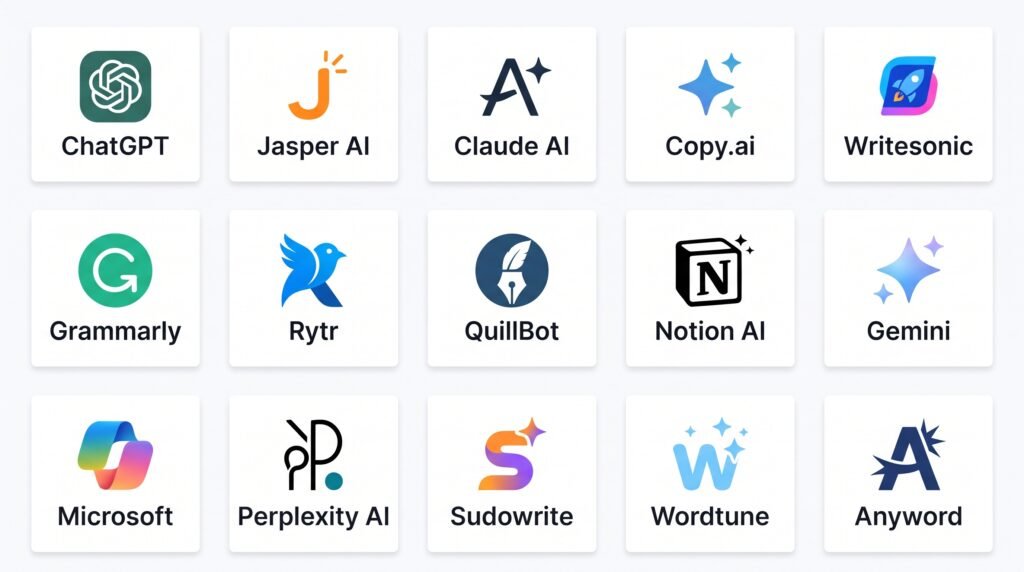
The Best AI Writing Tools of 2026: Comprehensive Review
| AI Tool | Best For | Standout Feature | Pricing Model |
|---|---|---|---|
| ChatGPT | General Writing & Brainstorming | Advanced Think Mode (Chain of Thought) | Free tier / Paid subscription |
| Jasper | Enterprise Marketing Teams | Brand Voice Customization | Paid plans only |
| Claude | Long-Form Prose & Analysis | 200,000 Token Context Window | Free tier / Paid subscription |
| Copy.ai | Automated Sales Workflows | Multi-step Marketing Workflows | Free tier / Paid subscription |
| Writesonic | Fast SEO Content Creation | Integrated SEO Optimization Tools | Free tier / Paid subscription |
| Grammarly | Copyediting & Polishing | Real-time Grammar & Tone Adjustment | Free tier / Paid subscription |
| Rytr | Budget-Conscious Creators | Built-in Rich Text Editor | Free tier / Paid subscription |
| QuillBot | Paragraph Paraphrasing | Advanced Rewriting Modes | Free tier / Paid subscription |
| Notion AI | Workplace Note Organization | In-app Document Automation | Paid Add-on for Notion users |
| Gemini | Google Ecosystem Integration | Direct Workspace File Connections | Free tier / Paid subscription |
| Microsoft Copilot | Office Productivity | Native Word & Excel Integration | Free tier / Paid subscription |
| Perplexity AI | Research-Backed Writing | Inline Citation of Web Sources | Free tier / Paid subscription |
| Sudowrite | Fiction & Creative Writing | Character & Dialogue Expansion | Paid plans only |
| Wordtune | Sentence Condensing | Precise Phrasing & Tone Tweaking | Free tier / Paid subscription |
| Anyword | Data-Driven Performance Copy | Predictive Performance Scoring | Paid plans only |

1. ChatGPT
Best For
General purpose writing, brainstorming, complex research assistance, coding, and day-to-day business productivity.
Key Features
- Chain of Thought Processing: The platform pauses to think through complex problems step-by-step before delivering an answer, which prevents factual errors.
- Custom GPT Builders: Users can build specialized bots trained on specific guidelines, style sheets, or datasets.
- Multimodal Input Processing: Easily analyze uploaded text files, spreadsheets, images, and PDF documents.
- Advanced Content Outlining: Quickly breaks down broad topics into logical, highly structured article outlines.
Pros
- Extremely versatile across creative, technical, and commercial tasks.
- Maintains conversation history exceptionally well to allow for easy revisions.
- The large user community makes it easy to find helpful prompts and workflows.
Cons
- Requires highly detailed prompts to avoid generic-sounding output.
- All factual claims must be double-checked before publication.
Pricing
- Free Plan: Access to standard models with basic usage limits.
- Plus Plan ($20/month): Access to advanced reasoning models, priority access, and custom GPT creation.
2. Jasper
Best For
Marketing departments, agencies, and companies looking to scale up their on-brand content production.
Key Features
- Brand Voice Engine: Scans your website and existing marketing materials to copy your specific tone, style, and vocabulary perfectly.
- End-to-End Campaign Generation: Creates blog posts, emails, and social ads simultaneously based on a single campaign brief.
- Enterprise Collaboration Tools: Allows multiple team members to edit drafts, leave comments, and manage content calendars in one space.
Pros
- Built specifically for commercial business use cases.
- Reduces formatting time by offering pre-made templates for popular marketing frameworks.
- Integrates smoothly with SEO tools like SurferSEO.
Cons
- The pricing structure is high for single freelancers or casual writers.
- It takes time to set up and train the brand voice assets correctly.
Pricing
- Creator Plan: Starts around $39/month billed annually.
- Pro Plan: Around $59/month billed annually for team features.
- Custom Enterprise Pricing available for large companies.

3. Claude
Best For
Deep analytical writing, long-form content generation, academic editing, and detailed text analysis.
Key Features
- Massive Context Window: Features a 200,000-token limit, meaning you can paste entire books, long podcast transcripts, or dozens of research studies at once.
- Human-Like Writing Voice: Produces natural, smooth prose that avoids common AI cliches and overly formal transitions.
- Projects Workspace: Lets users group related documents, style guides, and old articles into specific folders to guide new text generation.
Pros
- Requires much less editing and polishing compared to other long-form AI writers.
- Excels at following complex, multi-layered stylistic guidelines.
- Superb at condensing large, confusing data sheets into clear summaries.
Cons
- The web interface lacks advanced text formatting options like native tables or rich text styling.
- Strict hourly message limits apply even on paid subscription tiers during peak traffic hours.
Pricing
- Free Tier: Standard access with basic message allowances.
- Pro Tier ($20/month): 5x more usage, priority access, and experimental features.
- Team Tier: Designed for collaborative workspaces with higher usage pools.
4. Copy.ai
Best For
Sales teams, automated email outreach campaigns, and high-volume short marketing copy.
Key Features
- AI Marketing Workflows: Automates repetitive tasks, like pulling product data from a link and converting it into five distinct ad variations.
- Infinitely Scalable Templates: Templates for product descriptions, cold outreach emails, and ad copy.
- Centralized Info Base: Store company facts, core statistics, and product pricing rules so the AI never guesses key details.
Pros
- Clean, modern dashboard that is incredibly easy for non-technical teams to use.
- Excellent for removing the friction of repetitive copywriting tasks.
- Saves hours of manual work when building bulk product catalog descriptions.
Cons
- Not optimized for long, narrative-driven blog articles.
- Requires precise rules to prevent sales copy from sounding overly aggressive.
Pricing
- Free Plan: Limited seats and monthly generation credits.
- Premium Tiers: Start around $36/month billed annually, scaling up based on team seats and advanced features.

5. Writesonic
Best For
Affiliate marketers, niche site operators, and SEO managers who need rapid article generation.
Key Features
- Article Writer 6.0: Generates factual, SEO-optimized articles based on real-time search engine data and competitor analysis.
- Built-In Keyword Tools: Checks search volume and difficulty scores inside the prompt window.
- Landing Page Generator: Creates complete website mockups with conversion-optimized copy in seconds.
Pros
- Automatically checks Google search results to include up-to-date facts.
- Generates schema-ready FAQs to win featured snippets.
- Directly publishes drafts to WordPress, Wix, and Shopify.
Cons
- Output text can sometimes feel formulaic and requires a human edit to add personality.
- Consumes a high number of credits for deep research options.
Pricing
- Free Plan: Basic credits for testing templates.
- Individual Growth Plans: Start around $12 to $20/month depending on word volume.
- Team & Enterprise Tiers offer dedicated workspace seats.
6. Grammarly
Best For
Professional copyediting, fixing grammatical mistakes, and polishing pre-written drafts across the web.
Key Features
- Everywhere Desktop Overlay: Works inside your web browser, email inbox, Google Docs, Slack, and Microsoft Word.
- Contextual Tone Adjuster: Evaluates how your text sounds (e.g., confident, formal, concerned) and suggests changes to match your goal.
- Plagiarism Checker: Scans billions of web pages to ensure your work is entirely unique and properly cited.
Pros
- Incredibly lightweight app that does not slow down your daily workflow.
- Focuses heavily on improving human text rather than just generating generic drafts.
- Helps maintain a consistent communication style across entire customer support teams.
Cons
- The generative AI features for writing long articles from scratch are limited.
- Can occasionally suggest corrections that miss the creative context of a sentence.
Pricing
- Free Tier: Basic spelling, grammar, and punctuation checks.
- Premium Plan ($12/month billed annually): Full tone rewrite suggestions, sentence rewrites, and plagiarism detection.
- Business Plan: For team-wide style guide alignment.

7. Rytr
Best For
Freelance writers, solo entrepreneurs, and creators who need a budget-friendly writing tool.
Key Features
- In-line Text Extender: Highlight any sentence to expand it, shorten it, or rephrase it instantly.
- 30+ Built-In Tones: Choose exactly how you want your text to sound, from humorous and casual to formal and academic.
- Native SERP Analysis: View top-ranking competitor headers while you draft your copy.
Pros
- Highly affordable monthly plans with generous word allowances.
- Minimal learning curve makes it ideal for complete beginners.
- Built-in image generator helps create quick blog graphics alongside text.
Cons
- Lacks the deep reasoning capabilities required for technical whitepapers.
- The user interface can feel cramped when working on very long documents.
Pricing
- Free Plan: 10k characters per month allowance.
- Saver Plan ($9/month): 100k characters per month plus custom tone options.
- Unlimited Plan ($29/month): Generates unlimited characters with priority support.
8. QuillBot
Best For
Students, editors, and writers who need to rewrite, paraphrase, or summarize existing drafts.
Key Features
- 7 Paraphrasing Modes: Toggle between Standard, Fluency, Formal, Simple, and Creative modes to rewrite sentences.
- Smart Thesaurus Mapping: Click on individual words in your rewritten text to see a list of accurate synonyms.
- Citation Generator: Quickly creates APA, MLA, and Chicago style citations for research papers.
Pros
- Unmatched quality when it comes to changing sentence structures while keeping the original meaning intact.
- Excellent for breaking down dense, jargon-heavy reports into clear summaries.
- Affordable pricing with a highly functional free tier.
Cons
- Cannot generate an original long-form blog post from scratch based on a topic prompt.
- Requires pasting text manually into the tool rather than working via automated workflows.
Pricing
- Free Tier: Limited paraphrasing word count limits.
- Premium Plan ($8.33/month billed annually): Unlimited paraphrasing count, faster processing speeds, and plagiarism checking.

9. Notion AI
Best For
Teams, project managers, and content creators who already use Notion to organize their daily workflows.
Key Features
- Inline Contextual Writing: Highlight text within any Notion page to change the voice, fix spelling, or translate languages.
- Automatic Action-Item Extraction: Scans raw meeting transcripts to instantly generate a bulleted list of next steps.
- Workspace Search QA: Ask questions about your entire database of notes, and the AI will pull answers directly from your internal company documents.
Pros
- Eliminates the need to copy and paste text back and forth between different apps.
- Keeps team wikis, project briefs, and blog drafts organized in one central place.
- Saves hours of manual summarization work.
Cons
- Only useful if you are already deeply embedded in the Notion ecosystem.
- Lacks advanced keyword-driven SEO optimization tools.
Pricing
- Add-on Pricing: Costs an extra $8 to $10 per user per month on top of your existing Notion subscription plan.
10. Gemini
Best For
Researching complex modern topics and utilizing your personal Google Workspace data.
Key Features
- Google Workspace Integration: Connects directly with your Gmail, Google Drive, Docs, and Sheets to locate internal data effortlessly.
- Real-time Fact Extraction: Pulls live data from Google Search to answer time-sensitive queries.
- Deep Reasoning Capabilities: Utilizes Google’s advanced thinking models to solve multi-stage logic and structuring problems.
Pros
- Incredibly convenient for search engine optimization research and sorting through live data trends.
- The free tier offers access to highly competitive, modern language models.
- Flawless reading and writing capability across multiple global languages.
Cons
- Output text formatting can require manual adjusting to fit standard blog layouts.
- The focus on conversational accuracy means it requires strong prompts to generate stylized marketing copy.
Pricing
- Standard Plan: Free to use via web browsers or mobile apps.
- Advanced Plan ($20/month): Unlocks premium models, integration with Google Apps, and larger data processing limits.
11. Microsoft Copilot
Best For
Corporate employees, business analysts, and users working entirely within the Microsoft 365 environment.
Key Features
- Native Word Integration: Drafts entire formal letters, corporate proposals, and text summaries inside Microsoft Word.
- Excel Data Breakdown: Write text prompts to generate complex formulas, analyze sales spreadsheets, or build data charts.
- Outlook Email Drafting: Summarizes massive email threads and generates professional replies based on short notes.
Pros
- Enterprise-grade security rules protect sensitive company corporate files from being leaked.
- Reduces administrative busywork significantly for office workers.
- Maintains classic formatting standards across Word documents and PowerPoint slides.
Cons
- Requires an active Microsoft 365 business or personal subscription to access key features.
- Not designed for niche affiliate bloggers or creative web fiction writers.
Pricing
- Free Plan: Access via web browsers and Windows sidebar toolbars.
- Copilot Pro ($20/month): Priority model speeds and full integration across Microsoft 365 office apps.

12. Perplexity AI
Best For
Fact-heavy research, detailed source gathering, and producing highly accurate informational content.
Key Features
- Inline Source Citations: Every claim, metric, and statement made by the AI features a clickable footnote linking directly to the source website.
- Focus Filters: Narrow your research search parameters down to Academic Papers, YouTube transcripts, Reddit discussions, or the open web.
- Pro Discovery Check: The AI asks clarifying questions before running a search to ensure it knows exactly what you are looking for.
Pros
- Completely eliminates the risk of hidden AI hallucinations by pointing directly to live source data.
- Saves hours of time spent manually clicking through blue links on traditional search engines.
- Perfect for building highly authoritative outline foundations for complex industry guides.
Cons
- Better suited for deep information gathering than generating long, emotionally engaging storytelling drafts.
- Requires a human touch to reshape the collected facts into an engaging article narrative.
Pricing
- Free Plan: Unlimited standard searches with basic daily Pro queries.
- Pro Plan ($20/month): Unlocks advanced model selection, file uploads, and hundreds of Pro research queries per day.
13. Sudowrite
Best For
Fiction writers, authors, novelists, scriptwriters, and creative narrative designers.
Key Features
- Canvas Planning Tool: Generates plot outlines, character relationship maps, and story arcs visually.
- Sensory Description Engine: Highlight a word or place to generate descriptions based on Sight, Sound, Touch, Smell, and Taste.
- Guided Dialogue Writer: Re-drafts dialogue lines to sound specific to a character’s background, mood, or accent.
Pros
- Built purely for creative storytelling rather than generic corporate marketing.
- Helps authors smash through writer’s block by offering alternative plot directions.
- The community features deep collaborative spaces for planning multi-chapter books.
Cons
- Completely useless for business copywriting, SEO keyword integration, or technical manuals.
- Can quickly use up monthly generation points during heavy brainstorming loops.
Pricing
- Basic Plan: Starts at $10/month for limited monthly text generations.
- Professional Plans: Run up to $22 to $44/month for heavy creative book generation workflows.

14. Wordtune
Best For
Polishing pre-written paragraphs, tightening sentence structures, and improving text readability.
Key Features
- Sentence Shortener: Trims down wordy, confusing sentences to maximize clarity and reading speed.
- Tone Transitioner: Quickly switches your written content from casual to professional, or vice versa.
- Contextual Phrase Suggestion: Offers multi-word vocabulary changes to improve sentence flow.
Pros
- Extremely useful for non-native English speakers who want to sound completely natural to a US audience.
- The browser extension integrates smoothly across popular web writing platforms.
- Focuses heavily on making your existing writing highly concise.
Cons
- Lacks tools for building long structural outlines from scratch.
- The free tier features strict daily operational limits.
Pricing
- Free Plan: Offers a handful of daily text rewrites.
- Advanced Plans: Start around $9.99/month billed annually to unlock unlimited rewrites and text corrections.
15. Anyword
Best For
Performance marketers, media buyers, and growth hackers who need data-backed advertising copy.
Key Features
- Predictive Performance Score: Analyzes copy options and assigns a score predicting how well they will convert a chosen target demographic.
- Target Audience Personas: Create profiles for different buyer demographics to tailor your messaging precisely.
- Ad Account Integrations: Connects with Meta, Google, and LinkedIn ads to analyze your active copy variations automatically.
Pros
- Focuses entirely on maximizing conversion rates, sales clicks, and signups.
- Removes guesswork from A/B testing variations for paid ads.
- Keeps messaging aligned across disparate ad groups and campaigns.
Cons
- The pricing model is out of reach for casual bloggers or small budget freelancers.
- Not intended for drafting informational or educational articles.
Pricing
- Starter Plan: Around $39/month billed annually.
- Data-Driven Teams: Around $79/month billed annually for programmatic predictive scoring options.
Advanced Content Creation Workflow: Text, Audio, Visuals, and Automation

High-performance writing in 2026 is no longer just about text. The most productive content creators connect text, audio, visuals, and workflow automation into a single ecosystem. By utilizing insights from industry experts who have spent hundreds of hours testing over 110 tools, you can build a unified production system.
🎙️ Audio Transcription & Note-Taking
Getting your thoughts down fast is critical to maintaining a human writing style. Instead of typing manually, you can use specialized tools to capture spoken thoughts.
- Whisper Flow: This tool lets you hold a hotkey, speak naturally, and instantly transcribes perfectly formatted text directly wherever your cursor is placed (Google Docs, ChatGPT, etc.). Unlike standard dictation, it auto-corrects formatting as you speak, removes filler words, and features a course correction mode that understands revisions on the fly. It also includes a command mode to highlight text and change it via voice instructions.
- Super Whisper: If privacy and data compliance are top priorities, this Mac-only tool processes your speech entirely on your local device using offline AI models.
- Granola: For managing interview or client call audio without an intrusive bot joining the screen, Granola captures internal device audio invisibly. It blends your manual shorthand bullets with deep audio transcripts to generate highly accurate notes that look human-written.
- Fathom: A completely free alternative for Zoom, Google Meet, and Teams that creates complete searchable logs, actionable items, and clip cutouts.

📚 Hyper-Targeted Research Processing
- Notebook LM: While Perplexity is perfect for scouring the open web for live facts, Google’s Notebook LM excels at deep research on your private documents. You can upload up to 50 sources (PDFs, transcripts, data sheets), and the AI will answer questions based only on that specific data pool. This completely eliminates internet hallucinations. It can even generate an interactive, podcast-style audio overview between two AI voices summarizing your data.

🖼️ High-Retention Visual Tools
- Midjourney: The gold standard for cinematic-quality images and specific artistic illustrations. It features an official web dashboard that removes the old requirement of working exclusively inside Discord.
- Nano Banana Pro: Google’s image engine inside Gemini excels at rendering accurate, legible text overlays within images (e.g., YouTube thumbnails, infographics, signs). Because it is built directly into the Gemini framework, it has a deep grasp of real-world context and proportions.
🎬 Video Synthesis & Motion Tools
- VO3.1: Google’s premium video model. It stands out because it generates high-fidelity video alongside native synchronized audio, background ambient noise, and accurate lip-synced character dialogue all at once.
- Cling: Accessible at
clingai.com, this tool offers an affordable image-to-video conversion engine. Its standout feature is an elements manager that lets you upload up to four distinct reference images to preserve exact character consistency across video frames.

⚙️ Workflow Automation Systems
To connect these tools without copying and pasting manually all day, you can use low-code automation platforms:
- 8n8: A highly flexible, low-code automation engine used to string diverse AI nodes together into customized loops.
- Make.com: A highly visual automation platform featuring pre-built integration templates to link your research tools, content management systems, and text generators together instantly.

How to Choose the Right AI Writing Tool
To pick the best tool for your workflow, answer these four fundamental questions:
- What is your primary content format? If you write SEO articles, choose Writesonic or Claude. For short ads and email copy, choose Copy.ai or Anyword. For fixing pre-written drafts, choose Grammarly or QuillBot.
- What is your budget? If you want to keep costs low, look at Rytr or the free tiers of ChatGPT and Gemini. For corporate scale, budget for Jasper or Anyword.
- What apps do you already use? If your team lives in Google Docs, Gemini offers smooth integration. If you track projects in Notion, adding Notion AI will save you the hassle of switching apps.
- How important is real-time factual accuracy? If you write deep-dives on changing trends, use Perplexity AI to ensure every sentence features a verifiable source citation.

Key Takeaways
- AI Accelerates, Humans Refine: The most effective content strategies combine AI speed for first drafts with human editing for storytelling, perspective, and final accuracy.
- Optimize for Search Engines and AI Engines: Clean data hierarchies (H2/H3 tags), bullet points, and direct answers satisfy human readers while ensuring your content ranks in Google AI Overviews.
- Match the Tool to the Task: No single tool handles every task perfectly. Use ChatGPT for brainstorming, Claude for long articles, and Grammarly to polish the final draft.
- Build a Connected Workflow: Use voice-to-text tools like Whisper Flow and research hubs like Notebook LM to speed up your content creation pipeline from start to finish.
Frequently Asked Questions

What is the best AI writing tool in 2026?
For general flexibility and broad capabilities, ChatGPT remains the top choice for most users. If you need clean, natural-sounding long articles, Claude is highly recommended.
Do AI writing tools offer free options?
Yes. Many leading tools offer free tiers with monthly word limits. Paid subscriptions unlock faster speeds, advanced model reasoning, and deeper customization options.
Can AI write complete blog posts independently?
Yes, modern AI can easily generate complete drafts based on a prompt. However, human review is still essential to verify facts, add your unique experience, and maintain a consistent brand voice.
Are AI writing tools safe for SEO ranking?
Yes, search engines focus on content value, accuracy, and user satisfaction. When you use AI tools to build clear structures and integrate keywords naturally without keyword stuffing, your search rankings will improve.
How do I ensure my site ranks inside Google AI Overviews?
Provide clear, direct answers to common user queries at the beginning of your content sections. Use clean formatting tools like bulleted lists, comparison tables, and logical heading structures so AI crawlers can easily process your data.
Conclusion
The evolution of AI writing tools in 2026 offers creators, marketers, and businesses faster workflows and smarter options. The right platform for you depends on your budget, your formatting needs, and the apps you already use.
While AI can drastically speed up your writing process, the best results come from combining AI efficiency with human expertise. Reviewing, fact-checking, and refining every draft ensures your content remains accurate, trustworthy, and genuinely valuable for your readers.