
The Weight of a Simple Gesture
The fluorescent lights of the grocery store hummed with a clinical, soul-sucking persistence.
At forty-eight, my life felt like a series of checked boxes and fading receipts.
I stood in the checkout line, my mind a cluttered mess of unpaid utility bills, my daughter’s looming science project, and the persistent ache in my lower back that reminded me I wasn’t twenty anymore.
I reached for a loaf of bread, but my gaze drifted toward the bakery section.
That’s when I saw her.
She wasn’t just standing there; she was vibrating with a quiet, desperate kind of tension.
Her coat was worn at the elbows, her hair pulled back into a ponytail that had seen better days, and her knuckles were white as she gripped the handle of a small stroller.
Beside her stood a boy—six, maybe seven years old.
He was wearing a faded superhero shirt, his eyes wide and fixed on a circular chocolate birthday cake behind the glass.
It was a plain cake. No elaborate fondant, no hand-sculpted figures. Just chocolate frosting and a plastic “Happy Birthday” ring stuck in the center.
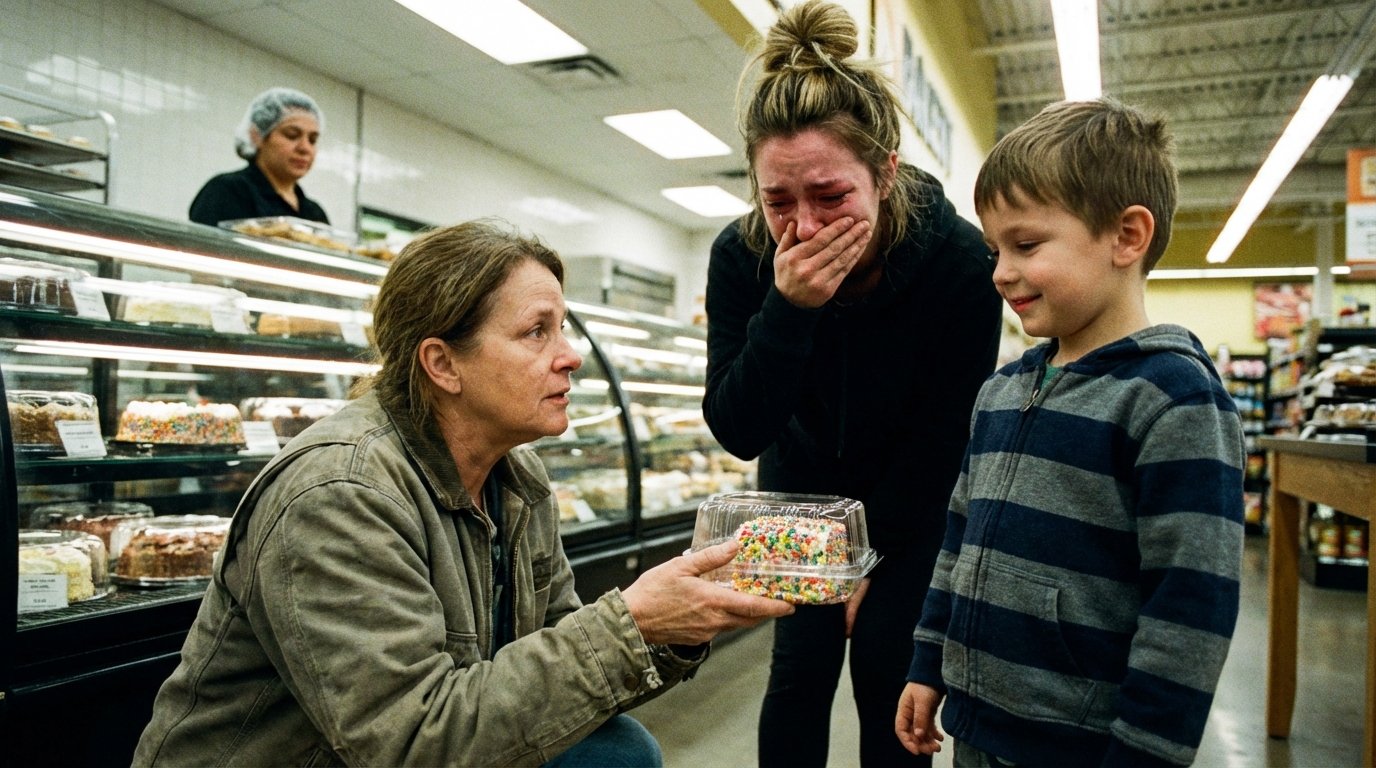
“Just that one,” she whispered to the clerk. “Nothing fancy. We don’t need the writing.”
I watched as the clerk scanned the box. The woman swiped a worn debit card.
The silence that followed was deafening.
Declined.
She swallowed hard, her throat bobbing. “Try it again? Maybe the chip is just dirty.”
The second swipe felt like a physical blow. The screen flashed red again.
“I’m sorry,” she whispered, her voice cracking like thin ice. “I thought… I thought there was enough.”
The little boy didn’t cry. He didn’t throw a tantrum. He simply reached out and tugged on her sleeve.
“It’s okay, Mom,” he said, his voice unnervingly mature for his age. “We can just have toast. Toast is good too.”
That sentence shattered something inside me.
The Echo of the Past
In an instant, I wasn’t a forty-eight-year-old woman in a grocery store.
I was twenty-four again, standing in a different line, holding a toddler who was screaming for a juice box I couldn’t afford.
I remembered the hot, prickly shame crawling up my neck as the cashier stared at me.
I remembered the way the air felt too thin to breathe.
Before I could talk myself out of it, I stepped forward.
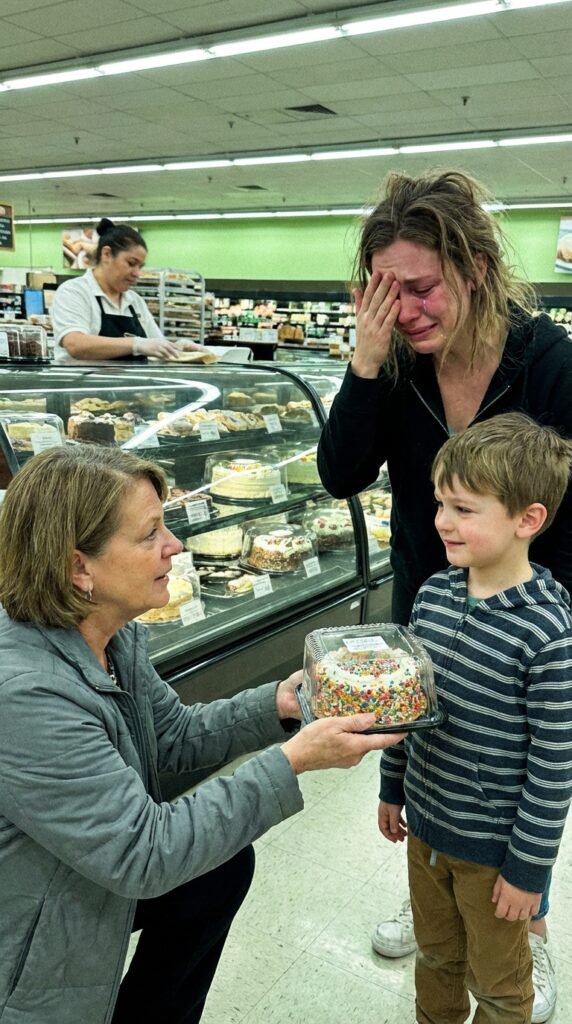
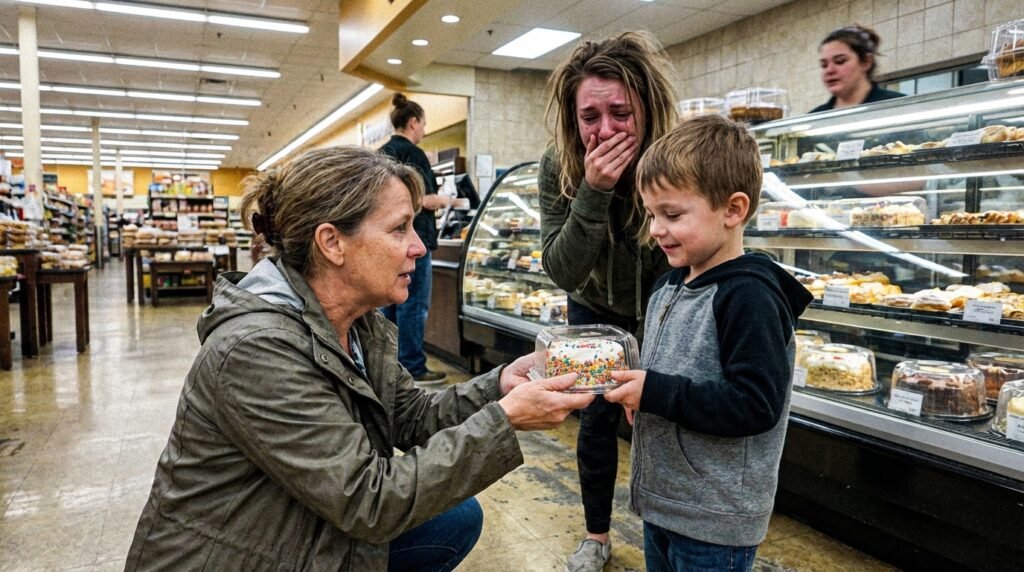
“I’ve got it,” I said, sliding my card into the reader before she could protest.
She turned to me, her eyes brimming with a sudden, violent flood of tears. “Oh, no. You don’t have to—”
“I want to,” I insisted, my voice firmer than I felt. “Everyone deserves a birthday cake.”
The transaction cleared with a cheerful beep.
She didn’t just thank me; she clung to the cake box like it was a life raft.
As I walked to my car, the weight of her gratitude felt heavier than the twenty dollars I’d just spent.
It felt like a debt paid to the universe.
The Phone Call That Shattered the Peace
A week passed. The memory of the woman and her son had settled into a warm corner of my heart.
I was at my desk at the insurance agency, mindlessly filing claims, when my phone began to vibrate violently against the wood.
It was my sister, Megan.
Megan and I have always been two sides of the same coin.
She’s five years younger, a whirlwind of energy who moved in with me after our mother passed away.
She’s the one who keeps me grounded, the one who knows my coffee order and my deepest fears.
I swiped the screen. “Hey, Meg. If this is about the grocery list—”
“SARAH!” she screamed.
The volume was so high I had to pull the phone away from my ear.
“Sarah, oh my god. Do you have any idea? DO YOU KNOW WHO THAT WAS?”
My stomach did a slow, sickening roll. The office around me blurred.
“Who what was? Meg, slow down. You’re hyperventilating.”
“The woman!” Megan’s voice was shaking, thick with a mixture of terror and disbelief. “The woman with the birthday cake! The one you told me about!”
I felt a chill crawl up my spine. “What about her? Did something happen?”
“I need you to sit down,” Megan whispered. “I’m not kidding. Sit down right now.”
I sat. My legs felt like they were made of water.
“I was going through Mom’s old cedar chest,” Megan began, her breath hitching. “The one she told us never to open until we sold the house.”
“Meg, why are you in there? We agreed to wait.”
“I found a folder, Sarah. A folder hidden under the false bottom. It has a name on it. A name I just saw on a funeral notice in the local paper.”
She paused, and the silence on the other end of the line felt like a physical weight pressing against my chest.
“The woman in the store… her name is Elena,” Megan said. “And Sarah… she’s not a stranger.”
The Funeral of a Ghost
The next morning, the air was thick with the scent of damp earth and lilies.
Megan and I stood at the edge of a small, private cemetery on the outskirts of town.
I was trembling, my hands shoved deep into my coat pockets.
In my mind, I kept seeing the woman’s face—the way she gripped her purse, the way her son looked at that birthday cake.
“Are you sure?” I whispered to Megan.
“Look at the photo on the memorial program,” Megan replied, handing me a small card.
I looked down. It wasn’t Elena.
It was an older woman. A woman who looked hauntingly like our mother.
Same high cheekbones. Same arched eyebrows. Same piercing, intelligent eyes.
“That’s Margaret Thorne,” Megan whispered. “She was Mom’s best friend. Or so we thought.”
We watched from a distance as a small group gathered around a modest casket.
And there, in the front row, was Elena.
She looked smaller today, draped in a black coat that seemed to swallow her whole.
The little boy sat beside her, swinging his legs, oblivious to the gravity of the soil and the stone.
As the priest spoke of “unspoken burdens” and “the grace of secrets kept,” I felt a knot of anger tightening in my throat.
Who was this woman? And why was her name buried in our mother’s private chest?
A Childhood Built on Omissions
As I watched the service, memories began to flicker like an old film reel.
I remembered my mother, a woman of iron will and terrifying silences.
I remembered the nights she would sit at the kitchen table, writing letters she never mailed.
I remembered a summer when I was ten. A woman had come to the door—a woman who looked like Margaret.
My mother had hissed at her to leave, her face a mask of cold fury I had never seen before.
“Don’t ever come back here,” Mom had said. “The deal was done. The papers were signed.”
I had asked who it was. Mom had just told me it was a solicitor.
Now, standing at this grave, the puzzle pieces were beginning to align in a way that made my skin crawl.
The Confrontation at the Iron Gate
After the service ended, the mourners dispersed, leaving Elena alone by the grave.
She was kneeling, her hand resting on the fresh mound of dirt.
“Go talk to her,” Megan urged, her voice trembling. “We need to know.”
I walked forward, the gravel crunching beneath my boots.
Elena didn’t look up until I was standing right behind her.
When she saw me, her eyes widened. Recognition sparked, then a deep, agonizing confusion.
“You,” she whispered. “The woman from the store. Why are you here?”
“I’m Sarah,” I said, my voice barely audible. “My mother was Evelyn Vance.”
Elena’s face went pale. Not the pale of shock, but the pale of a ghost who has finally been seen.
She stood up slowly, brushing the grass from her coat.
“Evelyn,” she breathed. “I wondered if you’d find out. I wondered if she’d ever tell you.”
“Tell me what, Elena? Why was your name in my mother’s chest? Why did you look like you were starving a week ago when you were trying to buy a birthday cake?”
Elena looked at her son, who was playing with a toy car near a large oak tree.
“I wasn’t just buying a cake for his birthday, Sarah,” she said, her voice cracking. “It was the anniversary of the day I was given away.”
The Revelation of Blood
“What are you talking about?” I asked, my heart hammering against my ribs.
Elena reached into her bag and pulled out a tattered, yellowed envelope.
“My mother—Margaret—died three days ago. She left me this. She told me she couldn’t take the truth to the grave anymore.”
She handed me the letter.
The handwriting was unmistakably my mother’s.
To Margaret,
I cannot keep the girl. The scandal would ruin us, and you know what my husband is like. You take her. You raise her as yours. I will send the money every month, but she can never know. Sarah can never know. If they ever find out they are sisters, the inheritance—and the reputation of this family—will burn to the ground.
Signed, Evelyn Vance.
The world tilted.
I looked at Elena. I looked at her eyes—my eyes.
I looked at her hands—my hands.
“You’re my sister,” I whispered.
“The ‘younger sister’ everyone thought Margaret adopted,” Elena said, a bitter smile touching her lips. “I grew up thinking I was a charity case. I grew up in poverty while you were raised in that big house on the hill.”
“I didn’t know,” I gasped. “Elena, I swear, I didn’t know.”
“I know you didn’t,” she said, her voice softening. “But when you bought that birthday cake… when you looked at me with that kindness… I felt it. I didn’t know why, but I felt like I knew you.”
The Final Piece of the Puzzle
We sat on a cold stone bench as the sun began to dip below the horizon.
Elena told me everything.
She told me how the checks from our mother had stopped the moment our father died.
She told me how Margaret had struggled, how they had lived in the shadows of our “perfect” family.
But then, she reached back into her bag.
“There’s one more thing,” Elena said. “The twist in the letter. Read the back.”
I flipped the parchment over.
There was a postscript, written in a different, more frantic ink.
P.S. Margaret, it wasn’t an affair. I didn’t cheat. He forced me. He forced me and then he made me give her up to hide his own sin. Protect her from him. Never let him near her.
I felt a wave of nausea.
Our father. The man we had toasted at every holiday. The man whose portrait hung in the hallway.
He hadn’t just been a cold man; he was a monster.
And our mother—the woman I had resented for her hardness—hadn’t been cruel.
She had been a survivor.
She had given Elena away not to hide a scandal of her own making, but to protect a child from the very man who had fathered her in violence.
Finding Closure in the Crumbs
The silence that followed was heavy, but for the first time in my life, it didn’t feel empty.
It was the silence of understanding.
I looked over at the little boy. My nephew.
“What’s his name?” I asked.
“Leo,” Elena said.
“Well, Leo,” I called out. “How was that birthday cake?”
The boy ran over, a huge grin on his face. “It was the best! It had chocolate bubbles inside!”
I looked at Elena. The anger was still there—anger for the years lost, anger for the lies told—but beneath it was something new.
A bridge.
“You’re coming home with us,” I said. It wasn’t a question.
Elena started to shake her head. “Sarah, we can’t—”
“Megan is already clearing out the guest room,” I lied, knowing full well she’d be doing exactly that the moment I texted her. “We have thirty years of birthdays to catch up on.”
As we walked out of the cemetery, the shadows didn’t feel so long anymore.
I realized then that the birthday cake wasn’t just a gift for a stranger.
It was the key that unlocked a prison we didn’t even know we were in.
We weren’t just two women who met in a bakery.
We were a family, finally coming out of the dark.