



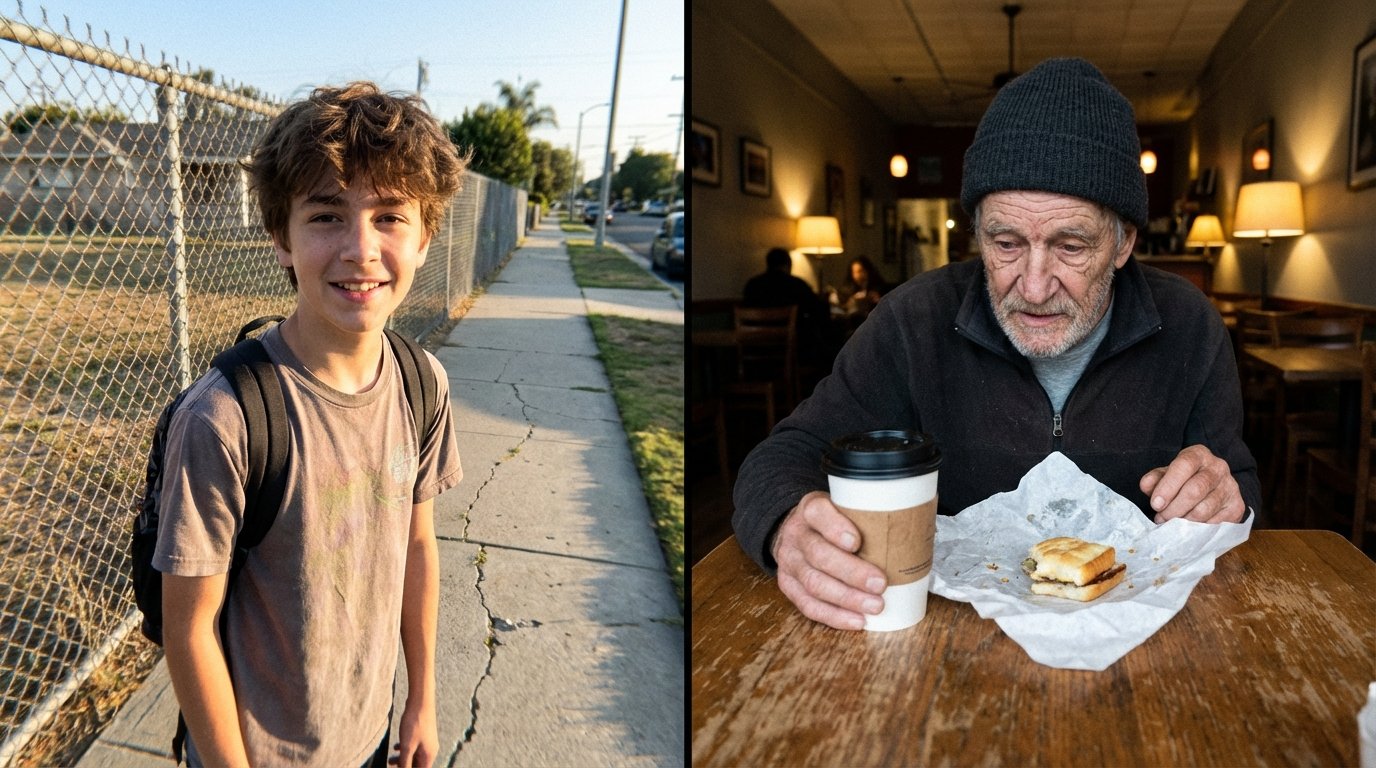
The homeless man moved with a heavy, rhythmic limp that echoed against the damp pavement of the city outskirts. Every step he took sent a jolt of adrenaline through my chest, a sensation so sharp it felt like a physical wound. I stayed fifty paces behind, tucked into the shadows of storefronts and rusting alleyways, my heart hammering against my ribs like a trapped bird.
I wasn’t supposed to be here. I was supposed to be at a corporate luncheon three hours away in my quiet, sterile suburb. I was supposed to be “moving on,” as my sister Elena constantly suggested with her sympathetic head tilts and soft-spoken pity.
But I couldn’t move on. Not when the sleeve of that jacket—the one moving away from me now—bore a small, hand-stitched guitar patch I had sewn with my own shaking hands.
The Morning the World Stopped
Almost a year ago, on a Tuesday that felt entirely too ordinary, Daniel left for school.
I remember the smell of burnt toast and the way the morning light hit the kitchen table. Daniel was sixteen, a boy of sharp elbows and a laugh that could fill a stadium. He was the kind of soul who rescued stray cats and spent his weekends teaching himself complex jazz chords on an old acoustic guitar.
“See ya, Mom,” he had said, tossing his bag over his shoulder.
“Wait, your jacket!” I called out.
He had paused, grinning, and grabbed the blue windbreaker from the hook. It was his favorite. He’d torn the sleeve climbing a fence to retrieve a neighbor’s drone, and I had spent two hours sewing that little guitar patch over the rip. I remembered the prick of the needle and the way he’d kissed my cheek in thanks.
He never came back.
By 6:00 PM, I was pacing. By 8:00 PM, I was calling his friends. By 10:00 PM, I was at the police station, my voice cracking as I pleaded with an officer who looked like he’d rather be anywhere else.
“Teenagers will be teenagers, Mrs. Thorne,” he said, tapping a pen against a clipboard. “He probably just stayed out late. He’ll be back in a couple of days with an apology and a hungry stomach.”
But Daniel wasn’t like other teenagers. He didn’t rebel by disappearing. He was the boy who texted me when his bus was five minutes late so I wouldn’t worry.
The security cameras at the school showed him leaving campus at 3:15 PM. He got on a bus. He rode it to the end of the line. And then, he simply evaporated into the gray mist of the city.
A Ghost in a Crowded Café
Eleven months of silence leads to a specific kind of madness. You start seeing their face in every crowd. You hear their whistle in the wind.
Yesterday, I was in a neighboring city for a business meeting I had no interest in attending. I was standing in a small, cramped café, waiting for a black coffee to numb the persistent ache in my head.
The bell above the door jingled.
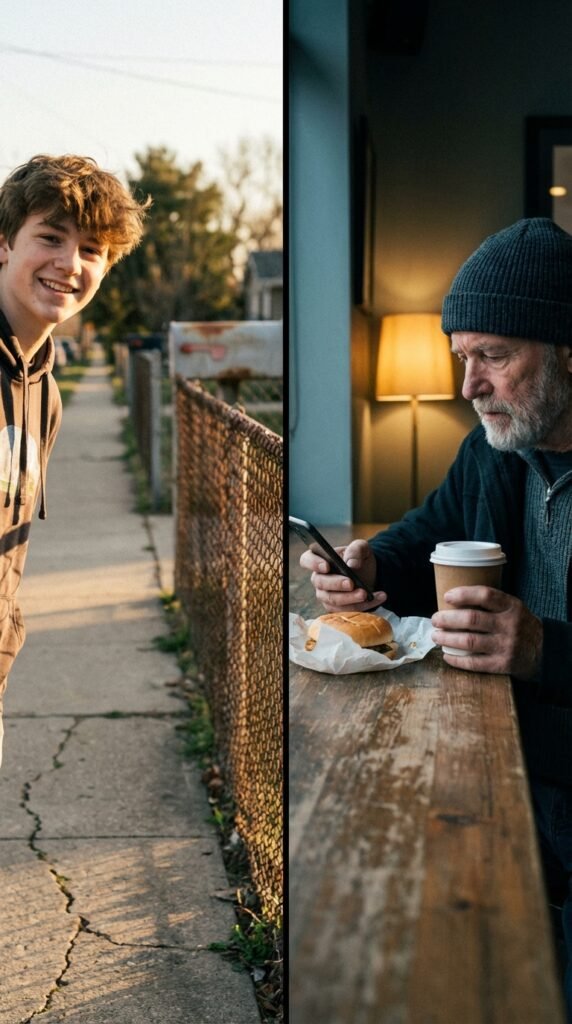
An elderly man shuffled in. He was thin, his face a map of deep-set wrinkles and stories of hardship. He smelled of rain and old tobacco. But I didn’t look at his face.
I looked at his chest.
The blue fabric was faded. On the back, there was a faint, stubborn white paint stain from the time Daniel had helped me paint the garage. And there, on the left sleeve, was the guitar patch. My stitches. My thread. My son’s life, draped over the shoulders of a stranger.
I felt the world tilt. My knees buckled, and I had to grip the edge of the laminate counter to keep from collapsing.
The man was counting coins—nickels and pennies—trying to scrape together enough for a cup of tea. His hands shook.
“Give him whatever he wants,” I whispered to the barista, my voice sounding like it belonged to someone else. “The tea, a bun… everything. I’ll pay.”
The old man looked at me. His eyes were milky with cataracts but filled with a sudden, overwhelming gratitude. “God bless you, miss,” he rasped. “You’re too kind.”
I stepped closer, my lungs refusing to take in enough air. “Where did you get that jacket?”
The man looked down at the blue fabric as if seeing it for the first time. He smiled, a gentle, broken expression. “A boy gave it to me. A very kind boy.”
“When?” I pressed, my hand reaching out to touch the sleeve before I caught myself. “Where is he?”
“He’s a good lad,” the man muttered, but the café was getting loud. A group of teenagers pushed past us, laughing. The old man seemed spooked by the noise. He clutched his tea and his bun and hurried toward the door.
“Wait!” I cried, but he was already gone.
I followed him. I didn’t think about my car, my meeting, or the life I was supposed to lead. I only thought about the guitar patch.
Shadows of the Past
As I followed the homeless man through the winding, industrial streets, my mind drifted back to Daniel’s childhood.
I remembered him at seven years old, crying because he’d found a bird with a broken wing in our backyard. We had stayed up all night, making a nest out of an old shoebox. He had this innate, almost painful empathy for anything that suffered.
“Mom,” he had whispered that night, “if I ever get lost, will you find me?”
“Always, Danny,” I had promised. “I will never stop looking.”
That promise now felt like a lead weight in my stomach. For eleven months, I had failed him. I had sat in our quiet house, staring at his unmade bed, while his jacket walked the streets of a city three hours away.
The man turned into a narrow alleyway, his pace slowing. He reached an abandoned, two-story house with boarded-up windows and a sagging porch. It looked like a skeleton of a home, a place where time had forgotten to move.
He knocked on the door. Not a loud, demanding knock, but a soft, rhythmic pattern.
Tap. Tap-tap. Tap.
The door creaked open, and the man disappeared inside.
The Confrontation of Silence
I stood on the sidewalk for a long time, the cold seeping through my coat. Every instinct told me to call the police, but I remembered the officer’s dismissive face. This wasn’t their mystery to solve. This was mine.
I walked up the rotting steps. The air smelled of damp wood and woodsmoke. I pushed the door open.
The interior was dim, lit only by a few flickering candles. It was surprisingly clean for a squat. In the corner, the old man sat on a crate, handing the bun I had bought him to a woman sitting in the shadows.
“Who are you?” a voice snapped.
I spun around. Standing by the window was a woman I recognized instantly. Elena. My sister.
She looked haggard, her eyes rimmed with red. She wasn’t supposed to be here. She was supposed to be at her law firm in the city.
“Elena?” I gasped. “What are you doing here? Why is that man wearing Daniel’s jacket?”
Elena didn’t look surprised to see me. She looked exhausted, as if a great weight had finally crushed her. She stepped into the candlelight, holding a small wooden box.
“I knew you’d find this place eventually, Sarah,” she said quietly. “You were always the one who wouldn’t let go.”
“Where is he, Elena? Where is my son?”
She didn’t answer. Instead, she pointed to a small, makeshift altar in the corner of the room. There were photos of Daniel. His favorite picks. And a letter, sealed with a piece of tape.
The Revelation in the Ruins
“Daniel didn’t run away, Sarah,” Elena said, her voice trembling. “He was hiding. But not from you. From what he found out.”
My heart stopped. “What are you talking about?”
“The ‘business’ our father left behind when he died,” Elena whispered. “Daniel found the ledgers. He found the records of the families Dad had ruined, the people he had stepped on to build our ‘legacy.’ Daniel couldn’t live with the guilt of the money that paid for his private school and his expensive guitars.”
“So he just… left?” I felt a surge of anger so hot it burned my throat. “He left me because of something his grandfather did?”
“No,” Elena said, her voice breaking. “He didn’t leave you. He was coming to tell you. But he saw someone following him. He thought they were coming for you too. He thought if he disappeared, the people Dad owed would leave us alone.”
She handed me the letter. My hands shook so violently I nearly dropped it.
The Letter from the Dark
The paper was yellowed and smelled of the same woodsmoke that filled the room. The handwriting was unmistakably Daniel’s—slanted, hurried, and full of heart.
Mom,
If you’re reading this, it means I wasn’t fast enough. Or maybe it means I was too late.
I found the boxes in the attic, the ones behind the old Christmas decorations. I saw the names, Mom. The people Grandpa hurt. The money… it’s all tainted. I couldn’t sit at that table anymore knowing where the bread came from.
I saw a man outside our house last week. A man in a dark suit. He was watching you. I realized that if I stayed, I was putting a target on your back. They want what’s in those ledgers. They think I have them.
I’ve been living here, helping where I can. The man you saw, Arthur, he was one of the people Grandpa cheated. He lost his home because of us. Giving him my jacket was the only thing I had left to give.
I’m so sorry, Mom. I’m so sorry I broke my promise. I didn’t want to be lost, but I had to be a ghost to keep you safe.
I love you more than the music.
— Danny
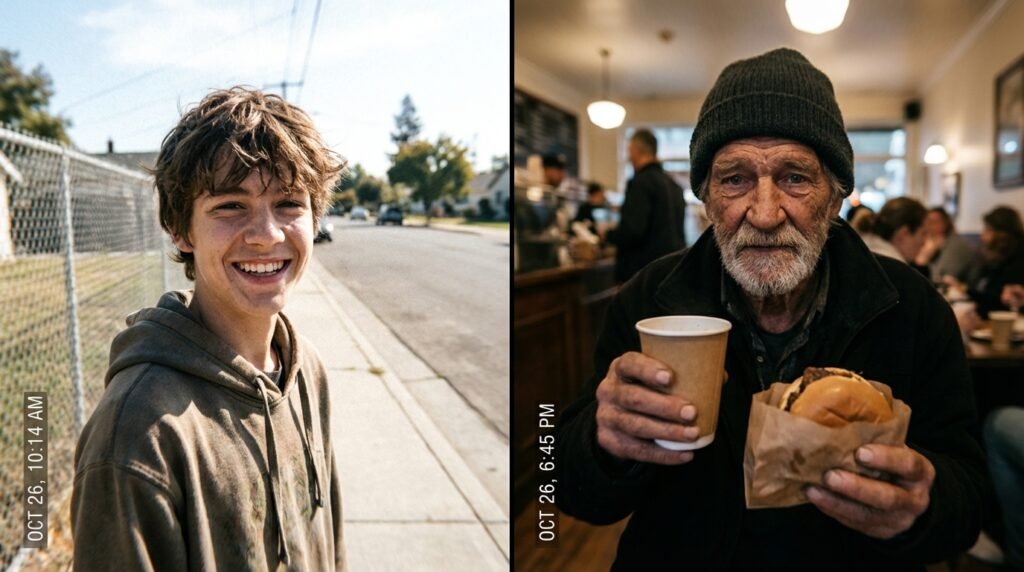
The Final Discovery
I finished the letter, tears blurring the ink into unrecognizable smudges. “Where is he, Elena? If he was here… where is he now?”
Elena looked at the floor. “He caught a fever, Sarah. Three months ago. We didn’t have a doctor. He wouldn’t let me take him to a hospital because he was afraid they’d find him. He was afraid for you.”
The room went cold. colder than the winter air outside.
“You knew?” I screamed, the sound echoing through the hollow house. “You knew he was here, sick, and you didn’t tell me? You let me mourn him for a year while he was three hours away?”
“I promised him!” Elena sobbed, falling to her knees. “He made me swear on his life. He thought he was saving you! I brought him food, medicine… but it wasn’t enough.”
I pushed past her, my mind screaming. I ran to the back of the house, toward a small garden that had been cleared of weeds.
There, under a sprawling oak tree, was a mound of fresh earth. It wasn’t marked with a headstone. Instead, a set of guitar strings had been tied around a branch, humming softly in the wind.
The Silence of Forgiveness
I sat by that mound until the sun went down and the stars began to poke holes in the velvet sky. The homeless man, Arthur, came out and sat a few feet away from me. He didn’t say anything. He just draped the blue jacket over my shoulders.
It still smelled like Daniel. A hint of peppermint and old wood.
The “suspense” of his disappearance had ended, replaced by a grief so profound it felt like a new limb I’d have to learn to live with. But as I clutched the jacket, I felt a strange, flickering light in the darkness.
Daniel hadn’t been a victim of a random crime. He hadn’t been a “rebellious teenager.” He had been a hero in a world that didn’t deserve him. He had spent his final months trying to right the wrongs of a man he’d never even really known.
I stood up, the jacket heavy and warm. I looked at the old house, at my broken sister, and at the man my son had died trying to help.
The police would come tomorrow. The ledgers would be handed over. The “legacy” of my father would be dismantled, brick by ugly brick.
But tonight, I just sat in the quiet, listening to the wind play the guitar strings in the tree.
“I found you, Danny,” I whispered into the fabric of the sleeve. “I finally found you.”
The mystery was over, but the story was just beginning. I would take Arthur home. I would take Elena home. And I would spend the rest of my life making sure the music my son started would never truly fall silent.