

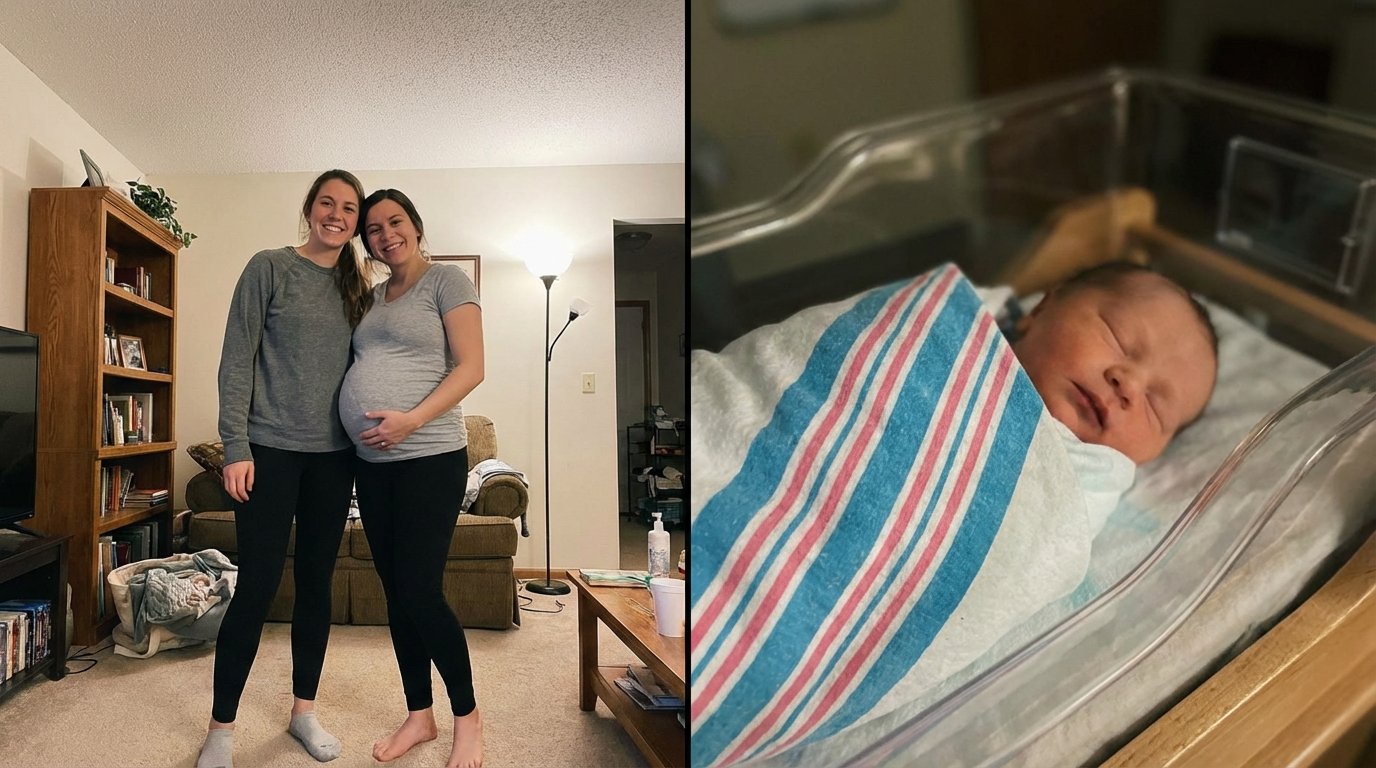
The baby lay swaddled in a sterile white blanket, a tiny bundle of lungs and heartbeat that had cost me nine months of my life. I was exhausted, my body trembling from twenty-one hours of labor, but I felt a sense of pride. I had done it. I had saved my family, and I had given my best friend the one thing she couldn’t have.
But as Rachel stepped toward the bassinet, the air in the hospital room turned to ice. She wasn’t looking at his eyes or his tiny, grasping hands. She was staring at his thigh. The baby had a birthmark—a jagged, dark violet shape that looked like a lightning bolt frozen in skin.
“No,” Rachel whispered, her voice cracking like thin glass. “I can’t take him.”
A Contract of Desperation
Three years ago, my life was a series of red-inked notices and quiet tears. Being a single mother to two young daughters, Maya and Sophie, felt like trying to hold back the ocean with a plastic bucket. Every time I fixed one hole, another opened.
The rent was three months behind. The car made a rattling sound that whispered expensive every time I turned the key. I was drowning, and the water was cold.
Then came Rachel. We had been friends since the third grade, sharing everything from skinned knees to first heartbreaks. Rachel had everything I didn’t: a beautiful home, a stable husband named David, and a career. But she lacked the one thing I had in abundance.
“I’ve lost four of them, Sarah,” she sobbed into her wine glass one rainy Tuesday. “The doctors say my body just… rejects them. It’s a tomb, not a cradle.”
Watching her break was unbearable. I remembered my own pregnancies—the way Maya used to hiccup in my womb, the way Sophie kicked when I played music. I looked at the overdue bills on my counter and then at my grieving friend.
“What if I did it?” I asked. The words felt heavy, like stones falling into a well. “I’m a proven carrier. I could be your surrogate.”
We did it all by the book. Legal contracts, fertility clinics, and psychological evaluations. It was her egg and David’s sperm. I was just the soil; they provided the seed. The money they offered was enough to pay off my debts and put a down payment on a modest house. It was a trade: my body for my children’s security.
Childhood Shadows
As the hormones surged through me during those first months, I found myself thinking back to our childhood. Rachel had always been the golden girl, but there was a fragility to her. I remembered a time in the fifth grade when she lost a necklace her mother, Elena, had given her.
Rachel had hyperventilated for an hour, terrified of her mother’s reaction. Elena was a cold, statuesque woman who demanded perfection. She treated flaws like infections.
“Don’t tell her,” Rachel had begged me back then. “If it’s not perfect, she doesn’t want it.”
I should have remembered that. I should have seen the warning signs. But as the baby grew inside me, I only saw hope. I saw a way out of poverty and a way for my friend to finally be whole.
The Mark of Betrayal
The pregnancy was a nightmare. I spent five months hovering over the toilet, my vision blurring with dehydration. While Rachel sat in my living room picking out nursery colors, Maya and Sophie were the ones rubbing my back and bringing me crackers.
“Is the baby ours, Mommy?” Sophie asked one night, her small hand resting on my protruding belly.
“No, sweetie,” I choked out, the guilt gnawing at me. “He’s a gift for Auntie Rachel. We’re just keeping him safe for a little while.”
Rachel was at every appointment. She wept during the 20-week ultrasound. She held my hand when the Braxton Hicks contractions started. She called the boy her “miracle.” But there was an underlying tension I couldn’t place—a desperation that felt less like love and more like a deadline.
The Delivery Room
The labor was a marathon of agony. I felt like my bones were being pulled apart. David paced the hallway while Rachel stayed by my side, her face pale. When the final push came and the room filled with the sharp, rhythmic wail of a newborn, I felt a wave of relief so profound I thought I might faint.
The nurse, a kind woman named Maria, cleaned the baby and brought him over.
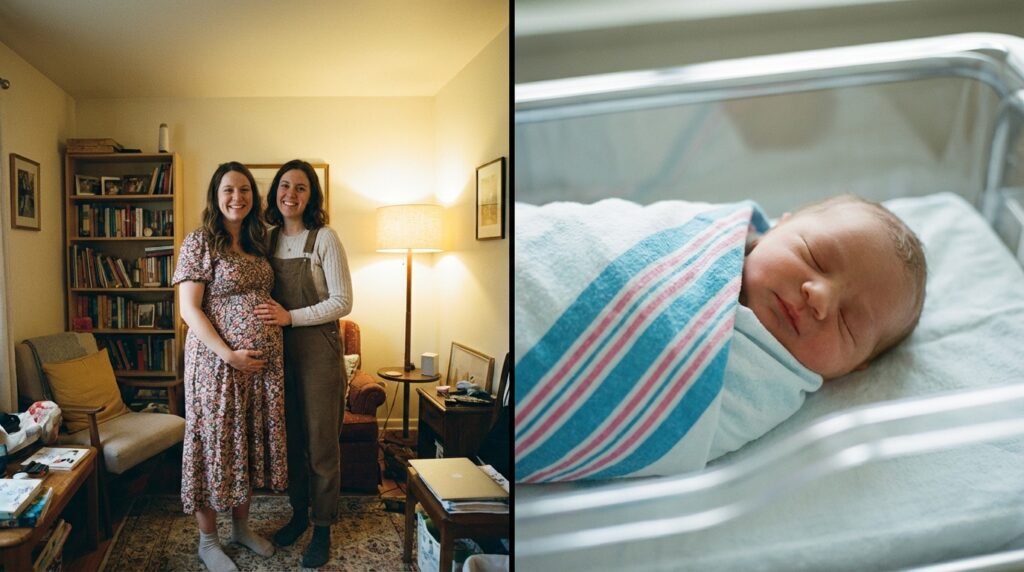
“He’s perfect,” Maria smiled. “He has a little ‘angel’s kiss’ on his leg, but he’s healthy as can be.”
She pulled back the swaddle to show Rachel how to check the diaper. That was when the world stopped. The birthmark was distinct. It wasn’t a small mole; it was a dark, prominent splash of pigment on the upper thigh.
Rachel didn’t reach for him. She didn’t coo. She recoiled as if the baby were a coiled snake.
“Rachel?” David asked, stepping into the room. “What’s wrong? He’s beautiful.”
“Look at it, David!” she screamed, her voice hitting a register that made the glass water pitcher on the nightstand vibrate. “Look at the mark! It’s not possible. It’s not supposed to be there!”
“It’s just a birthmark, honey,” David said, his voice trembling with confusion. “Lots of kids have them.”
“No,” Rachel hissed, her eyes wide and bloodshot. “Not this one. Not him.”
She grabbed her phone with shaking hands and dialed a number. “Mom? It happened. The mark. He has the mark. You lied to me! You told me it ended with you!”
She hung up, grabbed her purse, and walked out of the room without looking back. David stood frozen for a moment, looking from me to the baby, before chasing after her.
I was left alone with a child that wasn’t mine, in a body that was broken, while the silence of the room screamed.
The Sins of the Mother
For three days, I waited. The hospital staff was baffled. Social services were called. Because I was the surrogate, the legalities were a minefield. The contract said the child belonged to Rachel and David, but they were nowhere to be found.
I held the baby. I fed him. I smelled his sweet, milky scent. I named him Leo in my head, even though I knew I shouldn’t.
On the fourth day, David showed up. He looked like he hadn’t slept in a week. He sat in the chair by my bed, his head in his hands.
“She won’t come back, Sarah,” he whispered. “She’s had a nervous breakdown. She’s at her mother’s house. Elena… she’s locked the doors.”
“Over a birthmark, David?” I yelled, my voice raw. “It’s a cosmetic flaw! He’s your son! He has your DNA!”
David looked up at me, his eyes hollow. “That’s the thing. Elena told her that birthmark is a ‘curse’ in their family. She said it only appears on children born of… well, she wouldn’t say. But Rachel is convinced the baby is a sign of something terrible.”
The Funeral of a Secret
Two weeks later, Elena died. It was sudden—a massive stroke. The irony wasn’t lost on me. The woman who had poisoned Rachel’s mind was gone, but the damage was done.
I attended the funeral, leaving the baby with my sister. I needed answers. I needed to look Rachel in the eye.
The service was cold and formal, much like Elena herself. Rachel stood by the casket, a black veil covering her face. She looked like a ghost. After the burial, I followed her to the family estate.
“You have to take him, Rachel,” I said, cornering her in the library. “The state is going to put him in foster care. You signed a contract. More than that, you’re his mother.”
Rachel turned to me, ripping the veil away. Her face was gaunt. “I can’t, Sarah. You don’t understand. That mark… my mother had it. She hid it her whole life. She told me it was the mark of a ‘bastard’s blood.’ She told me that if I ever had a child with that mark, it meant I wasn’t who I thought I was.”
“That’s insane, Rachel! It’s an old woman’s superstition!”
“Is it?” Rachel pulled a tattered envelope from her pocket. “I found this in her safe after she died. It’s a letter. Read it. Then tell me I’m the mother.”
The Letter
I took the envelope. The paper was yellowed, smelling of stale perfume and mothballs. As I read the elegant, sharp handwriting of Elena, the floor seemed to tilt beneath my feet.
My Dearest Rachel,
If you are reading this, I am gone, and the secret I have carried like a lead weight has finally crushed us both. You saw the mark on the boy, didn’t you? I prayed to a God I don’t believe in that it would skip a generation.
You were never my daughter, Rachel. Not in the way you think.
Forty years ago, I couldn’t conceive. My husband—your ‘father’—was a proud man who would never admit to being the problem. I was desperate. I went to a clinic in the city, an experimental place that promised miracles. They used a donor. A man who had been a ‘mistake’ in my own father’s past. A half-brother I never knew existed.
I didn’t know until it was too late. I didn’t know the donor was my own flesh and blood. When you were born, you had that mark. I had the doctor surgically remove yours when you were an infant, leaving only a faint scar you always thought was a childhood fall.
But the genetics… they are a map of our sins. The mark is a dominant trait in our bloodline—a bloodline that is warped. When I saw the ultrasound photos of your surrogate’s baby, I knew. I saw the shadow of the mark even then.
The boy isn’t just David’s. He is the result of a legacy of lies. He is the mirror of my greatest shame. I told you he was a curse because I couldn’t tell you he was my brother’s grandson.
I dropped the letter. The room was spinning.
“The clinic,” I whispered. “The donor sperm David used… they used a different vial, Rachel. The clinic we went to… it was the same one your mother used years ago. It was a mistake in the records. A horrific, one-in-a-million clerical error.”
The twist was more than just a birthmark. The baby wasn’t David’s biological son. Through a catastrophic mix-up at the fertility clinic—the same facility Elena had secretly funded for decades—the “donor” sperm used for our IVF procedure had been a cryopreserved sample from Elena’s own private “family” stock.
The baby was Rachel’s biological half-brother and son combined in a knot of twisted genealogy. He wasn’t a miracle. He was a biological car crash.
A New Definition of Mother
Rachel couldn’t handle it. The revelation that her entire life was built on a foundation of incestuous secrets and medical malpractice broke what was left of her spirit. She and David divorced. She moved across the country, seeking a life where no one knew her name or her bloodline.
The “intended mother” walked away.
I sat in my small apartment, holding the baby. Maya and Sophie were asleep in the next room. The rent was paid, but the cost had been my soul.
I looked down at the mark on his leg. To Rachel, it was a badge of shame. To Elena, it was a secret to be buried. To the world, it was a medical anomaly.
But to me? To me, he was just Leo.
He didn’t choose his blood. He didn’t choose the clinic or the contracts. He was an innocent life caught in a web of adult cruelty.
I tore up the surrender papers the state had sent me. I didn’t care about the contracts. I didn’t care about the “legal” parents. My body had grown him. My blood had nourished him. And when the world turned its back on him because he wasn’t “perfect,” I was the only one left standing.
Emotional Closure
It’s been five years now.
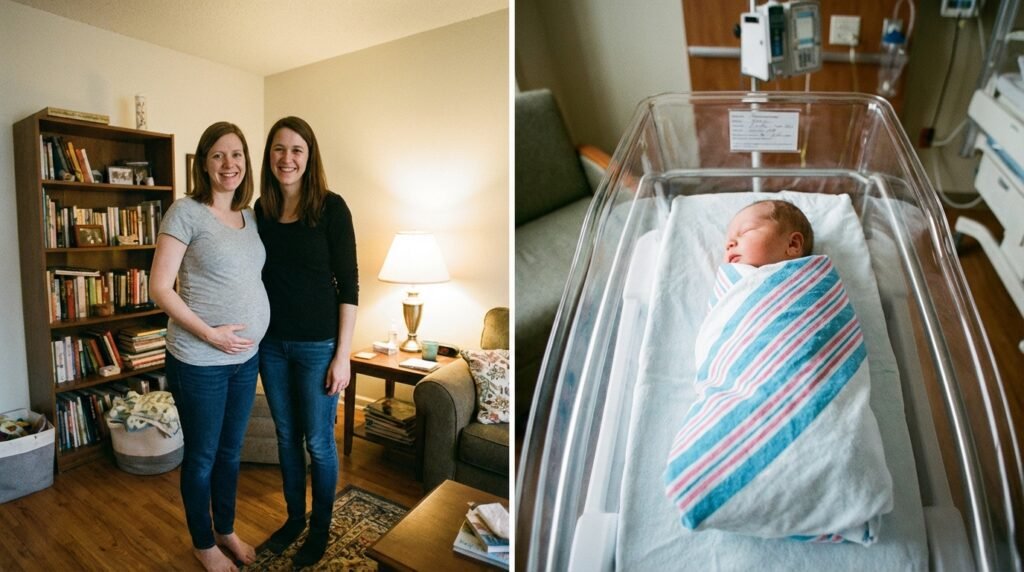
We live in a small house with a big backyard. The rattling car is gone, replaced by a reliable SUV that hauls soccer gear and grocery bags. I work as a nurse now, helping other families navigate the complexities of birth and health.
Sometimes, when the sun hits the window just right, I see Leo playing in the sprinkler with his sisters. He’s a happy, boisterous boy with a laugh that sounds like music. The birthmark is still there—a dark lightning bolt on his thigh.
He asks about it sometimes.
“It’s your map, Leo,” I tell him, kissing his forehead. “It shows how you found your way to the people who love you.”
The truth nearly destroyed three families. It broke a friendship, ended a marriage, and exposed a horrific legacy. But out of the ashes of that destruction, a new family was born.
I wasn’t the intended mother. But I was the mother he needed. And in the end, that was the only truth that mattered.