

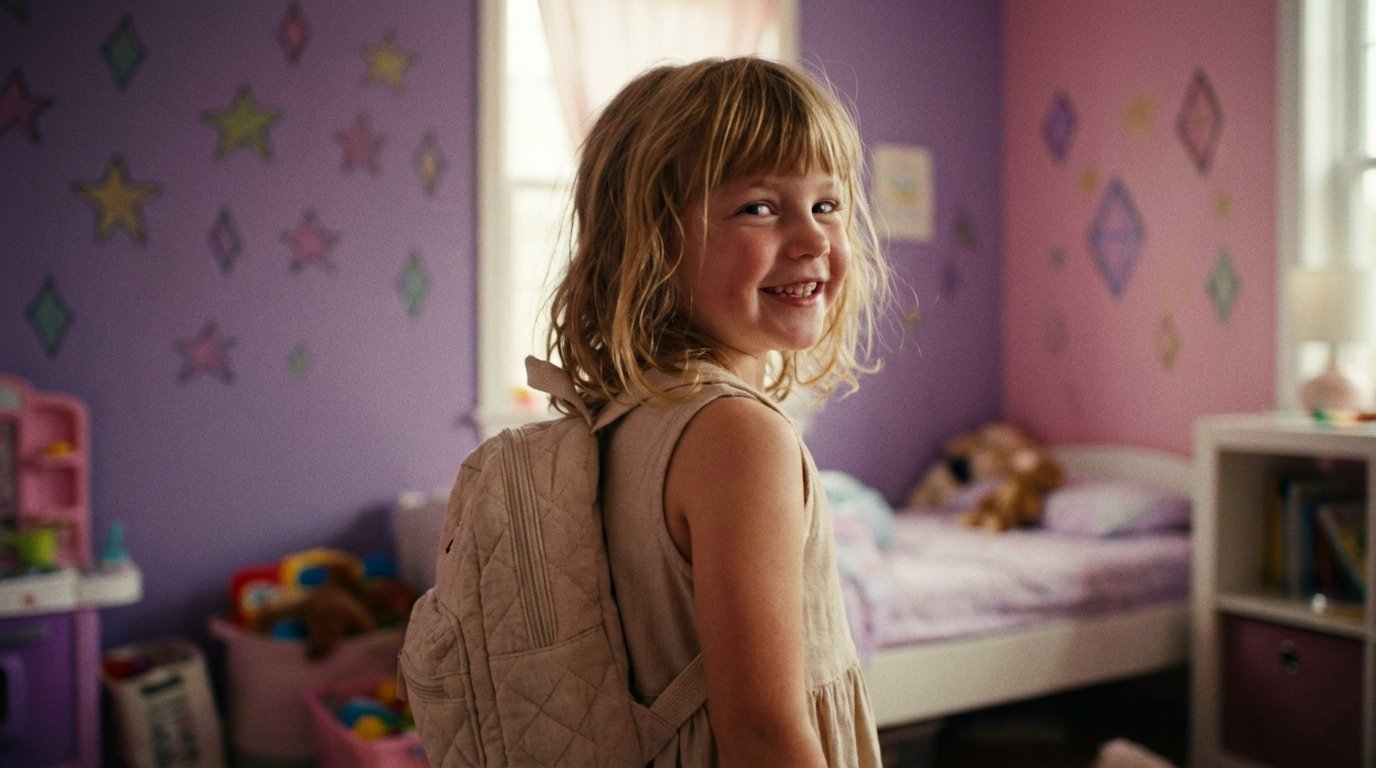
The scent of strawberry shampoo is a ghost that refuses to leave. It clings to the curtains of the smallest bedroom in the house, a sweet, synthetic fragrance that defies the passage of two decades.
In this room, time is a frozen lake. The lavender paint on the walls is peeling at the corners, and the glow-in-the-dark stars on the ceiling have lost their luminescence, appearing now as dull, yellowed scabs against the plaster.
I sat in the rocking chair, the wood groaning under my weight—a weight far heavier than it had been twenty-one years ago. I stared at the tiny sneakers by the door. They were white with pink laces, the toes scuffed from a game of tag that never truly ended.
Every year on this day, I perform the same ritual. I buy a single vanilla cupcake with pink frosting. I light one candle. I sit in the silence of my daughter’s room and I wait for the world to make sense.
But the world hasn’t made sense since 2005.
The Day the Sun Went Out
Catherine was four years old, a whirlwind of golden curls and questions that never ended. She wanted to know why the sky was blue, why worms lived in the dirt, and if the moon followed us home at night.
“It does, sweetie,” Frank would tell her, lifting her onto his shoulders. “The moon is your personal bodyguard.”
The morning of the disappearance started like any other. Frank was in charge of the school run. I remember him kissing my cheek, his chin slightly scratchy with stubble. He was holding Catherine’s hand. She was wearing her favorite red mittens, even though it wasn’t that cold yet.
“Don’t forget her juice box,” I called out as they headed for the car.
“Got it, Boss!” Frank shouted back, winking at me.
That was the last time I saw them together—the last time I saw either of them truly happy.
At 10:15 AM, the phone rang. It was the principal. Her voice was thin, vibrating with a terror she couldn’t hide. She said Catherine hadn’t come back inside after recess.
I drove to the school in a trance. The playground was a sea of yellow police tape. I saw her pink backpack lying by the slide, looking abandoned and small. A few feet away, in the woodchips, sat a single red mitten.
The teacher, Mrs. Gable, was hysterical. “I only turned my back for a second,” she wailed, her hands shaking. “The juice boxes… I was just lining them up.”
A second. A breath. A blink. That’s all it takes for a life to be dismantled.
Memories of a Ghost
In the weeks that followed, the house became a tomb. We stopped eating. We stopped sleeping. We just sat by the window, watching the driveway, waiting for a car that never arrived.
I would find Frank in Catherine’s room at 3:00 AM, clutching her stuffed rabbit, his shoulders heaving. He blamed himself. He was the one who dropped her off. He was the one who had waved goodbye.
“I should have stayed,” he whispered one night, his eyes bloodshot. “I should have watched her through the fence until she went inside.”
“Frank, you couldn’t have known,” I said, though my own heart was screaming the same thing.
Three months later, I found him on the kitchen floor. He wasn’t breathing. The doctors said it was “stress cardiomyopathy.” Broken heart syndrome.
I didn’t just lose my daughter. I lost the man I loved because he couldn’t live in a world where his little girl was a missing person poster on a telephone pole.
A Life Lived in the Shadows
For twenty-one years, I existed in the margins. I kept my job at the library because it was quiet. I avoided the gaze of neighbors who looked at me with that suffocating pity.
I never moved. I never changed the locks. I never touched her room. I lived in a museum of grief, waiting for a miracle that I eventually stopped believing in.
My sister, Elena, was my only link to the living. She was the one who brought me groceries when I couldn’t leave the house. She was the one who held my hand at Frank’s funeral, whispering that we would find Catherine together.
“You have to let go, Sarah,” Elena told me last month over coffee. Her voice was firm, almost impatient. “It’s been over twenty years. You’re killing yourself in this house.”
“I can’t leave her,” I replied, my voice raspy. “If she comes back and I’m not here… she’ll think I forgot.”
“She’s not coming back,” Elena said, her eyes flashing with something I couldn’t identify. Was it anger? Or guilt?
I brushed it off. Elena had always been the “strong” one, the one who dealt with reality while I dealt with ghosts.
But then came Thursday. Catherine’s twenty-fifth birthday.
I was sitting in the rocking chair, the cupcake candle flickering in the drafty room, when I heard the mail slot clatter. I didn’t expect much—bills, coupons, maybe a card from Elena.
I walked to the front door and saw a plain white envelope on the mat. No stamp. No return address. Just my name, Sarah Miller, written in a tight, elegant script I didn’t recognize.
The Face in the Photograph
My hands trembled as I tore the envelope open. I expected a cruel joke, a ransom note decades too late, or even a psychic claiming to have a “vision.”
Instead, a photograph fell out.
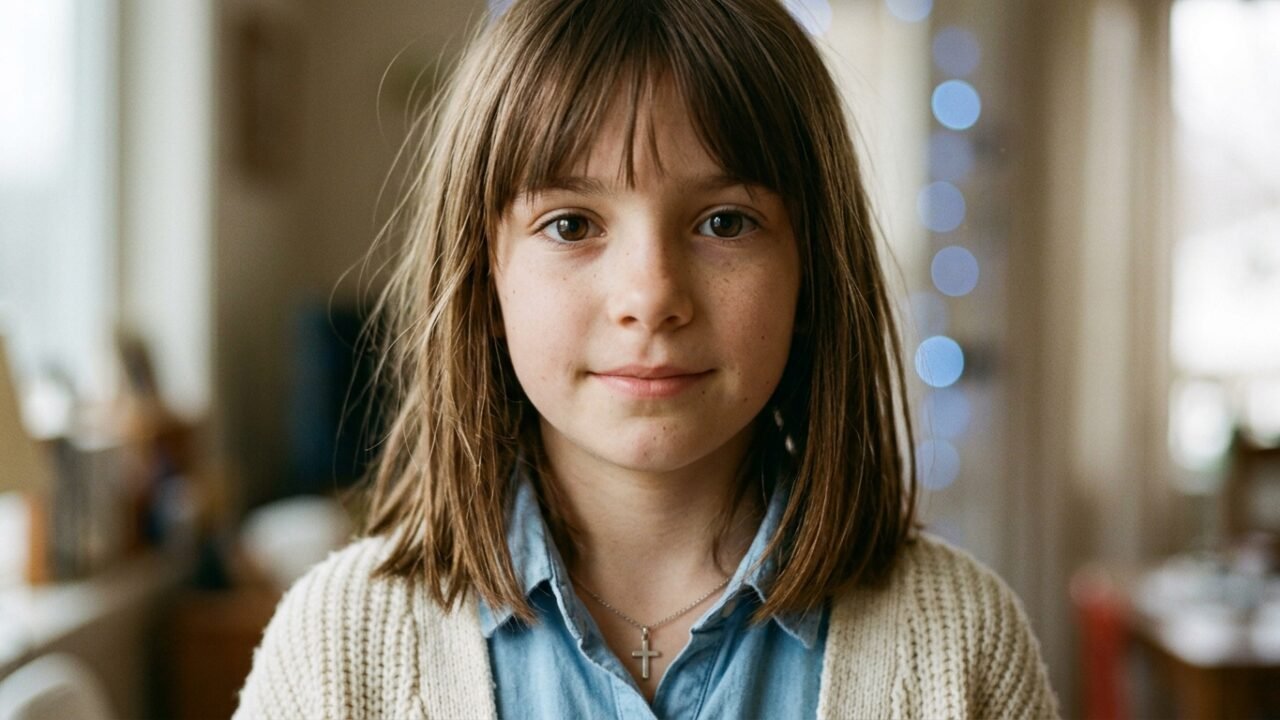
I stopped breathing. The girl in the photo was standing in front of a red brick building. She looked to be in her early twenties. She had my chin, my high cheekbones, and the same slight gap between her front teeth.
But her eyes… they were Frank’s eyes. Deep, soulful, and slightly downturned at the corners.
I flipped the photo over. On the back, in the same elegant script, were the words: Happy Birthday to me.
My heart hammered against my ribs like a trapped bird. I reached back into the envelope and pulled out a folded piece of yellowing notebook paper.
The first two words shattered my world.
Dear Mom.
I fell to my knees in the hallway. My vision blurred as I tried to read the lines, my brain struggling to process the reality of the ink on the page.
Dear Mom,
I know you’ve spent twenty-one years wondering where I went. I know you think a stranger took me from that playground. I know you think I’m dead.
I’m not. I’m alive. I’m twenty-five today. And I’m writing this because I can’t carry this weight anymore. I found the truth, Mom. I found out who really took me.
The person who took me from you was NEVER a stranger.
The Betrayal of Blood
The letter was long. It was a confession, a map of a stolen life, and a dagger to the heart.
As I read, the room seemed to grow colder. Catherine—my Catherine—explained that she grew up three states away. She grew up believing her mother had died in a car accident and that she had been adopted by a “distant relative” to keep her out of the foster system.
I grew up calling her ‘Auntie,’ the letter read. She was kind to me. She gave me a life. But she always told me never to look into the past. She told me the records were lost in a fire.
But two months ago, she got sick. She thought she was dying. And in her delirium, she started talking about ‘the playground.’ She started talking about ‘the red mitten.’
I went through her attic, Mom. I found a box. Inside was my pink backpack. Inside were my original birth records. And inside were letters—letters she had written to you, but never mailed.
I felt a sickening lurch in my stomach. The “Auntie” she described… the woman who had raised my daughter in secret…
Mom, it was Elena.
I dropped the letter. The world tilted on its axis.
Elena. My sister. The woman who had sat with me at the police station. The woman who had helped me pick out Frank’s casket. The woman who had told me, just weeks ago, that I needed to “let go.”
She hadn’t just watched me grieve; she had engineered the grief. She had stood in the shadows of the playground, called Catherine over to the fence, and told her that Mommy was sick and she had to come away right now.
I stood up, my legs feeling like lead. I didn’t think. I didn’t cry. I just walked to my car.
The Confrontation
I drove to Elena’s house, my hands death-gripped on the steering wheel. The betrayal was a physical weight, a thick sludge in my veins. Every memory I had of the last twenty-one years was being rewritten in real-time.
Every holiday. Every “supportive” phone call. Every time she told me to move on. She was making sure I never looked too closely. She was making sure I never found her.
I reached her house and pounded on the door. When she opened it, she was wearing a silk robe and holding a glass of wine. She looked peaceful.
“Sarah? What are you doing here so late?”
I didn’t speak. I simply held up the photograph.
The color drained from Elena’s face so fast I thought she might faint. The wine glass slipped from her hand, shattering on the hardwood floor.
“Sarah, I can explain,” she whispered, her voice cracking.
“Explain what?” I screamed, the sound tearing from my throat like a jagged piece of glass. “Explain how you let Frank die? Explain how you watched me want to end my life for two decades while my daughter was in your house?”
“I couldn’t have children!” Elena cried, collapsing onto her knees amidst the glass shards. “The doctor said I never would. And you… you had everything. You had Frank, you had this perfect life, you had her. I just wanted a piece of it. I thought… I thought you’d have another one. I thought you’d be okay.”
“You stole my life,” I said, my voice dropping to a terrifyingly calm whisper. “You killed Frank. You didn’t just take Catherine. You murdered our family.”
“I loved her!” Elena sobbed. “I gave her everything!”
“You gave her a lie,” I spat. “And now, you’re going to give the police the truth.”
A New Beginning
The legal battle that followed was a blur of headlines and depositions. Elena was arrested, her “perfect” life dismantled by the very girl she had tried to claim as her own. The news called it the “Aunt’s Abduction,” but to me, it was simply the end of a long, dark night.
But the headlines didn’t matter. Only one thing mattered.
Two weeks after the letter arrived, I stood at the airport. My heart was a frantic drum against my ribs. I smoothed down my skirt, my hands shaking.
I saw her walking toward the baggage claim.
She walked with Frank’s gait—a slight bounce in her step, her head tilted to the side. She was beautiful. She was a woman. She was a stranger, and yet, I knew every line of her face.
She stopped ten feet away. Her eyes—Frank’s eyes—searched mine. They were wet with tears.
“Mom?” she whispered.
The word was a healing balm on a twenty-one-year-old wound.
I didn’t say anything. I couldn’t. I just opened my arms.
When she ran to me, the scent of her was different—no longer strawberry shampoo, but something more mature, like vanilla and rain. But as I held her, as I felt the solid reality of her heart beating against mine, the frozen lake in my chest finally cracked.
Closure
We went back to the house. I let her walk into her old room.
She stood in the center of the lavender walls, looking at the tiny sneakers and the yellowed stars. She picked up the stuffed rabbit Frank used to hold.
“I remember this,” she said softly. “I remember the stars.”
“I never took them down,” I said, standing in the doorway. “I was waiting for you to turn them back on.”
That night, for the first time in twenty-one years, I didn’t sit in the rocking chair. I didn’t light a single candle. Instead, we sat in the kitchen—the same kitchen where I had lost Frank—and we talked until the sun came up.
The grief isn’t gone. It never truly goes away. Frank is still buried on the hill, and those twenty-one years are a debt that can never be repaid.
But as I watched my daughter laugh at a story about her father, I realized that the moon hadn’t just been her bodyguard. It had been mine, too, keeping the light on in the darkness until she found her way home.
The strawberry shampoo is gone now. The room smells like fresh air and coffee. And for the first time in a very long time, the house is no longer a museum.
It is a home.