

The homeless man sat under the flickering neon sign of the corner pharmacy, his leg brace glinting like cold teeth in the moonlight. I had passed him every day for a week, pulling my coat tighter, averting my eyes with the practiced indifference of a woman one missed paycheck away from being him.
But my seven-year-old son, Oliver, didn’t have a coat of indifference yet. He had a heart that leaked empathy like a cracked faucet.
“Mom,” Oliver whispered, his voice hitching in the biting November wind. “His hands are shaking. Like the leaves before they fall.”
I looked. Truly looked. The man, Adrian, was perhaps in his mid-forties, but the street had added decades to the map of his face. His beard was a chaotic thicket of salt and pepper, and his eyes—deep-set and hollow—carried a weight I recognized. It was the exhaustion of being invisible.
“We can’t, Ollie,” I murmured, my own exhaustion heavy in my bones. “We barely have enough for us.”
“You said we help people,” Oliver countered, his small hand gripping mine. “You said that’s what makes us human.”
That was the problem with raising a good boy; he eventually used your own lessons against you. I looked at the metal brace on Adrian’s leg, rusted at the hinges, and then at the purple tint of his fingernails.
“One night,” I sighed, stepping toward him. “Just one night.”
A Guest in the Shadows
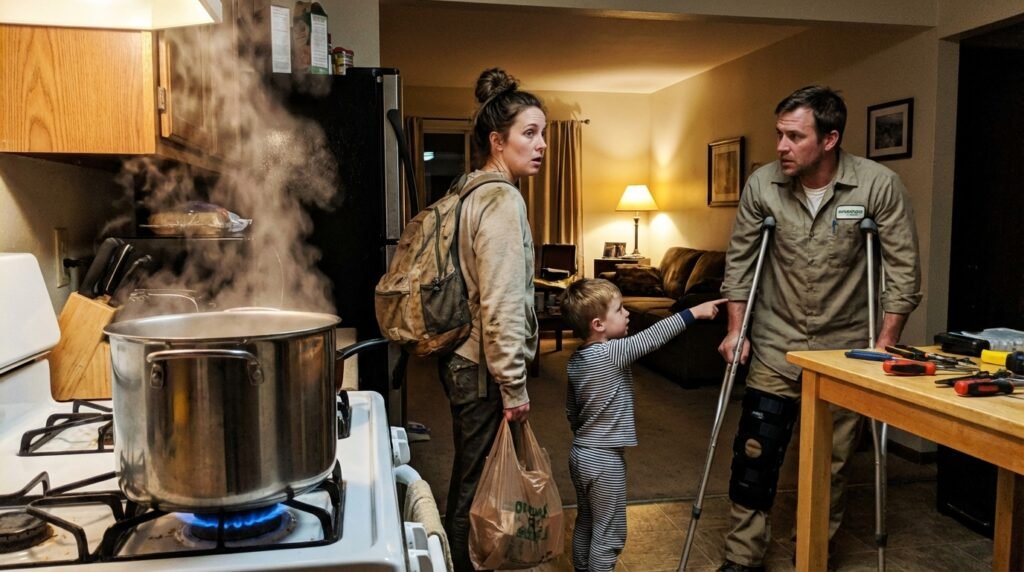
The walk to our third-floor walk-up was slow. Adrian moved with a rhythmic, metallic clack-hiss as his brace dragged across the pavement. He didn’t speak. He carried the scent of wet wool and old smoke, a smell that seemed to fill the narrow hallway of our building.
Inside, our apartment felt smaller than usual. It was a place of chipped paint and mismatched furniture, a sanctuary built on the fragile foundation of my double shifts at the diner.
“Rules,” Oliver said, puffed out with the importance of a host. “We have rules. No shoes on the rug, and you have to use the blue towel.”
Adrian offered a ghost of a smile, a fleeting expression that didn’t quite reach his weary eyes. “I can follow rules, little man.”
I handed him a set of clean clothes—remnants of a life I’d tried to forget, belonging to a man who had walked out on us three years ago. Adrian took them with a reverence that made my throat ache. He disappeared into the bathroom, and soon, the sound of pipes rattling heralded the first hot shower he’d likely had in months.
He stayed in there for a long time. I sat on the kitchen floor, my back against the fridge, wondering if I had made the most dangerous mistake of my life. I heard him cough—a deep, rattling sound that made me think of my mother’s final months.
When he finally emerged, steam clinging to his skin, he looked different. Thinner. More fragile. He sat at our small table and ate a bowl of canned tomato soup as if it were a five-course meal at a Michelin-star restaurant. He listened to Oliver talk about his rock collection and his fear of long-division with a level of focus that was almost unnerving.
“Thank you, Sarah,” he said softly as I spread an old duvet over the couch.
“Just one night, Adrian,” I reminded him, my voice firmer than my heart felt. “I leave for work at 5:00 AM. I expect the key to be under the mat when I get back.”
I locked my bedroom door that night. I hated myself for it, but the click of the deadbolt was the only thing that let me sleep.
The Ghost in the Apartment
The 5:00 AM alarm felt like a physical blow. I crept out of my room, avoiding the creaky floorboards. Adrian was a motionless mound under the blankets on the couch. The metal brace sat on the floor, looking like a discarded piece of a broken machine.
I kissed Oliver’s forehead, whispered instructions to the neighbor who watched him before school, and stepped out into the pre-dawn gray.
The diner was a blur of grease, demanding customers, and the constant, thrumming anxiety of more. My boss, Elena, was a woman who viewed a smile as a sign of weakness.
“You’re slow today, Sarah,” she snapped, shoving a tray of coffee at me. “Life’s hard for everyone. Move faster.”
I thought about Adrian. I thought about the way he had looked at the soup. I wondered if he was currently rifling through my jewelry box—not that there was anything in there worth more than twenty dollars—or if he had already vanished into the city’s cold maw.
By the time 4:00 PM rolled around, I was bracing myself for the worst. I expected a ransacked living room. I expected the police. I expected to find my life even more broken than I had left it.
When I reached my door, I hesitated. I didn’t hear the TV. I didn’t hear the heavy clack of a leg brace. I turned the key and pushed the door open, my heart hammering against my ribs.
I froze.
The apartment didn’t smell like old smoke or wet wool. It smelled like lemon oil and roasted garlic.
The pile of mail that had been colonizing my entryway for weeks was neatly stacked. The mountain of laundry I had been avoiding was folded into perfect, crisp squares on the dining table. The kitchen counters, usually filmed with a layer of inescapable city dust, were spotless—so clean they caught the fading afternoon light.
Even the door handle, which had jiggled loosely for months, felt solid. Someone had tightened the screws.
“Adrian?” I called out, my voice trembling.
The apartment was empty.
A Legacy in a Letter
I walked through the rooms like a stranger in my own home. Everything was changed. The squeak in the floorboard near the bathroom was gone. The leaky faucet in the sink was silent.
On the kitchen table, next to the folded laundry, sat a single envelope. It was yellowed at the edges, addressed to someone named “Clara” in a delicate, looping script. It wasn’t sealed. Beside it was a small, hand-drawn map of our neighborhood and a note written on a paper towel.
Sarah, I couldn’t leave without paying my rent. You gave me a night of peace. I gave you a day of mine. Please, read the letter. It’s the only thing I have left.
I sat down, the silence of the apartment feeling heavy and expectant. My mind drifted back to my mother, Clara. She had died five years ago, her memory a fog of dementia and unsaid words. She had always spoken of a brother she lost to the “great divide” of the family—a man who had been cast out for a mistake no one would name.
With trembling fingers, I pulled the letter from the envelope.
Dearest Clara,
If you are reading this, it means I finally found the courage to send it, or I am no longer here to be afraid. I know what they said about me. I know they told you I was a thief, that I took the family’s inheritance and ran. But Clara, I took that money to pay for your surgery when you were six. I took the blame so you could have a life. I chose the streets so you could have a home.
I’ve watched you from afar. I saw you marry. I saw you have a daughter, Sarah. She looks so much like you. I wanted to come home so many times, but the shame was a brace I couldn’t unlock. I became a ghost because it was easier than being a disappointment.
The air left my lungs. I looked at the name at the bottom of the letter. Adrian.
The Unlocking of Secrets
The room began to spin. Adrian wasn’t just a homeless man I had picked up off the street. He was my uncle. He was the “Boogeyman” my grandfather had warned me about, the one who had “stolen our future.”
But the truth was far more beautiful and far more tragic. He hadn’t stolen anything; he had sacrificed everything. The leg brace—I remembered now. My mother had told me a story about her brother falling from a roof while working a triple shift to keep the lights on. He had never seen a doctor for it. He had just kept working until the bone knit itself into a permanent limp.
A memory surfaced, sharp and sudden: me as a toddler, sitting on a porch. A man with a kind face handing me a wooden bird he had carved.
“For the little bird,” he had whispered.
I looked around the kitchen. On the windowsill sat a small, freshly carved wooden bird, made from a piece of scrap wood he must have found in the alley.
The “major twist” wasn’t just his identity. It was the realization that he hadn’t come to my street by accident. He had been looking for us. He had been guarding us from the shadows for years, watching his sister die from a distance, watching me struggle, waiting for a moment when he was “clean” enough to approach.
And he had only come inside because a seven-year-old boy saw his shivering hands.
I grabbed my coat and ran.
The Long Walk Home
The city was a blur of gray and neon. I checked the bus stop. Empty. I checked the park. Only shadows. I checked the shelter three blocks over.
“Adrian?” I gasped, leaning against the cold brick of the shelter entrance.
The man at the desk didn’t look up. “Lots of Adrians here, honey. You’ll have to be more specific.”
“He has a leg brace,” I said, my voice breaking. “He… he’s my uncle.”
I found him two hours later, sitting on the same piece of cardboard where I had first seen him. He was staring at the ground, the metal brace locked tight, his hands tucked into the sleeves of the jacket I had given him.
“Adrian,” I breathed, sliding down the wall to sit beside him on the frozen concrete.
He didn’t look up. “I didn’t want to ruin it, Sarah. I just wanted to see if you were okay. If Clara’s daughter was doing alright.”
“You cleaned my house,” I whispered, tears blurring the lights of the passing cars. “You fixed my door.”
“I used to be a carpenter,” he said, his voice a dry rasp. “Before the leg. Before the pills for the pain took the rest of me. I wanted you to have a home that didn’t feel like it was falling apart. Even if only for a day.”
“Come home,” I said.
He looked at me then, and I saw the reflection of my mother in his eyes. “I’m a homeless man, Sarah. I’m a mess.”
“No,” I said, reaching out to take his trembling hand. “You’re family. And we have rules, remember? Rule number one is that nobody shivers alone.”
We walked back together—the woman, the ghost, and the rhythmic clack-hiss of a brace that no longer sounded like a burden, but like a heartbeat.
That night, the apartment was warm. The garlic chicken he had started on the stove was ready. Oliver sat on the floor, showing Adrian how to play his handheld video game, and for the first time in five years, the silence in the house didn’t feel like loneliness. It felt like peace.
Healing wasn’t a miracle. It was the evidence of being needed. And Adrian was needed.