

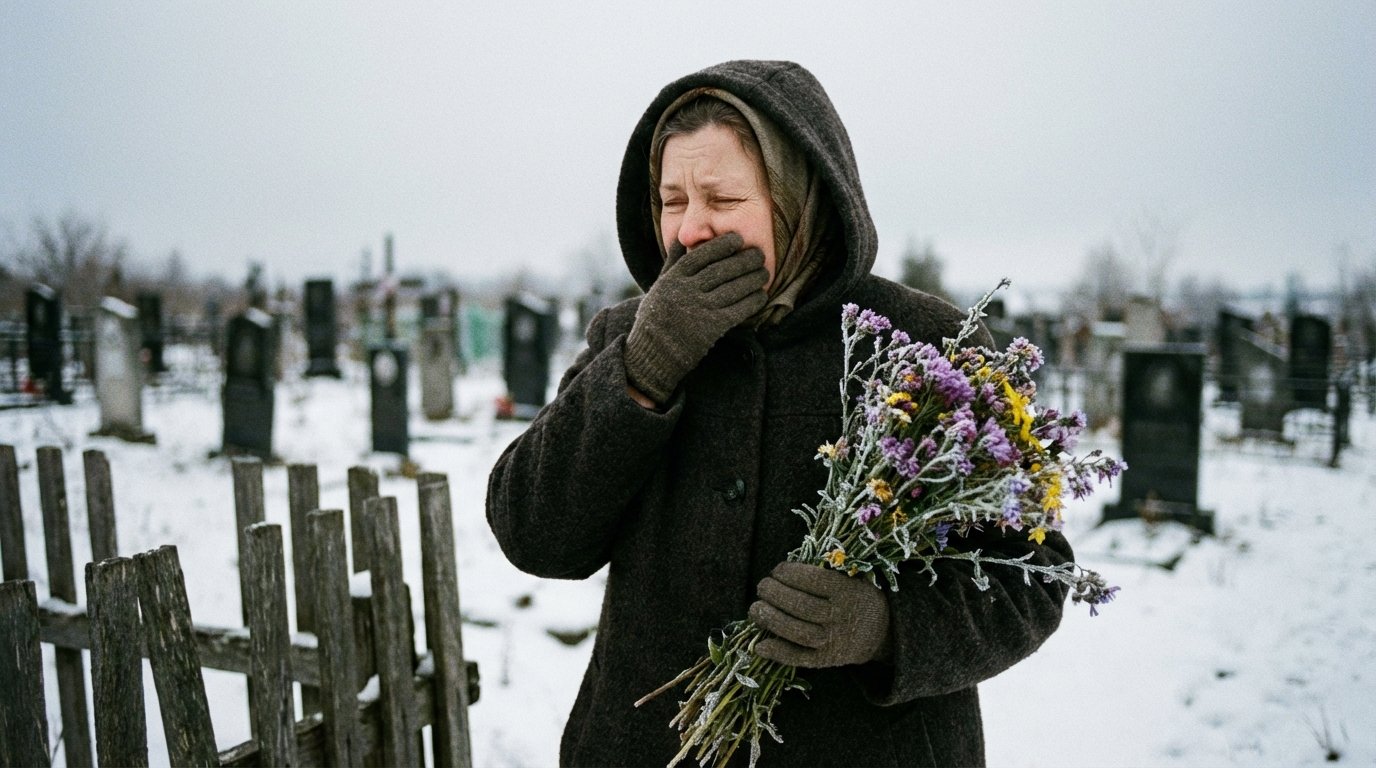
Living in a House of Whispers
The air in our home always felt heavy, as if the walls were holding their breath. David was a good man—kind, attentive, and fiercely protective. But there was a room in his heart that remained locked, a space occupied by Elena, the woman who had died just months before we met.
I remember our first anniversary. I had cooked a lavish dinner, candlelight dancing against the wine glasses.
“She loved lilies,” David had murmured, his eyes glazing over as he looked at the bouquet on the table.
“I can change them, David. I didn’t know,” I said, my voice small.
“No,” he snapped, his voice sharper than I had ever heard it. “Just… leave them. But don’t buy them again.”
That was the first time I felt the weight of her. It wasn’t just grief; it was a wall. As the years passed, my curiosity curdled into a strange, obsessive guilt. I felt like a squatter in a life that wasn’t mine. I needed to see her. I needed to tell her I was sorry for being happy where she should have been.
Childhood Echoes and the Need for Closure
My mother used to tell me that the dead don’t leave us until we say goodbye properly. She was a woman of rituals, someone who believed that unsaid words turn into stones in the belly.
“Maya,” she’d say, her hands flour-dusted as she baked, “if you carry someone else’s secret, you’ll never walk straight. Find the truth, even if it cuts you.”
My mother had lost her own sister young, and every year, she would trek to the hillside cemetery to talk to the grass. Watching her, I learned that peace wasn’t found in forgetting, but in facing the cold granite of reality.
David, however, was the opposite. He treated Elena’s memory like a landmine. If I mentioned her name, he would find a reason to leave the room. If I asked where she was buried, he would provide a vague direction—”The old cemetery by the creek”—and then suddenly become fascinated by the evening news.
“Why don’t we go together?” I asked him once, a year into our marriage. “On her birthday? It might help you, David.”
He looked at me with eyes that were suddenly cold, devoid of the warmth I had grown to rely on. “She’s gone, Maya. Moving on means leaving the dead where they belong. Why do you want to dig up a corpse?”
The harshness of his words stayed with me. It wasn’t the reaction of a grieving widower. It was the reaction of a man guarding a cage.
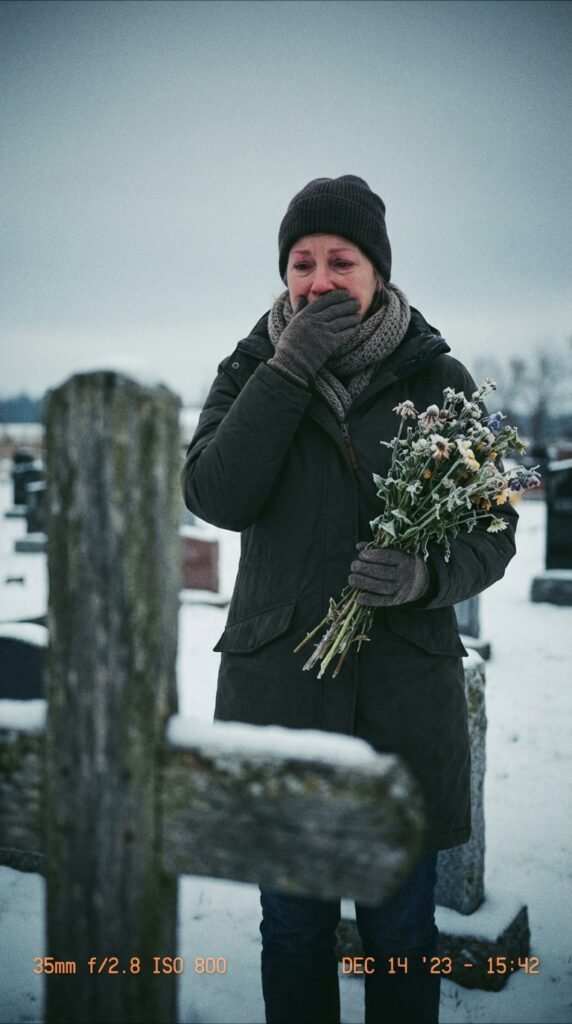
The Forbidden Pilgrimage
The breaking point came on a Tuesday. It was an ordinary, gray afternoon, the kind of day where the sky feels like it’s pressing down on your shoulders. David was away on a business trip, and the house felt cavernous.
I found myself in his study, looking for a stamp, when I saw it: a small, weathered map of the municipal cemetery with a red ‘X’ marked near the North Gate. It was tucked inside an old ledger. My heart hammered against my ribs.
I didn’t think. I didn’t plan. I grabbed my keys, stopped at a local florist to buy a bunch of white roses—not lilies—and drove.
The Cemetery of Sighs
The drive was a blur of autumn leaves and rising anxiety. The municipal cemetery was an old, sprawling place where the trees leaned over the path like mourners. The air smelled of damp earth and cedar.
I walked for what felt like miles, my heels sinking into the soft turf. The silence was absolute, broken only by the distant caw of a crow. I kept checking the map, my fingers trembling. Why was I doing this? Was it respect? Or was I looking for a reason to finally feel like I belonged to David?
I reached the North Gate section. The headstones here were newer, the marble still polished and bright. I scanned the names. Miller. Henderson. Thorne.
And then, I saw it. Elena Vance.
I stepped closer, my breath catching in my throat. I was ready to cry. I was ready to pray. I was ready to lay the roses down and whisper a quiet “thank you” to the woman who came before me.
But as I reached the base of the stone, I stopped. The bouquet slipped from my fingers, the white petals scattering across the dirt like spilled milk.
The headstone didn’t say Beloved Wife. It didn’t say Taken Too Soon.
It said: “Elena Vance. 1988 – 2018. She lived in the shadow, but the truth remains.”
And beneath that, carved in smaller, jagged letters that looked like they had been added later by a different hand:
“HE LIES.”
The Grave That Wasn’t a Grave
I stood there for an eternity, the wind whipping my hair across my face. My mind raced. Who had carved that? Who was “He”?
I knelt down, my hands brushing away the dead leaves at the base of the stone. There were no withered flowers here. No signs of recent visits. But there was something else. A small, plastic-wrapped bundle tucked into a crevice between the marble and the earth.
I pulled it out. It was a letter, the ink faded but legible.
My hands shook so violently I could barely unwrap the plastic. This was the Dead Woman’s Secret. This was the reason David grew pale when I mentioned her name.
A Shadow from the Past
Before I opened the letter, a memory flashed through my mind. Three years ago, at a grocery store, an older woman had stopped me. She had stared at me with such intensity that I felt stripped bare.
“You’re his new one,” she had whispered. Her eyes were rimmed with red, her skin like parchment. “You have his eyes on you now. God help you when he stops looking.”
I had laughed it off as a random encounter with a confused stranger. Now, standing over Elena’s grave, that woman’s face returned to me. She hadn’t been confused. She had been terrified.
I unfolded the paper.
The Long-Awaited Letter
The handwriting was frantic, the loops of the ‘L’s and ‘E’s stretching across the page like reaching fingers.
To whoever finds this—because I know he will never come here to look:
My name is Elena, and if you are reading this, I am already a memory. But I need you to know that the memory you have been told is a lie. David didn’t love me. He didn’t lose me to an illness. He lost me to his own need for control.
We didn’t meet in college. We met when I was trying to leave my home, and he promised me a world that didn’t exist. He is a collector of broken things, and once he fixes you, he owns you. I tried to run. I tried to go to the police, but he has friends, he has money, and he has a way of making you feel like you’re the one who is crazy.
The ‘accident’ wasn’t an accident. I knew the brakes were failing. I told him. He said he’d fix them. He never did. He let me drive that car knowing I wouldn’t come back. He wanted a clean slate. He wanted a woman who wouldn’t ask about the money he stole from my father’s estate.
Check the floorboards in the tool shed. Under the third plank from the back. There is a ledger. It’s not just my life he took; it’s the lives of the people who trusted him. If you are his wife now… run. Before you become the next one he needs to ‘fix.’
The letter ended abruptly, a smudge of dirt at the bottom.
I felt a wave of nausea so strong I had to lean against the cold marble of the headstone. My David? The man who brought me coffee every morning? The man who tucked me in when I was sick?
I thought back to the “accident.” David had told me she died of a sudden heart condition. A quiet passing in her sleep. He had lied about the very nature of her death.
The Confrontation with the Past
I didn’t go home. I drove to the one person who might know the truth—Elena’s sister, a woman David told me lived in Europe and wanted nothing to do with him.
Her name was Sarah, and she lived only twenty minutes away, in a small, cramped apartment above a bookstore.
When she opened the door, she didn’t look surprised. She looked exhausted.
“You’re Maya,” she said, not moving to let me in.
“I found the letter,” I gasped, holding up the plastic-wrapped paper.
Sarah’s face crumbled. She stepped back, gesturing for me to enter. The apartment was filled with photos of Elena. She looked like me. The same dark hair, the same high cheekbones. It was like looking into a mirror of a dead woman.
“David told me you were in France,” I said, my voice cracking.
“David told you what he needed you to hear to keep you quiet,” Sarah replied, sitting at a small wooden table. “He paid for the funeral, he paid for the headstone, and then he threatened to sue me for every penny if I ever contacted his ‘new life.’ He told me he’d tell the world I was an addict, that I was the one who tampered with Elena’s car.”
“Did he do it?” I whispered. “Did he kill her?”
Sarah looked at me with profound pity. “Elena was terrified of him. She was leaving him that night. She had her bags packed in the trunk. The police called it a tragic mechanical failure. But David… David just smiled at the funeral. He didn’t cry once. He just kept looking at his watch, like he was waiting for the next chapter to start.”
Breaking the Cycle
I drove back to our house in a trance. The sun was setting, casting long, bloody streaks across the horizon. As I pulled into the driveway, I saw David’s car. He was home early.
My heart was a drum in my chest. I felt the Dead Woman’s Secret burning a hole in my pocket.
I walked through the front door. The house smelled of roasted chicken and rosemary. David was in the kitchen, humming a tune.
“Hey, honey,” he said, turning around with a smile. “You’re late. I thought we could have a nice—”
He stopped. His eyes fell on my shoes, which were caked in the gray mud of the cemetery. Then he looked at my hands, which were still stained with the dirt from Elena’s grave.
The silence that followed was deafening. The mask he had worn for five years didn’t just slip—it shattered. His face became a blank slate, cold and calculating.
“I told you not to go there, Maya,” he said, his voice dropping an octave.
“Why did you lie about how she died, David?” I asked, my voice surprisingly steady.
“I didn’t want to burden you with the tragedy,” he said, stepping toward me. “I wanted us to be happy. Why are you ruining our happiness?”
“Because it’s built on a grave,” I spat. “I know about the ledger. I know about the car. I know about Sarah.”
David stopped. The air in the kitchen felt electric. For a second, I saw the monster Elena had described. His fingers twitched, and his jaw set in a hard, cruel line.
“You should have just left it alone,” he whispered.
But I wasn’t the woman he met five years ago. I was the woman who had walked through the valley of the dead and come out with the truth.
“I’ve already called the police, David,” I lied, my heart racing. “And I sent a photo of the letter to my lawyer. If I don’t check in within ten minutes, they’re coming.”
It was a gamble. A desperate, terrifying gamble.
David stared at me for what felt like hours. I saw him calculating, weighing his options, looking for a way to “fix” me. But the light in my eyes told him I was already broken beyond his repair.
He stepped back. “Fine,” he said, his voice devoid of emotion. “Get out. Take what you want and never come back. You’re just like her. Ungrateful.”
Emotional Closure: The First Breath
I left that night with nothing but my purse and the letter. I stayed with Sarah for a week, and together, we went to the police. With the information in the ledger—which I found exactly where Elena said it would be—the “accident” was reopened.
It turns out, the Dead Woman’s Secret was the key to a much larger web of embezzlement and fraud. David didn’t just lose his wife; he lost his freedom.
A month later, I returned to the cemetery.
I brought lilies this time. Big, fragrant, white lilies.
I knelt at Elena’s grave. The “HE LIES” inscription was still there, but someone had cleaned the marble. I placed the flowers down and sat in the grass.
“I’m sorry it took so long,” I whispered to the wind. “But you’re not in the shadow anymore.”
For the first time in five years, I took a breath that didn’t feel heavy. I wasn’t the second wife anymore. I was just Maya. And I was finally, truly, alone—and finally, truly, free.