

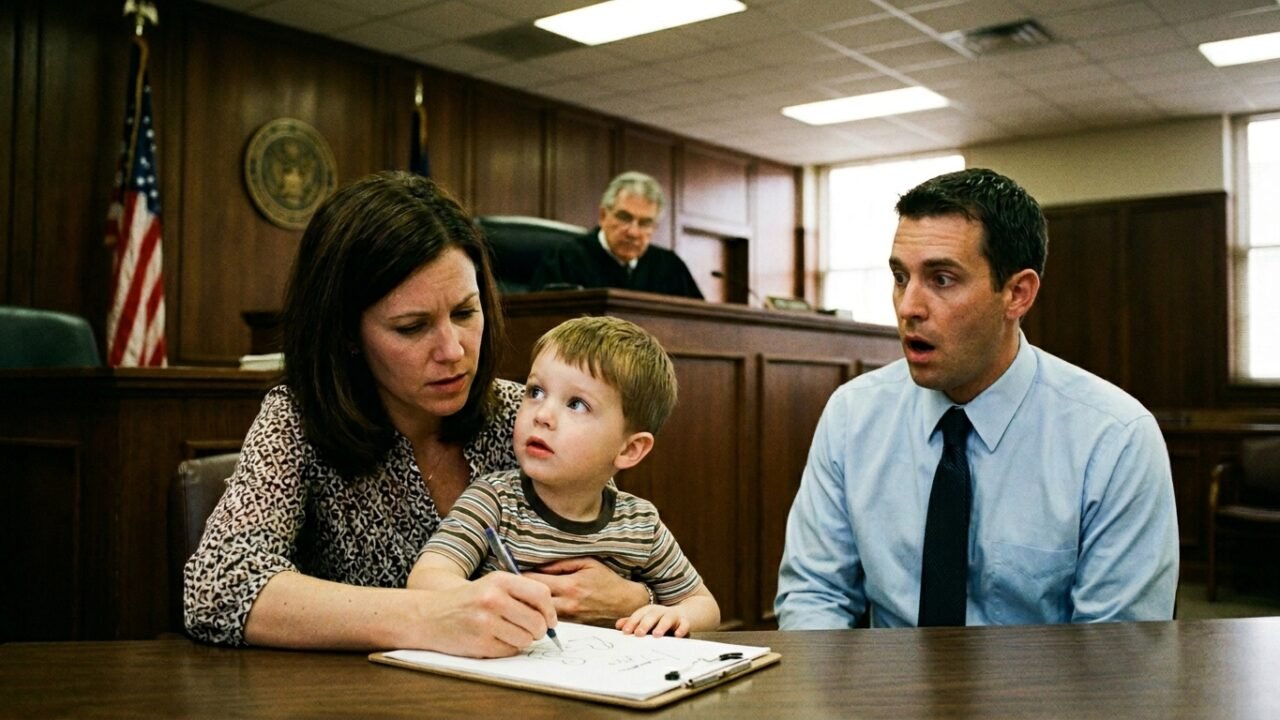



In the quiet, suffocating atmosphere of Courtroom 4B, the child custody battle secrets that had been simmering for months finally reached a boiling point. The air was thick with the scent of floor wax and old wood, a smell that usually signifies justice but, to me, felt like the scent of an impending funeral.
I sat at the scarred oak table, my fingers interlaced so tightly my knuckles turned a ghostly white. Every breath felt like swallowing shards of glass. Across the aisle sat Derek—polished, expensive, and utterly cold. He looked like a man who had never skipped a meal in his life, while I felt like a ghost haunting my own skin.
The Beginning of the End
My mind drifted back to the early days, before the lawyers and the lies. I remembered Derek when he was just a boy with a crooked smile, the man I thought would be my anchor. We used to sit on the porch of our first apartment, sharing a single pint of ice cream because it was all we could afford.
“We’ll make it, Elena,” he used to whisper into my hair. “Just you and me against the world.”
How did that man turn into the monster sitting five feet away from me? The transition hadn’t been a sudden explosion; it was a slow erosion. It was the way he started questioning every cent I spent on the girls. It was the way he slowly isolated me from my mother, making me feel like my family wasn’t “sophisticated” enough for his rising career in corporate law.
I remembered the day I finally left. It wasn’t because of a punch or a scream. It was the silence. The way he looked at our daughters, Lily and Maya, not as children, but as assets to be managed. I walked out with two suitcases and a heart full of terror, thinking the hard part was over. I was wrong. The real war was just beginning.
The Conflict in the Courtroom
“Your Honor,” Derek’s attorney, a woman with a voice like a sharpened blade, stood up. “The evidence is clear. Ms. Harper’s home is an environment of neglect. We have testimony and photographic evidence that these children are going to bed hungry.”
The word hungry vibrated through the room. It was a lie so jagged it sliced right through my composure. I looked at the judge, Marcia Leland. She was a woman known for her fairness, but I saw her eyes narrow.
“Ms. Harper,” the judge said, her voice echoing in the high-ceilinged room. “Is this true? Are you unable to provide basic nutrition for your daughters?”
I tried to speak. I opened my mouth, but the trauma of the last six months acted like a physical weight on my tongue. How do you explain the reality of a single mother’s pantry? How do you explain that the “empty” shelves were because I had just moved the dry goods to higher bins to keep them away from the new puppy?
I remembered the night those photos were taken. Derek had come over under the guise of “co-parenting communication.” He had lingered in the kitchen while I was upstairs tucking Maya in. I heard the faint click of a camera shutter, but I told myself I was being paranoid. I wanted to believe there was still a shred of humanity left in him.
I was a fool.
“My client has provided documentation,” the lawyer continued, holding up glossy 8×10 prints of my kitchen. “An empty pantry. Expired milk. A fridge containing nothing but condiments. This isn’t just poverty, Your Honor. This is choice. This is neglect.”
I looked at Derek. He wasn’t looking at the judge. He was looking at me with a smirk so faint it was almost invisible—a victor’s smile. He wanted me to break. He wanted me to scream so he could point and say, “See? She’s unstable.”
The Discovery of a Daughter’s Courage
The heavy double doors at the back of the room creaked open. The sound was small, but in the vacuum of that silence, it sounded like a gunshot.
I turned, expecting to see a court bailiff or a late spectator. Instead, I saw Lily.
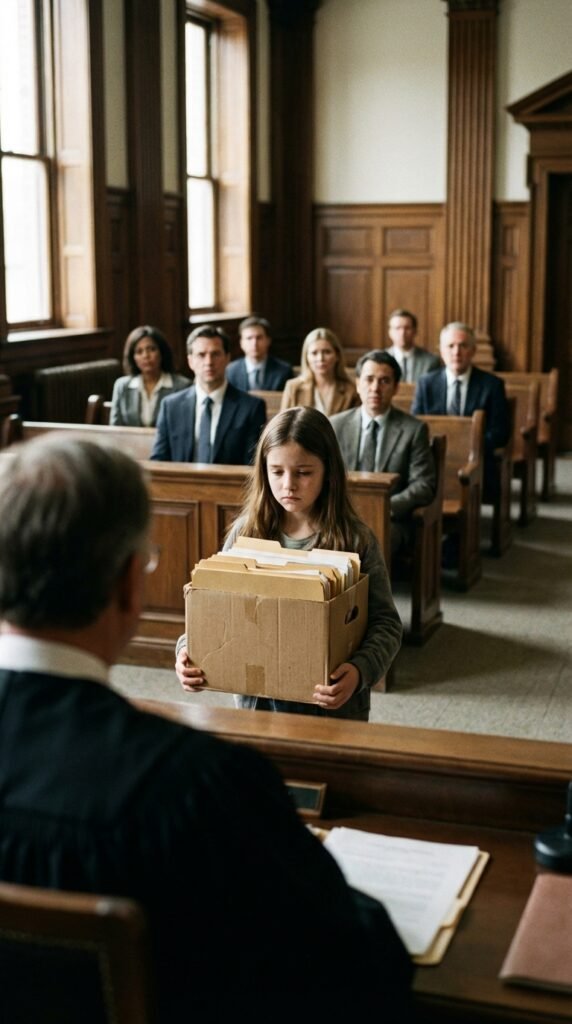
My nine-year-old daughter stood there, looking far too small for the monumental weight of the room. She was wearing the pale blue dress I had stayed up late ironing the night before, her hair pulled back into a ponytail so tight it made her eyes look wide and startled.
In her arms, she cradled an old Nike shoebox. She held it against her chest like a sacred relic.
“Lily?” I whispered, the first word I’d managed to form all morning.
The court liaison tried to reach for her arm, but Lily stepped out of reach. She didn’t look at me. She didn’t look at her father. She walked straight down the center aisle, her Mary Janes clicking rhythmically on the linoleum.
“Young lady,” Judge Leland said, her tone softening but remaining firm. “You aren’t supposed to be in here right now.”
Lily stopped at the wooden gate. She looked up at the bench, her chin trembling just enough to show she was terrified, but her eyes remained fixed.
“I know,” Lily said, her voice surprisingly clear. “But I have to show you this. Daddy told me to hide these receipts. He said if I showed anyone, Mommy would go to jail and I’d never see her again.”
The Revelation in the Shoebox
The courtroom turned into a tomb. I felt the air leave Derek’s lungs from across the room. He half-rose from his seat, his face flushing a deep, angry purple.
“Your Honor, this is highly irregular—” his lawyer started, but Judge Leland held up a single hand.
“Sit down, Counsel,” the judge commanded. She looked at Lily. “Bring the box here, Lily.”
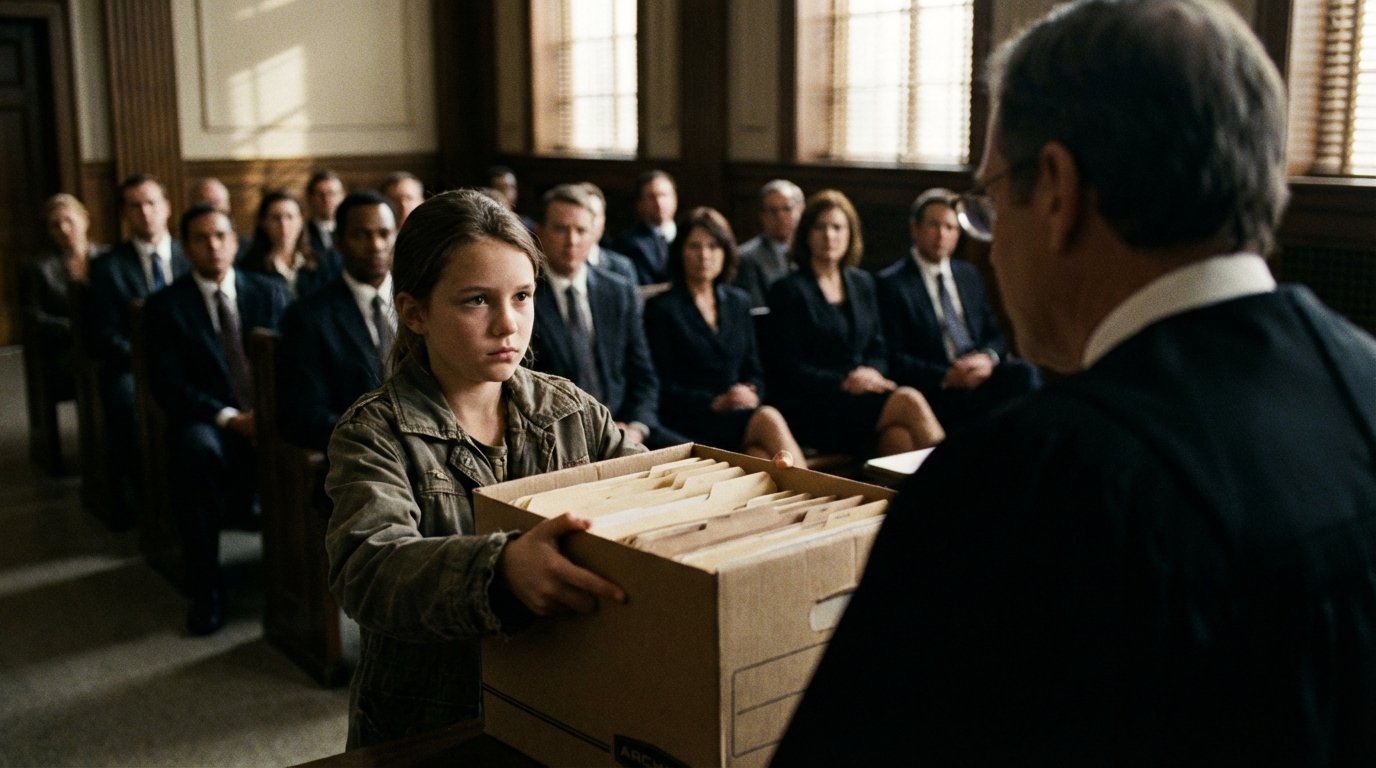
Lily walked through the gate. She passed Derek, who reached out as if to grab the box, but the bailiff stepped in, a silent wall of blue uniform. Lily placed the box on the judge’s bench.
Judge Leland opened the lid.
Inside wasn’t just paper. It was a roadmap of a calculated execution of my character. There were hundreds of receipts.
As the judge sifted through them, the silence grew heavier. These weren’t my receipts. They were Derek’s.
“These,” the judge muttered, picking up a handful of slips, “are for luxury grocery deliveries. Caviar. Prime rib. Organic imported fruits.”
She looked at Derek. “Mr. Whitman, these are addressed to your ex-wife’s home. But they are paid for with your corporate credit card.”
Then she found the letter.
It was a handwritten note, tucked into an envelope at the bottom of the box. It wasn’t meant for a judge; it was meant for the private investigator Derek had hired.
Lily had found it in the glove box of Derek’s car while he was inside a coffee shop. She had been collecting the “scary papers” for weeks, hiding them under her bed, sensing that the “secrets” her father told her to keep were actually weapons meant to hurt the person she loved most.
The judge read the letter silently. Her face, usually a mask of judicial neutrality, began to cloud with a storm of righteous fury.
“This letter,” Judge Leland said, her voice trembling with suppressed rage, “details a plan to systematically deplete Ms. Harper’s bank account by filing frivolous motions, while simultaneously ‘donating’ her groceries to a local shelter after they were delivered to her porch—ensuring her pantry remained empty for the staged photographs.”
A gasp erupted from the gallery. I felt like I was floating. The room spun.
Derek’s lawyer was whispering frantically to him, but Derek was staring at the floor, the “polished” man finally beginning to crack at the seams.
The Ending: A New Dawn
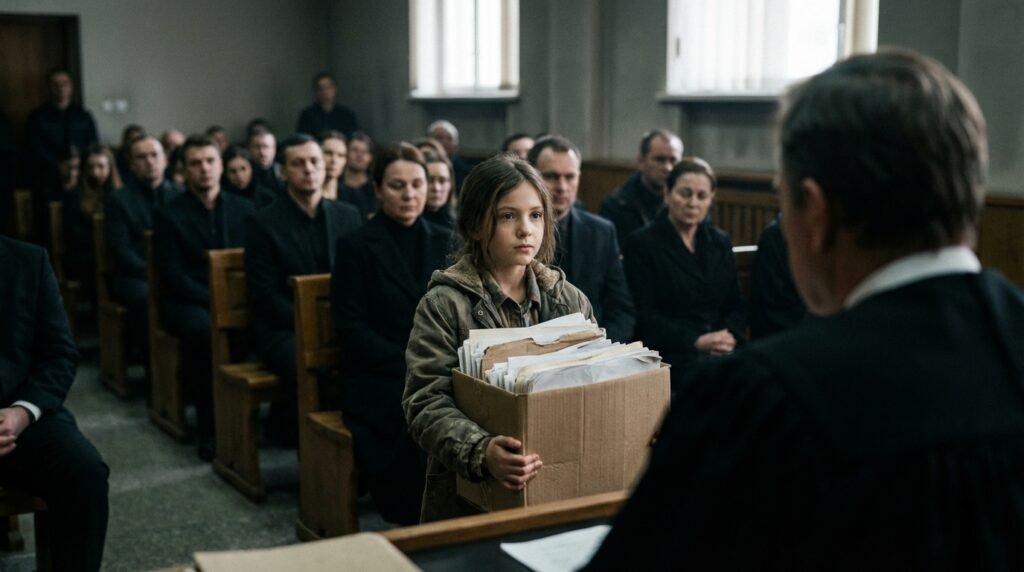
The judge didn’t wait for a closing argument. She didn’t need one.
“Mr. Whitman,” she said, her voice like thunder. “I have seen many things in this courtroom. I have seen desperation and I have seen anger. But I have rarely seen such calculated cruelty. You didn’t just try to take these children; you tried to starve their mother out of their lives.”
She turned her gaze to me. For the first time, I saw tears in the corners of the judge’s eyes.
“Ms. Harper, this court apologizes to you. The petition for change of custody is dismissed with prejudice. Furthermore, I am ordering an immediate investigation into Mr. Whitman for perjury and witness tampering.”
I didn’t hear the rest. I was already on my knees, pulling Lily into my arms. She smelled like strawberry shampoo and the faint, dusty scent of the shoebox.
“I’m sorry, Mommy,” she sobbed into my shoulder. “I was so scared.”
“You were so brave,” I whispered, rocking her. “You saved us.”
As we walked out of the courtroom, the sunlight hitting the steps felt different. It was warmer, brighter. The child custody battle secrets were no longer shadows looming over our lives; they were just scraps of paper in a box, powerless against the truth.
We walked toward the car, and for the first time in years, I didn’t look over my shoulder. I looked forward, toward a kitchen that would always be full—not just with food, but with the fierce, unbreakable love of a family that refused to be broken.