




The Weight of a Woman’s Grief and a Discarded Discovery
The air in the suburban cul-de-sac felt like cold glass. It was the kind of evening where the silence didn’t feel peaceful; it felt heavy, like a lungful of water. Emma stood by the curb, the plastic trash bag in her hand crinkling with every shallow breath she took.
It had been exactly three months since the funeral. Three months since the smell of lilies and the sight of mahogany had redefined her world.
She looked at her reflection in the darkened window of her garage. A woman in her early thirties, Emma looked like a ghost of the girl she used to be. Her eyes, once bright and inquisitive, were now rimmed with the permanent pink of exhaustion.
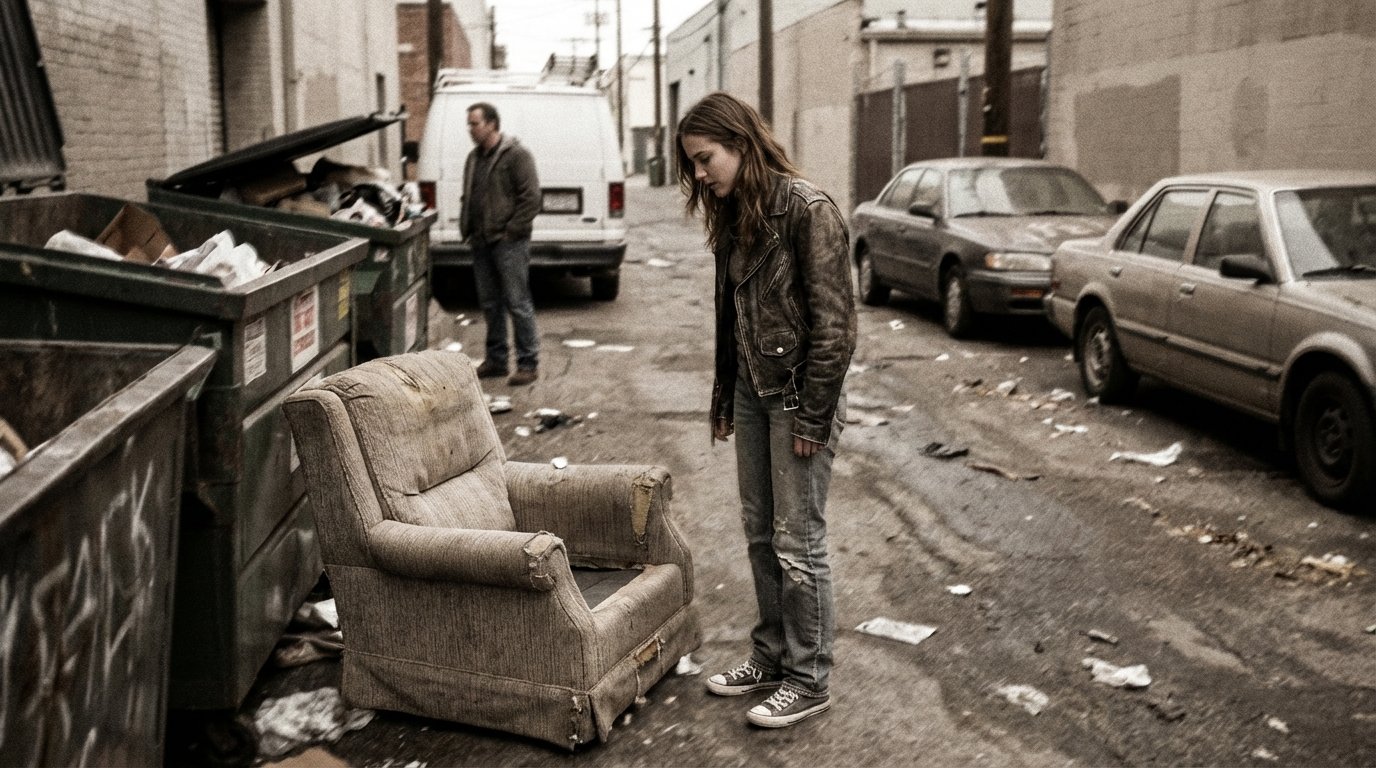
The neighborhood was gray. The sky was the color of a bruised plum. As Emma walked toward the communal dumpsters at the edge of the complex, a small, battered truck rattled to a halt.
Two men jumped out. They didn’t speak. They moved with a hurried, almost guilty energy. They hauled a bulky object from the truck bed, dropped it unceremoniously onto the concrete next to the bin, and sped away before the dust could settle.
Emma stopped.
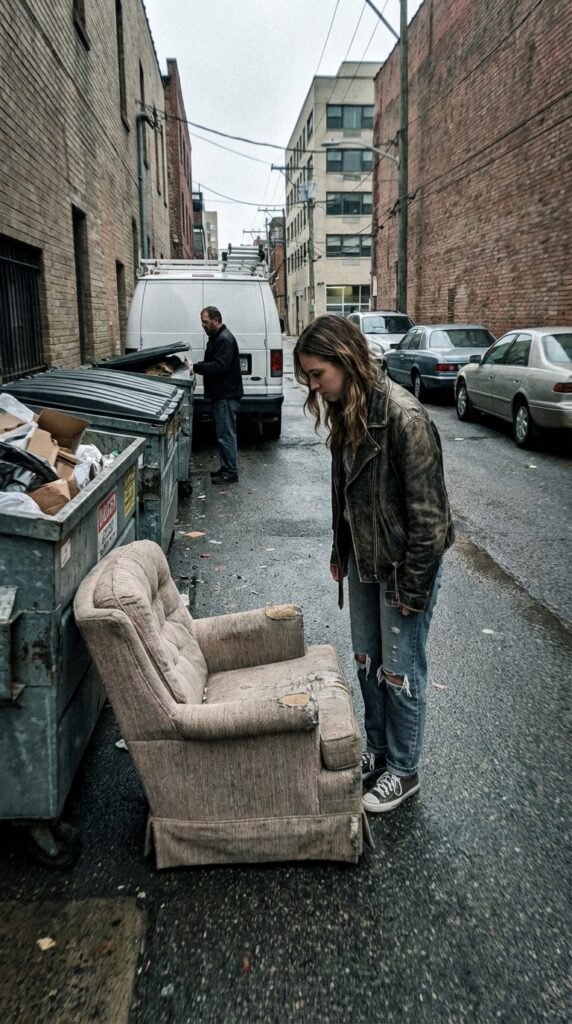
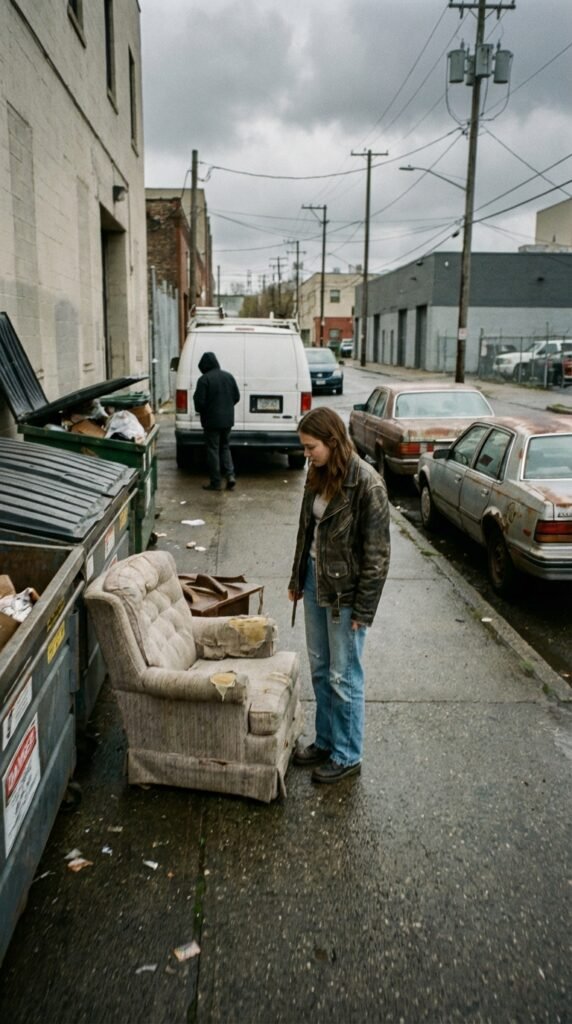
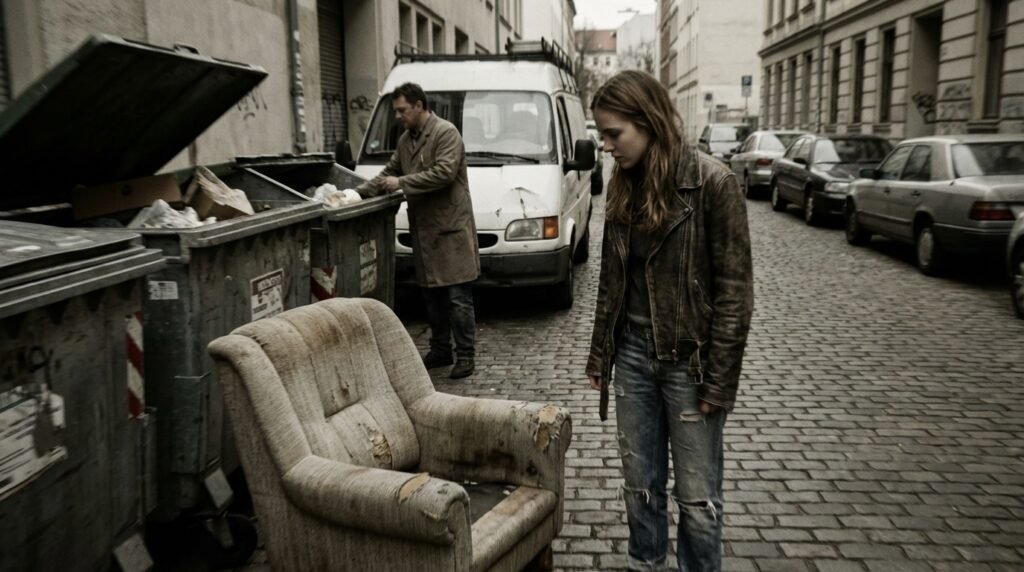
The object was a chair. It wasn’t a sofa, as she’d first thought from a distance, but a heavy, high-backed armchair. The upholstery was a faded, nauseating mustard yellow, torn at the seams and stained by time.
“Why would you just dump that?” she whispered to herself.
She stepped closer. Despite the grime, the bones of the piece were magnificent. The legs were hand-carved oak, curved into elegant lion’s paws. It reminded her of the furniture in her mother’s house—the house that was now standing empty, three states away, waiting to be sold.
Emma reached out and touched the fabric. It was rough, but the frame beneath didn’t wiggle. It was solid. It was anchored. In a world that felt like it was spinning out of control, this chair felt grounded.
“I can fix this,” she murmured.
It wasn’t just about the furniture. It was the need to mend something. Anything. Because she hadn’t been able to mend her mother.
The Conflict Between Memory and the Present
Dragging the chair back to the apartment was a struggle that left Emma’s palms raw and her chest heaving. Every inch of progress felt like a battle against the weight of the wood. When she finally kicked the front door open, her husband, Daniel, looked up from his laptop.
“Emma? Are you kidding me?”
He stood up, walking over to the monstrosity she had just hauled into their living room. He didn’t see the craftsmanship. He saw the filth.
“It’s a project, Dan,” Emma said, her voice trembling slightly. “Look at the frame. It’s oak. Real oak.”
“It’s a health hazard, Em,” he sighed, though his eyes softened when he saw the desperation in hers. “We’re supposed to be packing for the final trip to your mom’s place. We don’t need more… stuff.”
“I need this,” she said, more sharply than she intended.
The silence that followed was thick. Daniel knew the subtext. He knew that “this” wasn’t the chair. “This” was the distraction from the grief that was eating her alive.
“Fine,” Daniel said, reaching for his toolbox in the closet. “But if I find one cockroach, it goes back to the curb. Deal?”
“Deal.”
They moved the chair to the center of the room, under the bright LED lights. Emma grabbed the seam ripper and a pair of heavy-duty shears. Daniel knelt with a flathead screwdriver and pliers.
As they began to work, Emma’s mind drifted back to the funeral. She remembered her cousin, Elena, standing by the casket. Elena had been acting strange—not just grieving, but terrified.
Elena had stayed by the back of the room, her eyes darting toward the entrance as if she expected a ghost to walk through the doors. When Emma had tried to hug her, Elena had flinched.
“She kept so many secrets, Emma,” Elena had whispered that day, her voice shaking. “Your mother… she wasn’t just the woman you thought she was.”
Emma had dismissed it then as the ramblings of a distraught relative. But now, as she watched Daniel struggle to pull a particularly stubborn staple from the chair’s base, those words echoed in her mind.
“Who even assembled this?” Daniel grumbled. “It’s firmly attached, but it’s done haphazardly. These aren’t professional staples. It’s like someone was in a hurry to seal it up.”
The Discovery Beneath the Dust
The work was slow. The yellow fabric came away in jagged strips, revealing layers of old foam and batting that smelled of cedar and stale air.
Emma worked on the armrests, her fingers flying with a frantic energy. She kept thinking about her childhood. Her mother had always been a woman of “pockets.” She hid things. Spare keys under loose floorboards. Money in the freezer. Letters in the back of the pantry.
“She lived like she was waiting for a storm,” Emma thought.
Daniel moved to the seat cushion area. He began to peel back the final layer of heavy canvas that protected the internal springs.
Suddenly, the metal screech of the pliers stopped.
“Emma…”
She didn’t look up. “Almost done with this side. Is the frame cracked?”
“Emma, stop. Come here. Quickly.”
There was a vibration in his voice that Emma had never heard before. It wasn’t annoyance. It was cold, hard shock.
She dropped the shears and knelt beside him.
Daniel had pulled back a flap of the inner lining. Tucked deep within the spring housing, wrapped in a layer of moisture-proof plastic and tied with a thick, black ribbon, was a flat, heavy bundle.
It wasn’t just a letter. It was a cache.
“What is that?” Emma whispered. Her heart began to hammer against her ribs.
Daniel reached in and pulled it out. The plastic was dusty, but the contents were pristine. Beneath the plastic sat an old, leather-bound journal and a thick envelope addressed to The Woman Who Finds My Rest.
Emma’s breath hitched. The handwriting on the envelope was unmistakable. It was elegant, slanted, and sharp.
It was her mother’s handwriting.
A Flashback to the Shadows
Emma’s mind raced back to a night twenty years ago. She was ten years old. She had woken up in the middle of the night to the sound of her mother crying in the living room.
When Emma had peaked through the door, she saw her mother sitting in this very chair—or one exactly like it. Her mother had been sewing something, her needle moving with a desperate, stabbing motion.
“Mom?” Emma had asked.
Her mother had jumped, nearly dropping the needle. “Go back to bed, Emma. I’m just… fixing things. I’m just making sure we’re safe.”
Safe from what? Her mother had never answered.
The Revelation of the Hidden Life
Emma took the envelope from Daniel. Her hands were shaking so violently that she almost dropped it. Daniel put a hand on her shoulder, but he stayed silent. He knew this was a threshold she had to cross alone.
She tore the seal. Inside was a letter, twelve pages long, written on thin, onion-skin paper. As she began to read, the world around her faded away.
“To my dearest Emma,
If you are reading this, then the chair has finally failed, or you have finally found the courage to take things apart. I pray it is the latter.
You knew me as a librarian. A widow. A woman who loved gardens and silence. But I was a woman born of a different name and a darker purpose.
My name was not Martha Vance. I was born Sofia Moretti. And the man you called your father… he was not the man who died when you were three.”
Emma gasped, the air catching in her throat. She looked at Daniel, her eyes wide with terror.
“Read it,” Daniel whispered.
The letter detailed a life of high-stakes deception. Her mother hadn’t been a librarian in her youth; she had been a witness for the federal government against a powerful organized crime syndicate in the late eighties.
She had fled. She had changed her identity. But the twist—the part that made Emma’s blood turn to ice—was about Elena.
“Your ‘cousin’ Elena is not your cousin. She is my sister. And she was the one who helped me hide. But Emma, the secret I carried wasn’t just about the past. It was about the money.
The money I took from them when I ran. I didn’t take it for greed. I took it to ensure you would never want for anything. But I could never spend it. It was tainted. It was blood.”
Emma reached into the bottom of the envelope. There, tucked behind the last page, was a key to a safe deposit box in a bank that Emma passed every single day on her way to work.
But there was one more thing. A photograph.
It was a picture of her mother standing next to a man with dark, piercing eyes. The man was holding a baby. The baby had a distinct birthmark on its wrist—the same crescent-shaped mark Emma had on her own.
The man in the photo wasn’t the man in the pictures on their mantelpiece. He was someone else entirely. A man who looked exactly like the local congressman Emma had seen on the news just last week.
The Confrontation and the Final Ending
The next morning, Emma didn’t go to work. She drove to Elena’s house.
She didn’t knock. She walked in through the unlocked back door, the letter gripped in her hand like a weapon. Elena was sitting at her kitchen table, a cup of tea steaming in front of her. She looked up, and when she saw Emma’s face—and the yellow fabric threads still clinging to Emma’s sweater—she went pale.
“You found the chair,” Elena said. It wasn’t a question.
“Who am I, Elena?” Emma’s voice was a low growl. “Who was my father? And why is he on the news every night talking about ‘family values’ while his daughter is scavenging furniture from a dumpster?”
Elena began to cry. “She was trying to protect you, Emma. If he knew you existed, he would have used you. He’s a dangerous man. He’s always been dangerous. Your mother didn’t run from the mob. She ran from him.”
The realization hit Emma like a physical blow. The “mob” story in the letter was her mother’s way of softening the truth until the very end. Her father wasn’t a criminal in the shadows; he was a criminal in the light.
“The money,” Emma said, her voice trembling. “What is it?”
“It’s his,” Elena whispered. “She took it from his campaign funds. Enough to ruin him if it ever came to light. It was her insurance policy. If he ever found you, she would release the records.”
Emma looked down at the key in her hand. This wasn’t just money. It was power. It was the ability to take down the man who had forced her mother to live a life of fear.
The Resolution of the Heart
Emma returned home. The chair sat in the middle of the room, now completely stripped of its yellow mask. The bare wood looked honest. It looked clean.
She sat on the floor and leaned her head against the oak frame. For the first time in months, she didn’t feel the crushing weight of grief. She felt a new, burning sense of purpose.
Her mother hadn’t been a victim. She had been a warrior. She had lived a quiet, unassuming life to keep Emma safe, but she had left the sword in Emma’s hand when she was gone.
Daniel came into the room and sat beside her. “What are we going to do?”
Emma looked at the key, then at the skeletal chair.
“We’re going to finish the chair,” she said firmly. “We’re going to upholster it in something beautiful. Something strong. And then, I’m going to go to that bank.”
She realized then that being a woman of strength didn’t mean living without fear. It meant taking the broken pieces of the past and building something new from them.
The suspense that had gripped her heart for months finally began to loosen. She wasn’t just a grieving daughter anymore. She was a woman with the truth. And the truth was the only thing that could finally set her mother—and herself—free.
As the sun began to set, casting long, golden fingers across the floor, Emma picked up the new fabric. It was a deep, royal blue. It was the color of the sea after a storm.
“Help me stretch the fabric, Dan,” she said, a small, genuine smile finally touching her lips. “We have a lot of work to do.”