


The scent of stale lilies always reminded me of death, but standing in the foyer of my childhood home, it was the smell of my mom’s perfume that felt truly suffocating.
Linda Dawson stood in the doorway, her silhouette sharp against the hallway light. She didn’t look like a grieving widow. She looked like a landlord conducting an eviction.
“You have twenty-four hours, Ava,” she said, her voice devoid of the warmth that usually colored her tone when she spoke to my sister. “Pack your things. Hand over the keys. If you’re still here tomorrow morning, I’ve already spoken to the sheriff. You will be physically removed.”
The Beginning of the End
I looked at her, searching for a flicker of the woman who used to braid my hair before elementary school. I found nothing but cold, hardened steel.
Behind her, my younger sister, Kendra, stood with her husband, Mark. Kendra was practicing her “sad face”—the one where she bites her lip and looks at the floor—but her eyes were darting around the living room, mentally measuring where her new sectional sofa would fit.
“It’s just time, Ava,” Kendra whispered, though there was no weight of sorrow in it. “We need the space. With the kids growing, and Mark’s new job… it’s a family home. It should be used by a family.”
“I am family,” I said softly.
My mom laughed, a short, brittle sound. “You’re a squatter, Ava. You’ve been living here under the guise of ‘helping out’ since your father died. But let’s be honest—you just wanted a free ride.”
The words felt like a physical blow to the chest.
A Legacy of Invisible Labor
For three years, I had been the ghost in the walls. When Dad’s lungs began to fail, Kendra was “too sensitive” to handle the sight of the oxygen tanks. Mom was “too overwhelmed” to manage the medication schedules.
I was the one who quit my firm in the city to move back to this dusty suburb. I was the one who learned how to change out a morphine drip. I was the one who sat in the sterile silence of ICU waiting rooms at 3:00 AM while they slept in their own beds.
I remembered the way Dad’s hand felt in mine during those final hours—papery, dry, and trembling.
“Take care of the place, Birdie,” he had whispered, using his childhood nickname for me. “Don’t let the foundations rot.”
I thought he meant the house. I didn’t realize he meant the people inside it.
The Conflict of Blood and Greed
The night after the ultimatum, I didn’t scream. I didn’t throw plates. I sat in Dad’s old leather armchair, the one that still smelled faintly of peppermint and old books, and I listened to the house.
Every creak of the floorboards was a memory.
Shadows of the Past
I remembered being six years old, hiding under the dining table during a thunderstorm. Dad had crawled under there with me, bringing a flashlight and a book about stars.
“The house is a shell, Ava,” he’d told me. “It protects the heart. As long as the heart is honest, the walls will stand.”
I looked at the walls now. They felt thin. Fragile.
Mom had always preferred Kendra. Kendra was the “miracle baby,” the one who did ballet and married a man with a steady paycheck. I was the “difficult” one—the one who asked too many questions, the one who chose a career in forensic accounting instead of a “proper” feminine pursuit.
The Funeral Scene
The memory of the funeral a month ago flashed vividly in my mind.
It was a gray, drizzling afternoon. I stood by the casket, my coat soaked through, while Mom and Kendra sat under the dry canopy, clutching designer tissues.
Elena, Dad’s long-time legal assistant and the closest thing I had to an aunt, had approached me afterward. She looked pale, her eyes red-rimmed behind her spectacles.
“Ava,” she had whispered, gripping my elbow. “Your father… he worried about this. He knew how Linda and Kendra could be when it came to the estate.”
“He left everything to Mom,” I had said, my voice hollow. “The will was clear. The house is hers.”
Elena had looked at me with a strange, piercing intensity. “Wills are documents of intent, Ava. But truths… truths are hidden in the foundations.”
She had pressed a small, brass key into my palm and walked away without another word.
I hadn’t understood it then. But a week later, I had visited Dad’s private office—the one he kept in a rented unit downtown—and I had used that key.
The Discovery in the Dark
That night, as my family slept, dreaming of the rooms they would steal from me, I finished my packing.
I didn’t pack the furniture I had bought with my own savings. I didn’t pack the new water heater I’d installed last winter or the high-end security system I’d paid for.
I packed a single shoebox.
Inside were the documents I had found in Dad’s secret office. I had spent the last month verifying every signature, every bank transfer, and every deed.
The Confrontation with Elena
I had met Elena for coffee three days after finding the papers.
“Is it true?” I had asked her, my hands shaking so hard the coffee splashed onto the table.
“Your father was a cautious man, Ava,” Elena said. “He saw how your mother was spending money behind his back. He saw the debts Kendra and Mark were racking up. He knew if he left the house to Linda outright, she’d lose it in a year, or Kendra would talk her into selling it for a quick payout.”
“So he lied?”
“He didn’t lie,” Elena corrected. “He just made sure the house belonged to the person who actually valued it. He set up a blind trust. The ‘will’ they saw at the funeral was an old draft. The final one… the one that matters… was filed privately.”
I had realized then that I held a live grenade. I could have pulled the pin right then. I could have stopped the eviction.
But as I watched my mom sneer at me from the hallway the next morning, I decided to let them pull the pin themselves.
The Revelation on the Lawn
The sun rose on the day of my eviction like a spotlight on a stage.
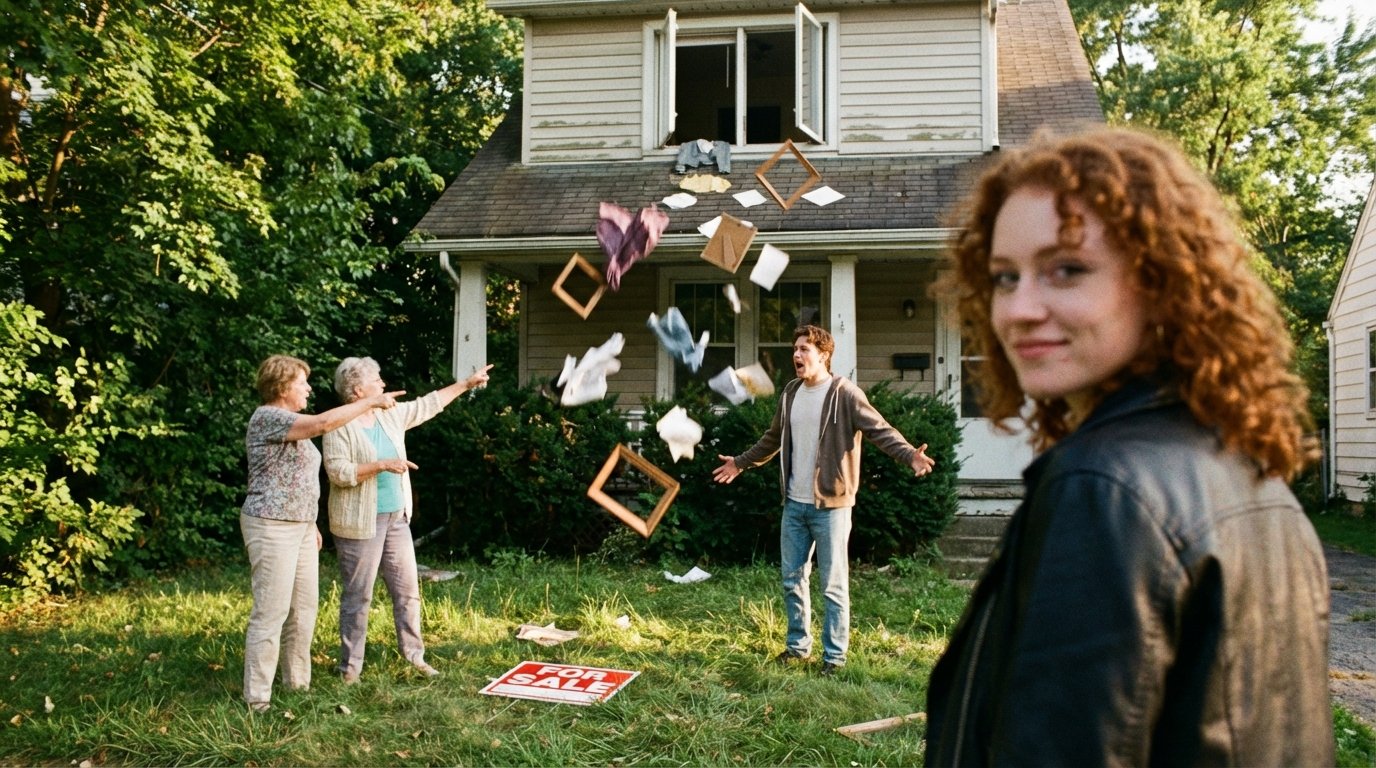
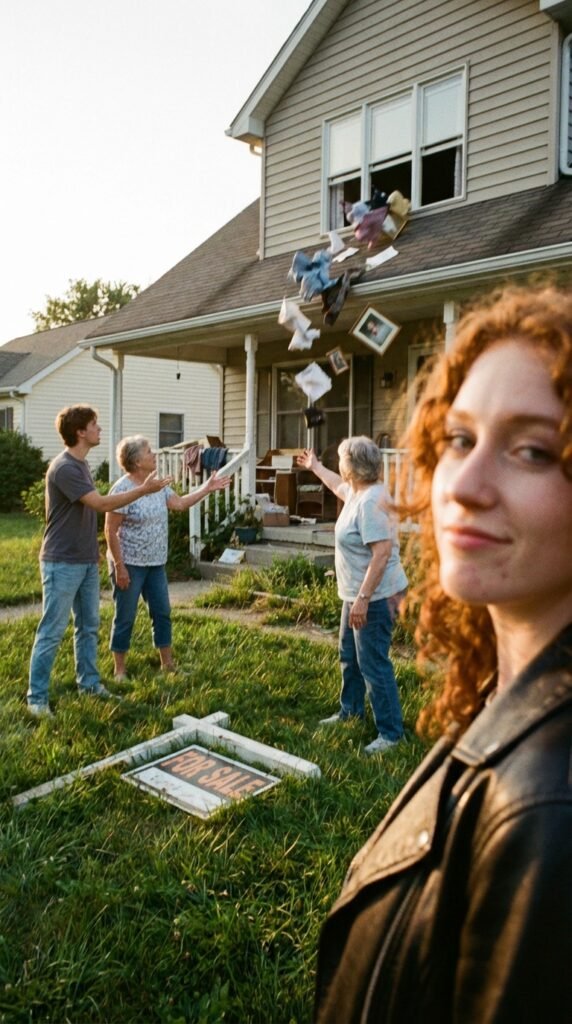
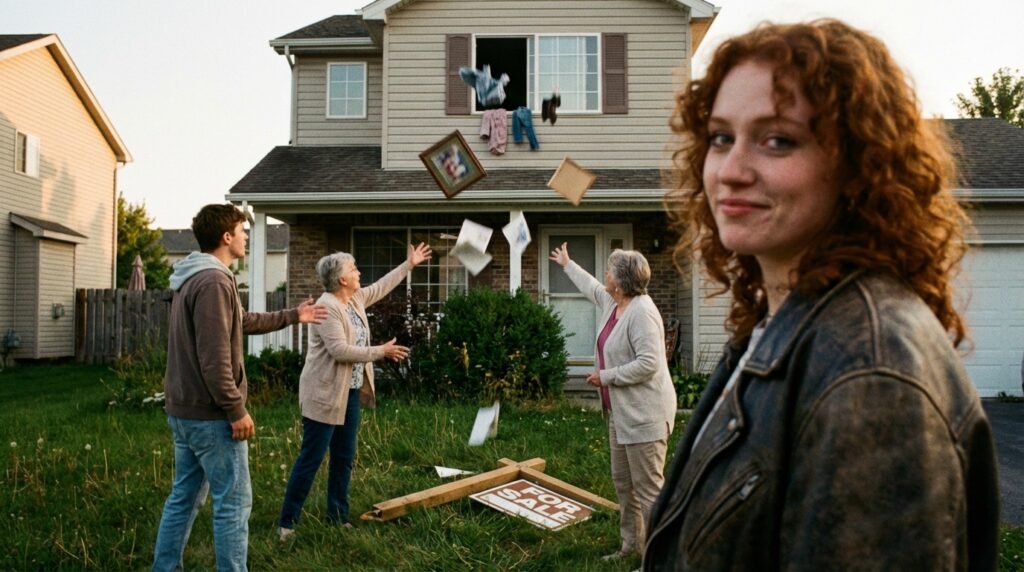
By 8:00 AM, a massive orange moving truck was idling in the driveway. Kendra’s children were running through the yard, screaming about which rooms would be theirs. Mark was already on the porch, holding a crowbar, looking entirely too eager to “renovate.”
“Out,” my mom said, pointing to the lawn.
They didn’t wait for me to carry my things. Mark and two of his friends began hauling my dresser out. They weren’t careful. They bumped the corners against the doorframe, chipping the wood I had polished for years.
They dumped my books onto the damp grass. They tossed my clothes in garbage bags.
Neighbors began to gather on the sidewalk. Mrs. Gable from next door watched with her hand over her mouth. She knew what I’d done for this family. Everyone knew.
The Laughter
“Hurry up, Mark,” Kendra shouted, lugging a box of my kitchenware toward the curb. “I want to get the nursery started by noon!”
She looked at me, a triumphant smirk on her face. “Don’t look so pathetic, Ava. You can always rent a room in the city. You’re a big girl.”
I stood by my car, the shoebox tucked under my arm.
I looked at the house—the peeling paint on the shutters, the garden I had weeded until my fingers bled, the roof I had patched.
And then, I started to laugh.
It started as a low simmer in my chest, a bubbling realization of the sheer absurdity of human greed. Then it broke out of me, loud and clear, ringing across the suburban street.
“What is wrong with you?” Mom snapped, stepping onto the porch. “Have you finally lost your mind?”
“No,” I said, wiping a tear of mirety from my eye. “I just realized how much work you’re going to have to do.”
“We’re moving in, Ava,” Kendra sneered. “We aren’t doing ‘work.’ We’re living the life we deserve.”
“Oh, you definitely deserve what’s coming,” I said.
I climbed into my car, started the engine, and drove away without looking back. I had a hotel room booked. And I had a phone call to make.
The Ending: A New Foundation
The “Truth” didn’t hit them until three hours later.
I was sitting in a quiet bistro, sipping a latte, when my phone began to explode.
12 Missed Calls: Mom. 8 Missed Calls: Kendra. 4 Text Messages: Mark.
I let them wait. I finished my drink. I enjoyed the silence. Then, I finally answered.
“AVA!” My mom’s voice was shrill, bordering on a scream. “There are men here! Men with a legal notice! They’re saying we have to leave! They’re saying the house is under ‘Management’!”
“Hello, Mom,” I said calmly.
“What did you do?” she shrieked. “The deed is in my name! The will said—”
“The will you have is a 15-year-old draft, Mom,” I interrupted. “Dad updated his estate plan eighteen months ago. He saw the credit card statements. He saw the way Kendra was ‘borrowing’ from his retirement fund.”
There was a stunned silence on the other end.
“The house isn’t yours,” I continued, my voice steady. “It was placed into an irrevocable trust. The trustee is a third-party firm. And the beneficiary isn’t you. Or Kendra.”
“Who?” she whispered.
“Me,” I said. “But there’s a catch. Dad knew I’d be too soft to kick you out. So he put a clause in the trust. If anyone attempted to forcibly remove the primary resident—that’s me—or if the property taxes were neglected by the secondary occupants, the trust would automatically trigger a sale.”
“A sale?” Kendra’s voice echoed in the background.
“Yes,” I said. “I called the trustee this morning as I was driving away. I informed them that I had been physically evicted and that the locks were being changed without my consent. That constitutes a violation of the trust terms. The house is being liquidated. The proceeds are going to a charity for lung cancer research. Dad’s favorite.”
The Final Confrontation
I drove back to the house one last time that evening.
The moving truck was gone. In its place was a “For Sale” sign and a “Notice of Impoundment” on the front door.
Mom, Kendra, and Mark were sitting on the curb, surrounded by the boxes they had just moved in. They looked small. They looked broken.
Kendra stood up as I parked. “You ruined us! We sold our condo! We have nowhere to go!”
“You had a home,” I said, stepping out of the car. “I would have let you stay here forever. I would have kept paying the bills. I would have kept the roof over your heads just like I did for Dad.”
I walked up to my mom. She wouldn’t look at me.
“You threw my life onto the grass because you thought you could take something that didn’t belong to you,” I said. “Dad didn’t do this to you. I didn’t do this to you. Your own greed did.”
I reached into my pocket and pulled out the long, hand-written letter I had found in the shoebox. It was the one Dad had written to me, the one I hadn’t shared with them yet.
“To my Birdie,
If you’re reading this, it means they’ve finally pushed you too far. I’m sorry I couldn’t teach them how to love without a price tag. I’m sorry I’m leaving you with the burden of being the ‘strong one.’
Do not feel guilty for the walls falling down. Some structures are built on sand, Ava. Your mother and sister chose their foundation long ago. You are my heart. You are the only one who truly understood that a home isn’t a trophy—it’s a sanctuary.
Take the money I hid in the second account. Go back to the city. Buy a place with big windows. Let the light in. You’ve spent enough time in the shadows of this family.
I love you. Now, let it go.”
I didn’t give them the letter. They didn’t deserve his words.
I watched as a locksmith arrived to finalize the securing of the property. The house was no longer a home; it was just wood and glass, waiting for someone new to fill it with something better than resentment.
Emotional Closure
As I drove away for the final time, I looked in the rearview mirror.
I saw my mom standing in the middle of the street, clutching a designer handbag that was worth more than the integrity she had lost.
I didn’t feel anger anymore. I didn’t even feel the sting of the betrayal.
I felt light.
For the first time in three years, I wasn’t the one holding everything together. I wasn’t the one fixing the leaks or silencing the ghosts. I was just Ava.
I turned on the radio, rolled down the windows, and let the wind wash away the scent of stale lilies.
The house was gone, but the heart was finally free.