

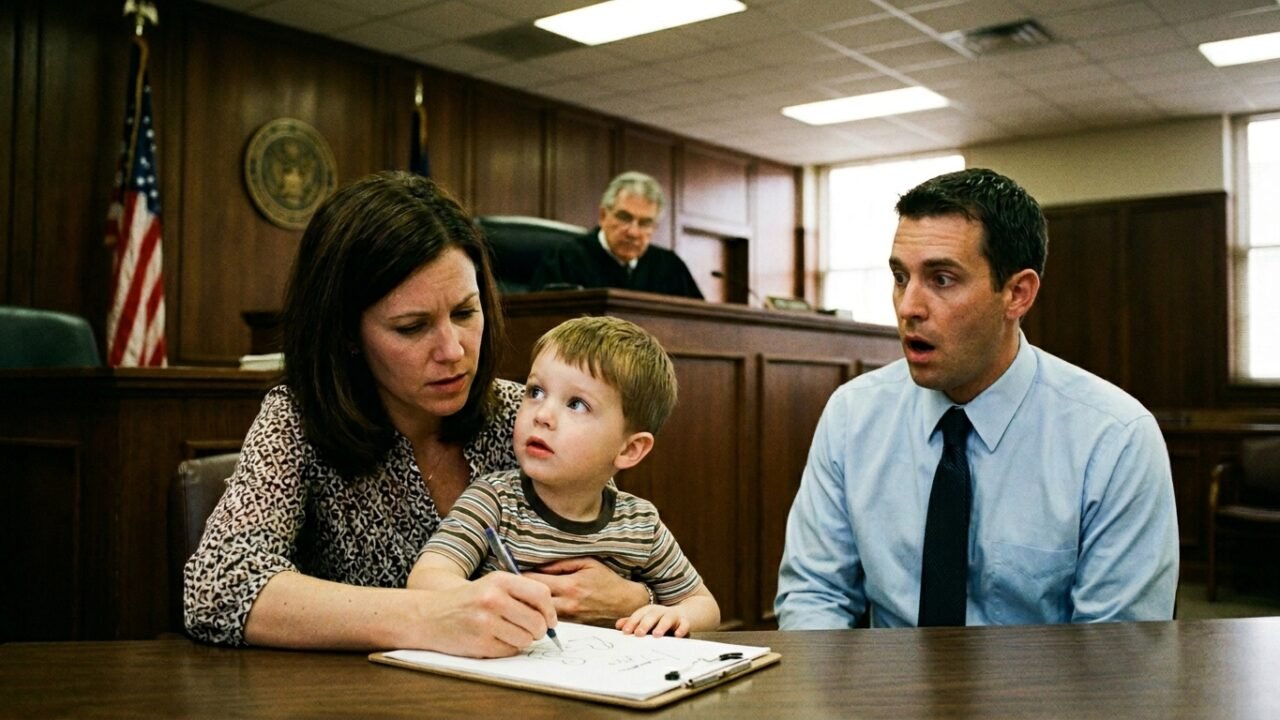

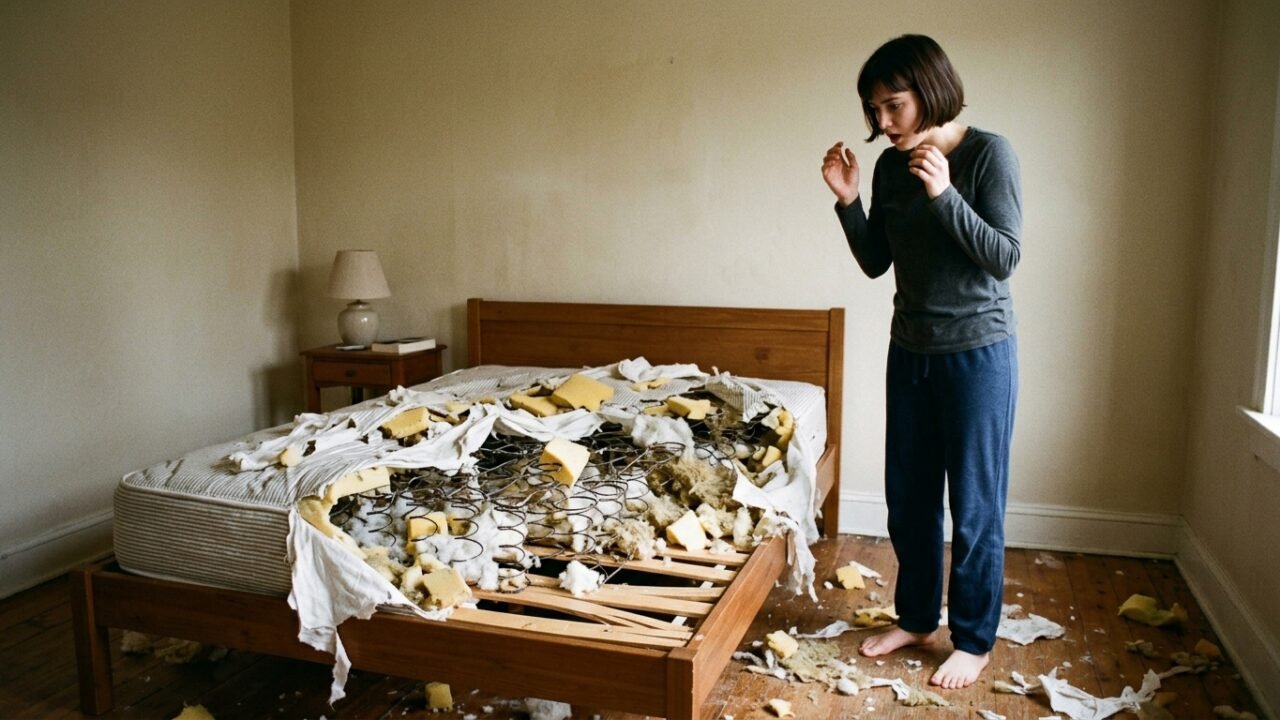

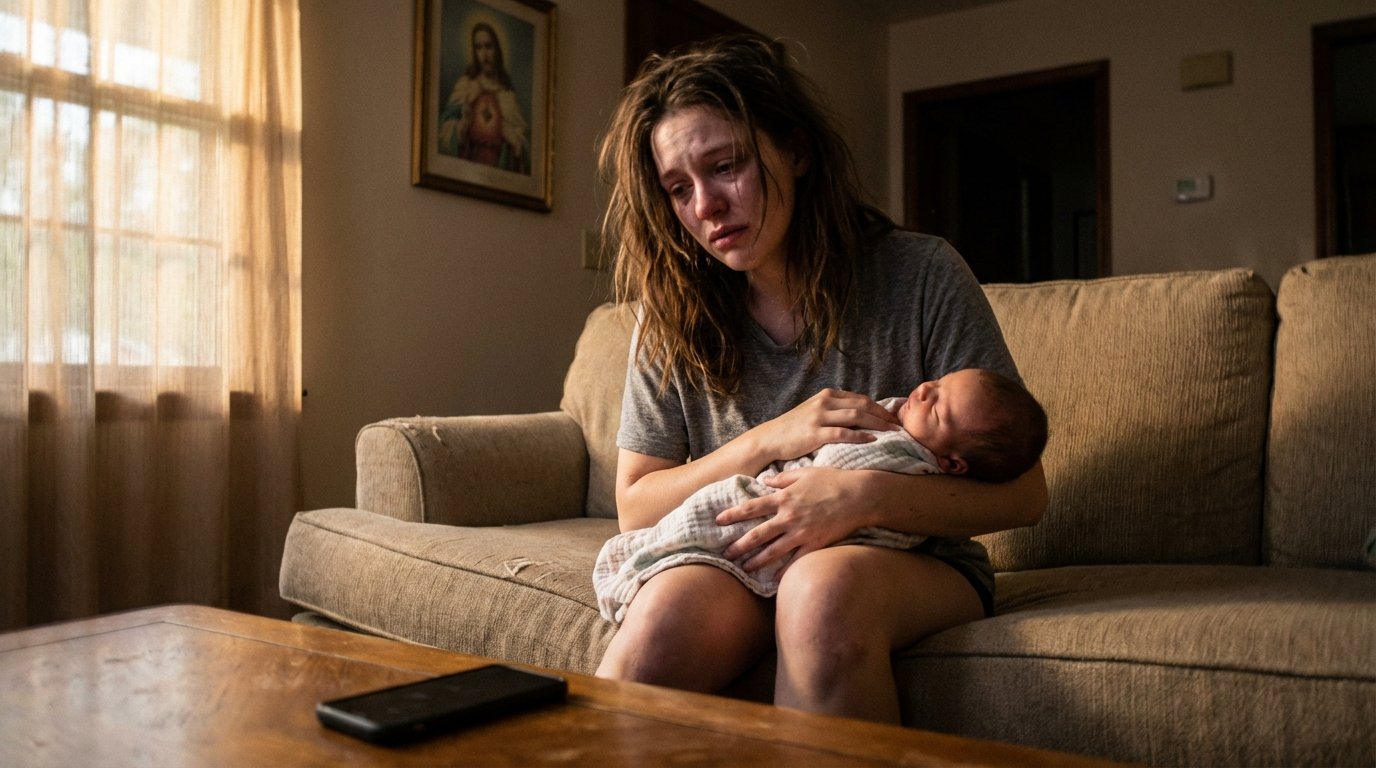
Leaving my newborn house that morning didn’t feel like an exit; it felt like an escape from a burning building where I was the only one holding the hose.
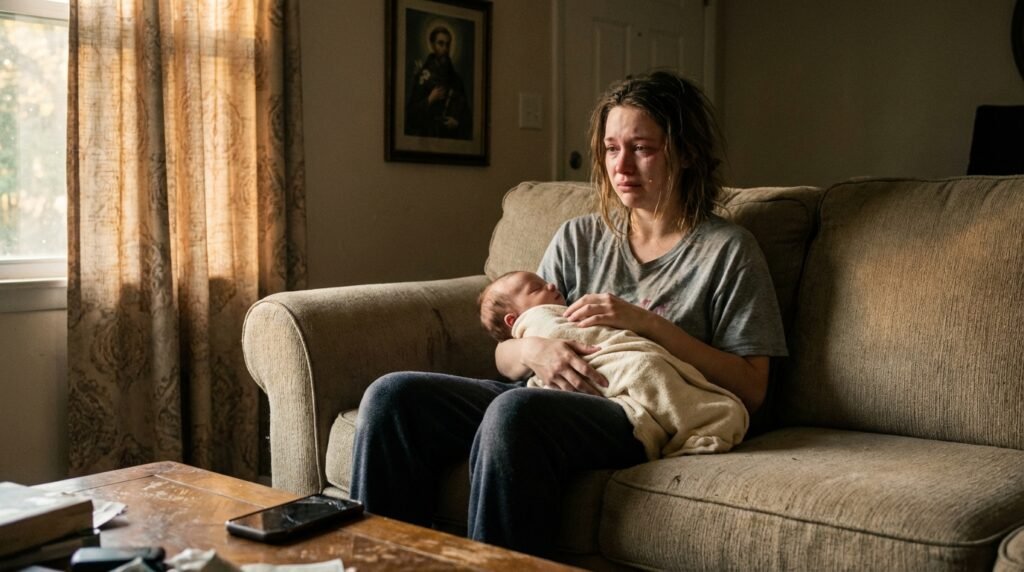
The air in the hallway was thick with the scent of curdled milk and unwashed hair. My son, Leo, was screaming—a jagged, rhythmic sound that sliced through my nervous system like a dull saw. I looked at the clock. 6:42 a.m. I hadn’t slept more than forty consecutive minutes in three weeks.
My vision was tunneling. The edges of the world were fraying into gray static. I knew, with a terrifying, cold clarity, that if I didn’t get away from the sound of that crying for just one rotation of the earth, I was going to break into pieces that could never be glued back together.
The Beginning: A Descent Into the Fog
I don’t remember the drive to my mother’s house. I only remember the physical sensations: the steering wheel felt like it was made of lead, and my eyelids were shutters being pulled down by invisible weights. I pulled over twice, resting my forehead against the cool glass of the window, sobbing without tears because I was too dehydrated to produce them.
When I finally reached her porch, I was trembling so violently the baby’s car seat rattled in my hand. My mother, Evelyn, opened the door in her floral robe, the smell of cinnamon toast wafting out—a cruel reminder of a world where people still ate breakfast and felt human.
“Sarah? What’s wrong? Is Leo okay?” she asked, her eyes darting to the infant.
“He’s fine,” I rasped. My voice sounded like it belonged to a stranger. “I’m not. Mom, I need to sleep. Not a nap. I need to disappear for a day. If I don’t… I don’t know what I’ll do.”
Memories of a Different Mother
As she stared at me, I saw a flash of the woman who raised me. My mother had always been a pillar of “suck it up.” I remembered her cleaning the house with a 103-degree fever when I was six. I remembered her telling me that a woman’s strength is measured by what she can endure in silence.
“But Sarah, he’s so small,” she whispered, her voice tinged with a judgment she couldn’t quite hide. “What if he needs his mother? What if he won’t take the bottle?”
“Then he’ll be hungry for a minute,” I snapped, the desperation bubbling over. “I left the milk. I left the bags. I need you to be his mother for today, because I can’t be.”
I handed him over. It felt like handing over a live grenade. I didn’t wait for her to say yes. I turned, stumbled back to my car, and drove home to my silent, empty newborn house. I crawled into bed with my shoes still on. The darkness swallowed me before my head even hit the pillow.
The Conflict: The Digital Execution
I woke up fourteen hours later. The room was pitch black. For a blissful, shimmering second, I forgot I was a mother. I felt light. Then, the weight of the world slammed back onto my chest.
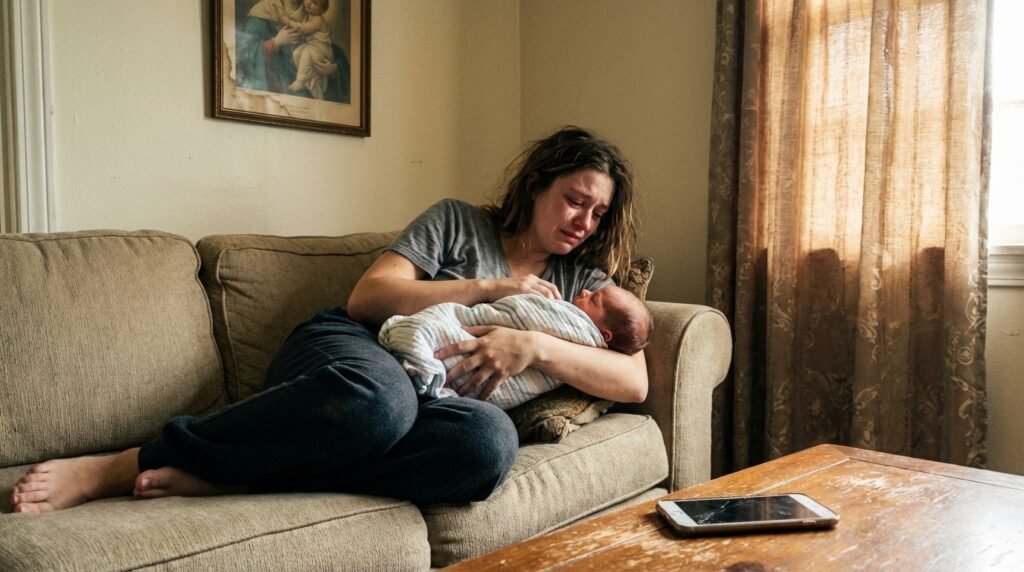
I reached for my phone. The screen was a strobe light of animosity.
63 Messages.
I scrolled through the family group chat, my heart hammering against my ribs.
- Elena (Mother-in-law): “I went by to see the baby and Sarah wasn’t there. Evelyn says she’s ‘sleeping.’ At 3 p.m.? This is beyond irresponsible. That baby needs his mother’s scent, not a bottle.”
- Mark (My Husband): “I’m trying to call her. She isn’t answering. I’m stuck at work, but this is getting ridiculous. She knew what she was signing up for.”
- Jessica (Sister): “Mom says Sarah looked ‘unstable.’ Is she having a breakdown? Maybe the baby isn’t safe with her.”
- Elena again: “It’s abandonment. Plain and simple. I never left Mark for a single hour until he was six months old. Mothers today are so weak.”
The words blurred. Monster. Irresponsible. Weak. Unstable.
They had held a trial, found me guilty, and sentenced me to shame—all while I was trying to save my own life. No one asked if I had eaten. No one asked if I was okay. They only cared that the “vessel” was momentarily unavailable.
The Discovery: A Mother’s Hidden Scars
I drove back to my mom’s house in a daze of rage and grief. When I walked in, the house was quiet. Leo was asleep in the portable crib. My mother was sitting at the kitchen table, a single lamp casting long shadows across her face. She looked older than she had that morning.
“The vultures have been circling,” I said, dropping my phone on the table.
“I know,” she said quietly. “Elena came by. She was… unkind. She told me I was enabling your ‘laziness.'”
“Laziness?” I let out a jagged laugh. “I haven’t slept in twenty days, Mom!”
“I told her to leave,” my mother said, her voice gaining a sudden, sharp edge. “I told her that my daughter needs to stay alive so she can be a mother. And then… I told her to never come back to this house without an apology.”
I froze. My mother, the woman of “silence and endurance,” had stood up for me?
The Revelation of the Box
“There’s something you need to see,” she said. She reached under the table and pulled out an old, tattered shoebox. It smelled of cedar and old paper. “I found this in the attic last month. I was going to burn it. I think… I think you should read it instead.”
She handed me a letter, yellowed at the edges, dated July 14, 1994. My birth year.
“I wrote that when you were three months old,” she whispered. “I was sitting exactly where you are now. And I was planning on leaving. Not for a nap. For good.”
The Revelation: The Letter from the Edge
I opened the envelope. The handwriting was frantic, the ink smeared in places where tears had clearly fallen decades ago.
To whoever finds her,
I can’t do this anymore. Every time she cries, I feel a physical pain in my chest that makes me want to scream. I haven’t slept in weeks. I look in the mirror and I don’t recognize the woman looking back. She looks like a ghost. She looks like she’s dying.
Everyone tells me I should be happy. They tell me I’m ‘glowing.’ But I’m drowning. My husband doesn’t see me. My mother tells me to pray more. No one sees that I am disappearing. I am leaving her with her father because if I stay, I might do something I can’t take back. I love her so much it’s killing me. Please, don’t let her grow up thinking I didn’t love her. Tell her I just didn’t have any air left.
I looked up at my mother. Her eyes were swimming in tears.
“I didn’t leave,” she said. “I stayed. I stayed and I suffered in silence for thirty years because I thought that’s what a ‘good mother’ did. I let that resentment poison my marriage and my health. And seeing you this morning… it was like looking at a ghost. I won’t let them do to you what they did to me.”
The Twist in the Secret
“But Mom,” I whispered, “The group chat… Mark… he’s so angry. He thinks I’m a monster.”
“Mark’s mother is the one who wrote the letters to me back then,” my mother revealed, her voice trembling. “Elena. She was the one telling me I was a failure in 1994. She’s been repeating the same cycle of cruelty for thirty years. She didn’t forget how hard it was—she just decided that because she suffered, you have to suffer too.”
The betrayal felt like a physical blow. Elena wasn’t just being a “concerned grandmother.” She was a gatekeeper of misery.
The Ending: A New Foundation
The front door creaked open. Mark walked in, his face tight with a mixture of anger and worry. He saw me, then saw the letter on the table.
“Sarah? What the hell? My mom is frantic. She says you just dropped the baby and vanished. Why weren’t you answering your phone?”
I didn’t yell. I didn’t cry. I simply handed him the letter his own mother had driven mine to write thirty years ago.
“Read this,” I said. “And then decide if you want to be the kind of husband who helps his wife breathe, or the kind of man who lets his mother suffocate her.”
The silence in the room was heavy as he read. I watched his face change from irritation to confusion, and finally, to a deep, haunting shame. He looked at his mother’s name mentioned in the margins of the old notes. He looked at me—truly looked at me—for the first time since we brought Leo home.
“I didn’t know,” he whispered.
“You didn’t ask,” I replied.
Emotional Closure
We didn’t go back to our newborn house that night. We stayed at my mom’s. Mark sat with Leo for four hours while I sat on the porch and watched the stars, finally feeling the air reach the bottom of my lungs.
I deleted the family group chat. I blocked Elena for the week. I realized that being a “good mother” didn’t mean being a martyr. It meant having the courage to say “I am at my limit” before the limit broke me.
As I finally climbed back into bed, Mark leaned over and kissed my forehead. “Go back to sleep,” he whispered. “I’ve got him. I’ve got you.”
For the first time in a month, the screaming in my head had finally stopped.